

eCommerce AI SEO: Top 10 Strategies to Rank in AI Search

Remember the old way we searched?
Ten blue links, the endless scroll of ten blue links, opening a dozen tabs just to compare prices and reviews. That era is disappearing slowly. Today, when you want to buy something, you often just ask an AI tool like ChatGPT or Gemini for an instant, complete answer.
This is the big shift happening in online shopping. It means eCommerce AI SEO is no longer a concept; it’s a reality.
Instead of merely indexing pages like a traditional search engine, generative AI scrapes, analyzes, and synthesizes product data from across the web, including reviews, pricing, and brand reputation, to deliver one trusted, concise recommendation.
If your products do not surface in those AI-generated answers, your eCommerce business is missing a major chance to connect with active buyers. Ranking within AI search results is now a must-do for eCommerce brands planning for long-term growth and high search performance.
Why You Need to Prioritize AI SEO Now

Why should your brand focus its SEO strategy on AI SEO right now?
Because generative AI traffic is already surging. The numbers show that customers are relying on these AI systems for discovery.
- The last holiday season (November to December 2024), U.S. retail sites saw a staggering 1,300% increase in traffic from generative AI searches compared to the prior year. This trend persisted, demonstrating a 1,200% increase in February 2025 over July 2024, signifying a persistent change in user behavior (source: Adobe).
- The people coming from AI-powered search are better customers. They stay on your eCommerce website 8% longer, browse 12% more pages, and bounce 23% less compared to referrals from traditional search engines (source: Forbes).
- Consumers are actively relying on this technology: 39% use generative AI for online shopping, 55% for research, and 47% for product recommendations (Source: Search Engine Land).
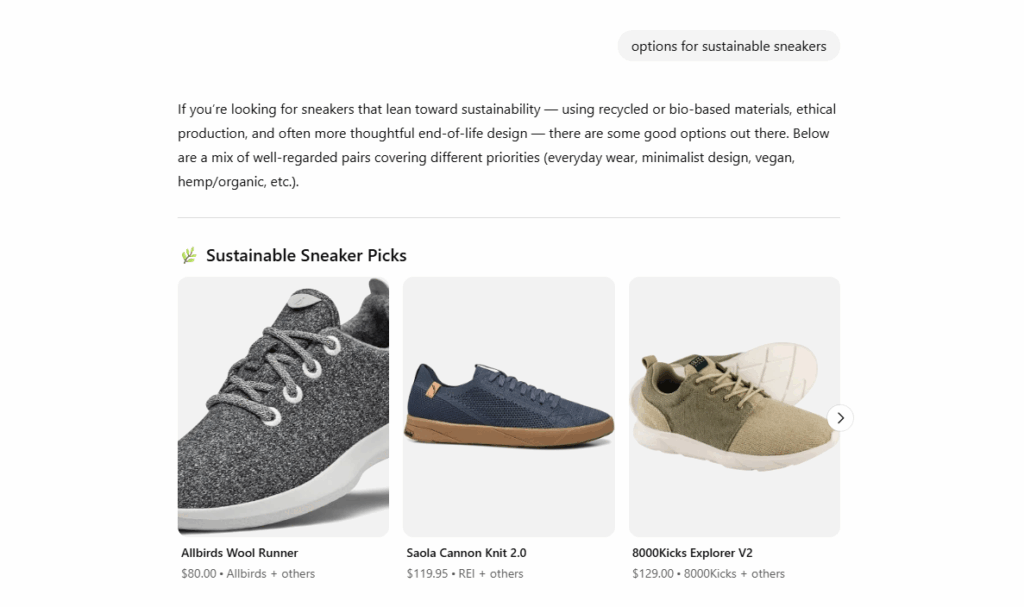
When AllBirds started appearing in ChatGPT responses for “sustainable sneakers,” they noticed a distinct visitor pattern. These shoppers arrived with clearer intent, spent more time on product details pages, and had higher add-to-cart rates than typical Google organic traffic.
The AI had already pre-qualified them by explaining the brand’s sustainability angle before they even clicked.
The rise of AI crawlers means that visibility now depends entirely on adapting to these new discovery models. Mastering eCommerce AI SEO ensures your products appear where modern shoppers are making decisions, which is foundational to the success of online businesses.
How AI Search Changes the Way We Talk to the Internet
Some people suggest AI SEO is just a variation of traditional SEO, arguing that ranking highly on Google is enough. While fundamentals like technical SEO remain important, the two disciplines are distinct because of changing user behavior.
The biggest difference between traditional SEO and eCommerce AI SEO is simply how people talk to the search engine.
| Traditional Search (Google) | AI Search (ChatGPT, Gemini) |
| Example: “Black running shoes similar to Hoka” | Example: “I am looking for black running shoes. Can you suggest brands similar to Hoka?” |
| Traits: Short, keyword-driven | Traits: Long-tail, specific, question-based, conversational, |
Your SEO strategy needs to adapt to these detailed, conversational user queries.
The AI models process these questions contextually, comparing products based on features, star ratings, price, and user intent, rather than just high rankings in traditional search.
That’s why ranking on Google no longer guarantees visibility in AI-driven search recommendations.
Types of AI Visibility for eCommerce Brands
When you optimize for AI search, you’re aiming for specific outcomes. AI visibility starts with how these new systems (the LLMs) decide what to display.
Since AI search collapses the buyer journey, brands compete across three distinct discovery models.
1. Brand Mentions
Mentions drive product discovery and build top-of-funnel LLM visibility for your brand. This is where your brand is featured in AI-generated answers, often without a direct link to your eCommerce site.
This visibility type typically comes from reputation signals like Reddit posts, media coverage, and user reviews. For new or emerging eCommerce brands, this is often the first way the AI tool introduces you to a shopper.
2. Citations
Citations are linked references, acting like a footnote, within AI-generated results. With citations, AI systems attribute specific information, claims, or data points directly to your eCommerce pages.
When an AI tool cites your brand, it signals to shoppers that you are an authoritative voice and a source of truth. Citations support your narrative, meaning the AI model pulls your framing and product descriptions into the response.
If ChatGPT explains the difference between cold-pressed and expeller-pressed oils and cites your product page as the source for that explanation, you’ve essentially written the script the AI uses to educate the shopper about your product category.
3. Product Recommendations
This is the ultimate win for eCommerce businesses. AI platforms actively recommend your products for a shopper’s specific needs. Your products can show up with pricing, star ratings, and other details, effectively merging discovery and purchase in one place.
Showing up in this curated list makes your brand a part of the final decision interface.
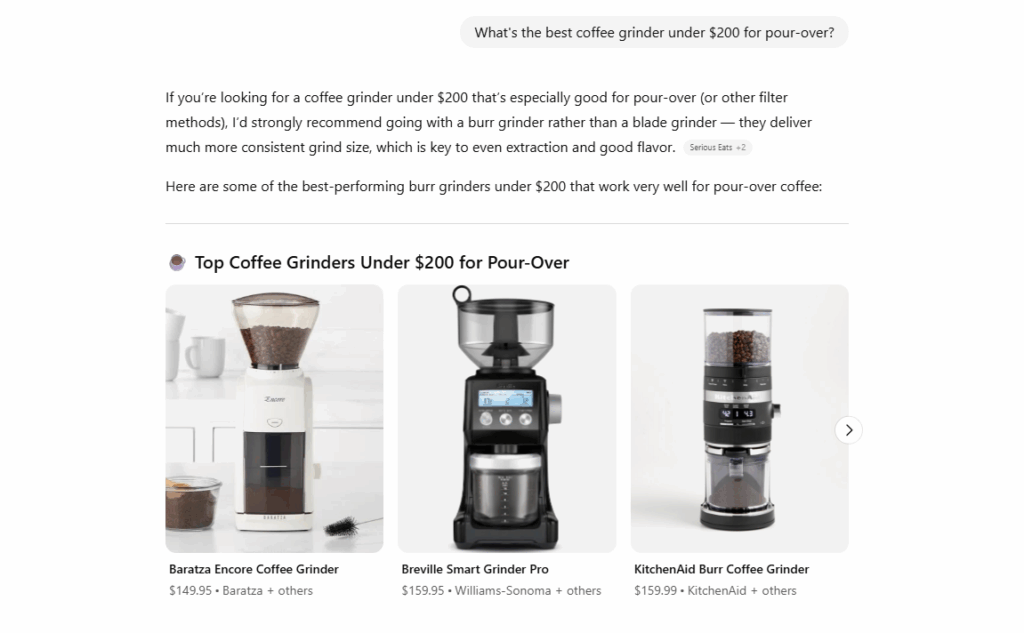
Ask Claude or ChatGPT, “What’s the best coffee grinder under $200 for pour-over?” and brands like Baratza Encore or Breville often appear with specific model numbers, current pricing, and why they suit pour-over brewing. That’s a direct product recommendation that can immediately drive a purchase decision.
How AI Models Rank Ecommerce Brands
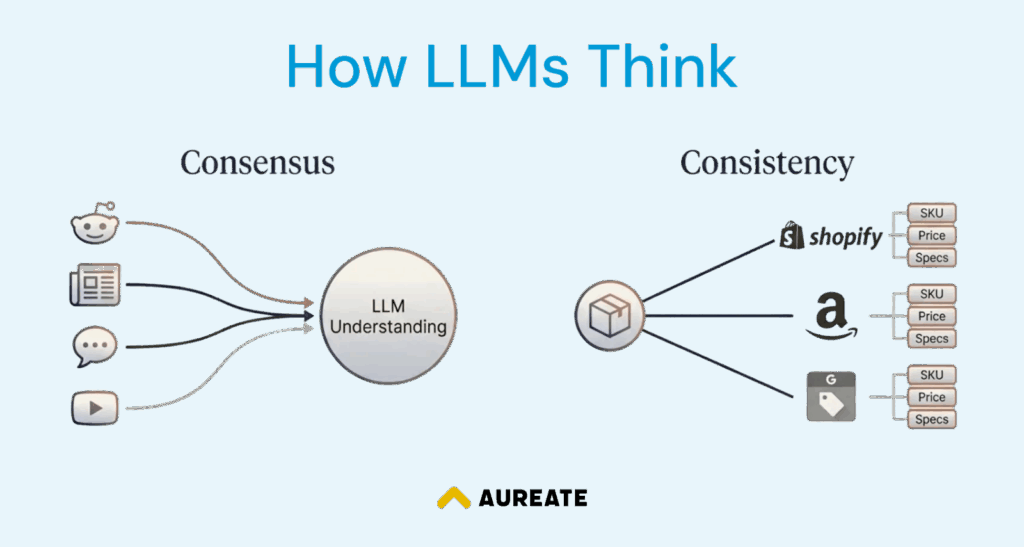
AI visibility is influenced by two driving forces that determine how AI engines choose which eCommerce pages to surface: consensus and consistency.
Consensus
AI models don’t evaluate your eCommerce website in isolation; authority is built from a consensus across sources.
LLMs ask, “What do credible sources agree on about this product?”.
To decide which brands to highlight, LLMs cross-reference multiple platforms, including Reddit threads, YouTube videos, customer reviews, and trusted publishers. A glowing review on your product pages means little if customers on Amazon consistently leave 1-star ratings.
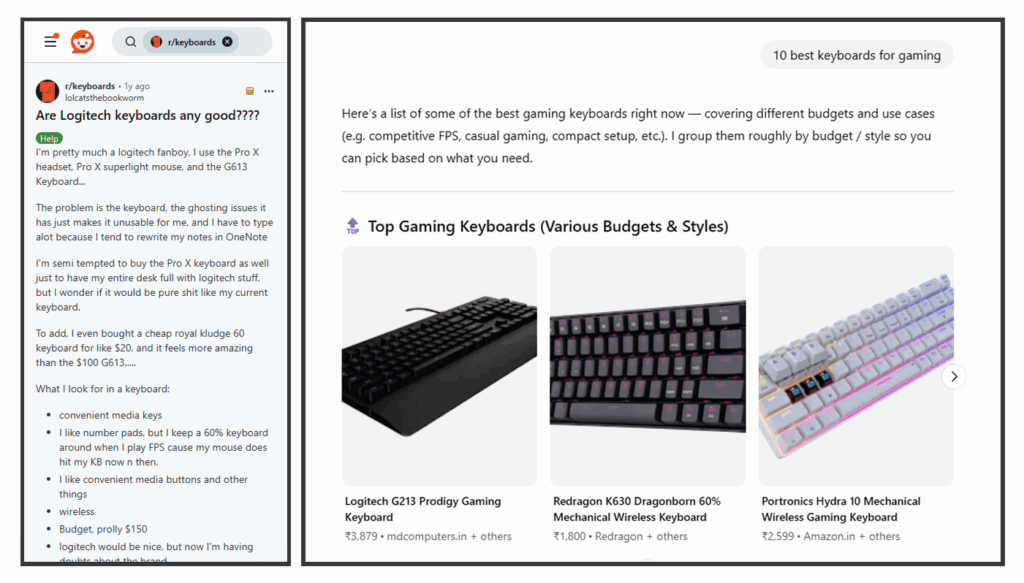
The mechanical keyboard brand Logitech frequently shows up when you use AI search platforms to find mechanical keyboards.
This is because the brand has earned trust through a pattern of independent validation:
- Review sites rank them highly,
- Reddit threads recommend the brand, and
- their Amazon product pages are detailed with positive reviews and an average of 4.4 star ratings.
This pattern of independent sources validating the same product is what AI engines rely on.
Consistency (Data Hygiene)
The other pillar is Consistency. LLMs pull data from various locations your eCommerce store, Google Merchant Center, or Amazon.
If your product attributes, such as model numbers, materials, dimensions, or pricing are inconsistent across these channels, the AI tool might exclude the product or include the wrong information.
Data hygiene is a must-do for building AI visibility.
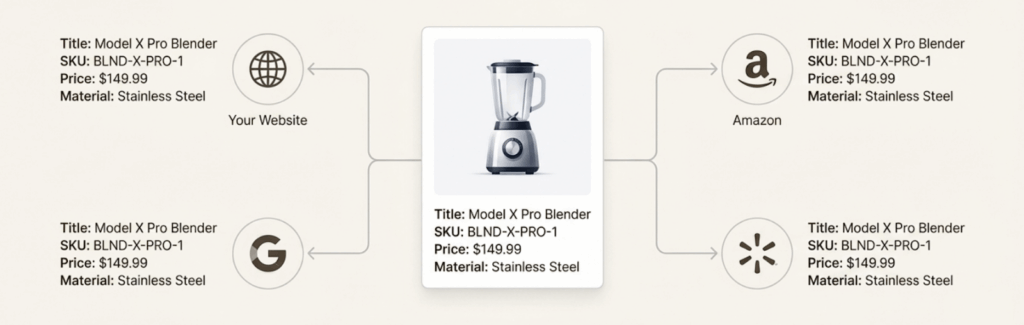
You need to maintain a clean, synchronized identity for every SKU across every channel. Your product attributes must follow the same pattern across your site, marketplaces, and feeds. Outdated data signals decay, and AI engines may deprioritize products with outdated info.
Top 10 Strategies to Rank Products in AI Search
The brands that adapt early will stay ahead. Here are the tactics you need to optimize your site for AI visibility:
1. Optimize Technical Performance and Crawlability
Your AI SEO strategy starts with making sure your eCommerce site is fully visible to AI crawlers.
Hidden or blocked content limits your reach. Many AI bots struggle with content rendered primarily by JavaScript, which can make modern, interactive eCommerce websites invisible without extra support.
You can reduce JavaScript reliance for critical elements and ensure a responsive mobile-first design. Run regular crawl audits using tools like Google Search Console to catch errors and ensure optimal page speed.
Your next move: Check your robots.txt file to ensure you’re not accidentally blocking AI crawlers. Some sites block “GPTBot” or “Claude-Web” without realizing it. Your robots.txt should allow these crawlers access to your product pages and structured content.
If your site uses a lot of dynamic content, consider a solution like Prerender.io to eliminate crawling and indexing issues and ensure high visibility to AI crawlers. The faster and more accessible your eCommerce site is, the more likely AI models will crawl and refer to it.
2. Implement Comprehensive Structured Data
Structured data is essential for eCommerce AI SEO because AI crawlers prefer and rely on machine-readable schema over plain text to accurately interpret product details. Adding schema markup is a direct way to align eCommerce websites with AI-driven search visibility requirements.
Here’s how to optimize eCommerce websites for machine readability:
- Include Product Schema (name, price, availability, brand, GTIN/SKU).
- Review and Aggregate Rating Schema (to showcase star ratings and trust signals).
- FAQ Page Schema (to structure Q&A content for conversational AI platforms).
- Use Google’s rich results test to verify that your structured data is implemented correctly.
For list-style content, add ItemList structured data to help the LLM understand the list structure and relationships between items.
What this looks like in code:
{
  "@context": "https://schema.org/",
  "@type": "Product",
  "name": "Organic Cold Brew Coffee Concentrate",
  "brand": "Blue Bottle",
  "offers": {
    "@type": "Offer",
    "price": "18.00",
    "priceCurrency": "USD",
    "availability": "https://schema.org/InStock"
  },
  "aggregateRating": {
    "@type": "AggregateRating",
    "ratingValue": "4.7",
    "reviewCount": "328"
  }
}
When AI models scan your page, they immediately understand the product name, current price, stock status, and customer satisfaction level. Without this structure, they’re left parsing paragraphs and might miss critical details.
3. Adapt Content to Natural Language Processing (NLP)
AI search engines use Natural Language Processing to decode user intent and generate relevant responses. You must structure your site’s content to match the conversational search patterns that platforms like ChatGPT prioritize.
What actions to perform:
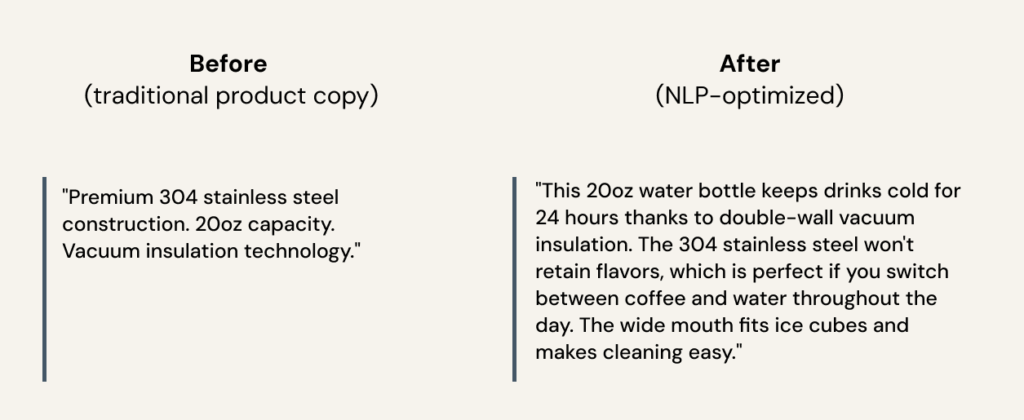
- Write ChatGPT-ready product listings using natural language that mirrors real user queries.
- Go beyond specs, explaining the why and how customers will use the product, formatting descriptions and FAQs to directly answer common “how,” “why,” and “which” queries.
Using everyday phrases and entity-based terms in the site’s content makes it more likely to appear in AI results.
Let’s take a look at how your copy will sound:
4. Optimize for Keyword Entities and Long-tail Intent
AI-powered search engines understand concepts and relationships between terms, not just exact matches, making keyword entities crucial for relevancy.
For that, you should focus on user intent with conversational phrasing and long tail keywords. Instead of optimizing for “best Bluetooth headphones”, optimize for a query like, “Suggest some of the best Bluetooth headphones with noise cancellation under $100”.
This focus provides AI systems with a broader perspective and meaning to your online shopping pages. Your keyword research must cluster topics by entity features, problems, and outcomes, and cover each with concise, expert copy.
For example: Create a content hub around your product category. If you sell yoga mats, don’t just optimize for “yoga mat.” Create content that answers:
- “What thickness yoga mat is best for sensitive knees?”
- “Do I need a yoga mat for hot yoga, or will it get too slippery?”
- “How do I clean a rubber yoga mat without damaging it?”
Each of these long-tail queries gives AI models more context to recommend your specific products when those exact scenarios come up.
5. Showcase Detailed User-Generated Content (UGC)
AI platforms prioritize User Generated Content (reviews, Q&As, testimonials) because it reflects real-world experiences and product value.
UGC is expected to fuel 80% of SEO-friendly content generation by 2030.
If a customer review says, “This headphone has the best noise cancellation quality I’ve ever experienced, and it’s also budget-friendly than other alternatives”, AI engines pick up those specific phrases like ‘best noise cancellation’ and ‘budget-friendly’ to recommend your products to users with similar queries.
Here, your aim should be detailed reviews with real experiences, not just star ratings. Try to add Q&A sections where users can answer each other’s questions, building credibility among users and AI bots.
6. Build Topical Authority and Focus on E-E-A-T
AI platforms reward expertise and credibility (E-E-A-T: Expertise, Experience, Authority, and Trustworthiness) when ranking AI SEO for eCommerce platforms. Proving reliability across product pages is key here.
Here’s how to ensure your site follows E-E-A-T guidelines:
- Establish Expertise by providing accurate, detailed product descriptions with verified data.
- Build Authority through high-quality guides and backlinks.
- Create in-depth guides, tutorials, and buying resources (part of your content strategy) that position your brand as an expert, naturally linking back to your product pages.
- Add crucial Trust signals like secure checkout, clear return policies, and use verified ratings.
If you sell coffee equipment, publish guides on:
- “Understanding Coffee Grind Size for Different Brew Methods”
- “How Water Temperature Affects Coffee Extraction”
- “Espresso Machine Maintenance Schedule”
These guides establish you as an authority in the coffee space, making AI more likely to recommend your products when someone asks coffee-related questions.
7. Prioritize External Citations and Omnichannel Authority
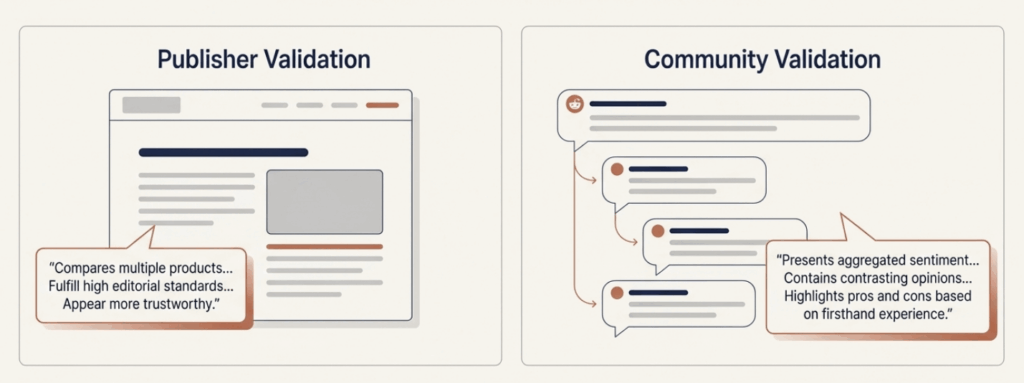
Authority is built on consensus, meaning citations (linked references) from authoritative sources matter significantly. LLMs build consensus by cross-referencing platforms like Reddit threads and trusted publishers.
- Aim for inclusion in “best of” lists on editorial websites. Strategically seed product discussions on community sites like Reddit (ethically and transparently, of course).
- Social media posts and platforms like YouTube are universal citation sources for LLMs.
- Optimize Pinterest Pins by including the exact search phrase in the image, title, and description, as these are indexed and surfaced as citations.
8. Optimize Content for Voice Search
Voice search is a central trend in AI search, with 21% of users relying on it regularly and 52% using it for product research.
Since 40% of voice assistant users search for product details, you should structure your site’s content for quick, conversational answers using natural, long tail keyword phrases. Plus, ensure your FAQ sections provide direct, concise responses to common shopper queries.
Instead of a traditional product description, add a voice-friendly FAQ section:
Q: What’s the best coffee grinder for a French press?
A: The Baratza Encore is the best coffee grinder for a French press because it produces consistent coarse grinds and costs around $140. It has 40 grind settings, so you can adjust the coarseness to match your brew time.
This format works perfectly for voice queries because it provides a complete, speakable answer in 2-3 sentences.
9. Leverage Internal Product Listicles and Comparison Content
LLMs compress the traditional research journey by synthesizing research into one response. Your eCommerce site needs to provide structured comparison data that the AI model can easily summarize.
Here are the actions to perform:
- Start publishing internal product listicles on your own site (e.g., “Best under $X” guides).
- Create structured comparison tables on your product pages or category pages that include differentiators like “best for travel”, “most durable”, or “entry-level option”.
- Use ItemList structured data on these listicles for better LLM comprehension.
For example, a luggage retailer creates a page titled “How to Choose the Right Suitcase Size” with a comparison table:
| Suitcase Type | Best For | Capacity | Price Range |
| Carry-On (22″) | Weekend trips, business travel | 3-4 days of clothing | $150-$300 |
| Medium Check (26″) | Week-long vacations | 7-10 days of clothing | $200-$400 |
| Large Check (29″) | Extended travel, families | 2+ weeks of clothing | $250-$500 |
When someone asks an AI, “What size suitcase do I need for a 10-day trip?” the AI can cite this exact table and recommend the Medium Check size, along with specific products from that retailer’s catalog.
10. Implement Geo Optimization for International Audiences
LLMs like ChatGPT and Perplexity don’t always personalize results based on location unless explicitly prompted. This is important for online businesses with international audiences.
If a user in Canada searches for “best hair masks for dry winter weather”, they might get product recommendations only available in the U.S. unless they specify otherwise.
For that, you can create region-specific content (e.g., “Top Vegan Snacks in the UK”) or include natural geographic indicators on your eCommerce pages (like “Ships across Europe”) to clarify regional relevance to AI crawlers.
Getting featured on regional forums and publications can also directly influence what shows up in region-specific queries.
To execute an effective AI SEO strategy, utilize these generative AI tools:
- Google Search Console: Track indexing and visibility.
- Ahrefs / SEMrush: Conduct keyword research, keyword discovery, and competitor analysis. SEMrush recently added an AI SEO Toolkit that shows how your brand appears in AI responses.
- Screaming Frog: Audit technical SEO issues, check crawlability, and verify structured data implementation.
- Surfer SEO: Optimize content for AI-driven search by aligning with common user queries and entity coverage.
- Track My Visibility (TMV): Monitor brand mentions across AI platforms like ChatGPT, Perplexity, and Gemini. This tool helps you understand when and how your brand appears in AI-generated responses, which is critical for measuring AI visibility.
- BrightEdge or MarketMuse: For enterprise-level content optimization and AI visibility tracking.
It’s time to see how it can make a difference.
How Caraway is Winning in AI Search
To see eCommerce AI SEO working in practice, let’s look at the cookware brand Caraway.
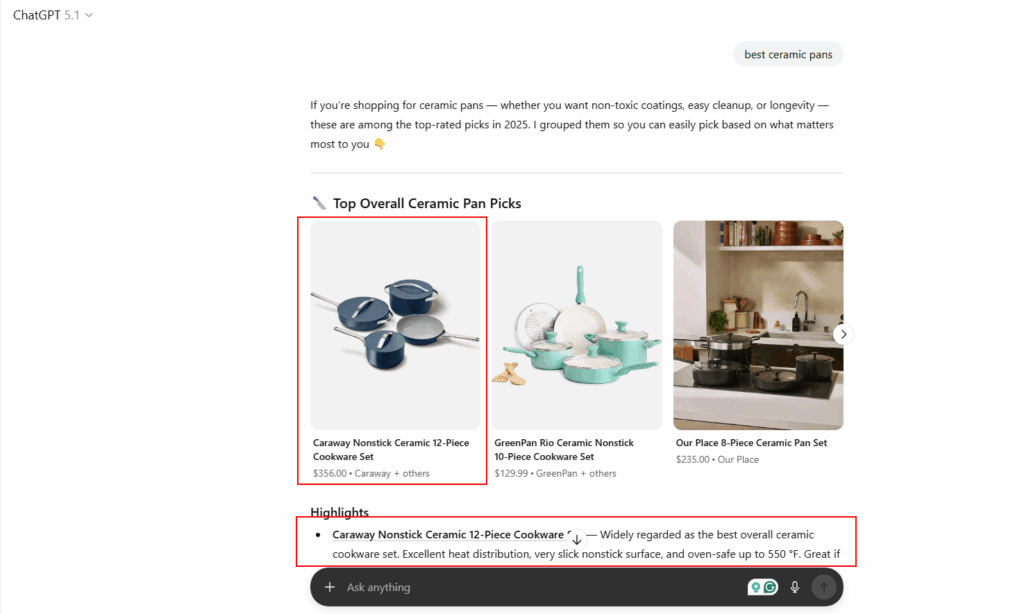
When you ask AI search for the “best ceramic pans” or “best bakeware set”, Caraway consistently makes the shortlist.
Caraway wins because they focus on high consensus and data consistency, as discussed below.
Showing Up Where LLMs Look
Caraway is frequently featured on authoritative publishers like Food and Wine and Good Housekeeping.
These are the exact sources LLMs cite when constructing answers about cookware queries. This focus on earning high-quality citations strengthens their authority. Caraway also earns mentions through organic discussions on Reddit and kitchen forums.
Retailer Evidence That AI Can Cite
Caraway maintains clean, detailed product pages across its own eCommerce store and marketplaces. These listings provide AI engines with concrete signals like easily readable star ratings, in-stock SKUs, and sales velocity.
These product detail pages become credible sources for verifying pricing, availability, or product specs.
Strong Affiliate Presence
Caraway makes it easy for publishers to feature its products by running a robust affiliate program.
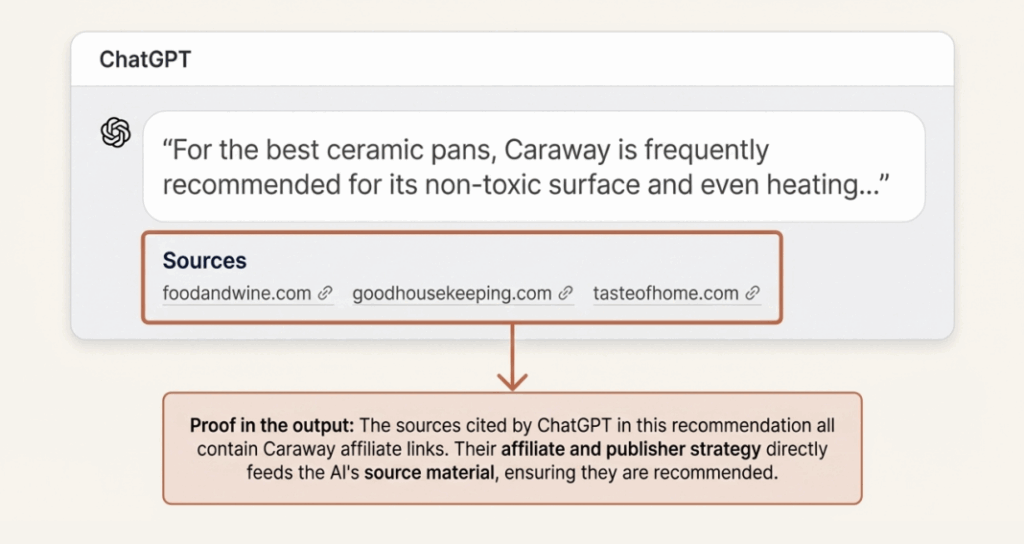
This ensures that when publishers write about the brand, those linked references appear as citations in AI results. This seamless integration means more partners are willing to talk about them, strengthening their content strategy.
What Your Brand Losing Without AI Visibility
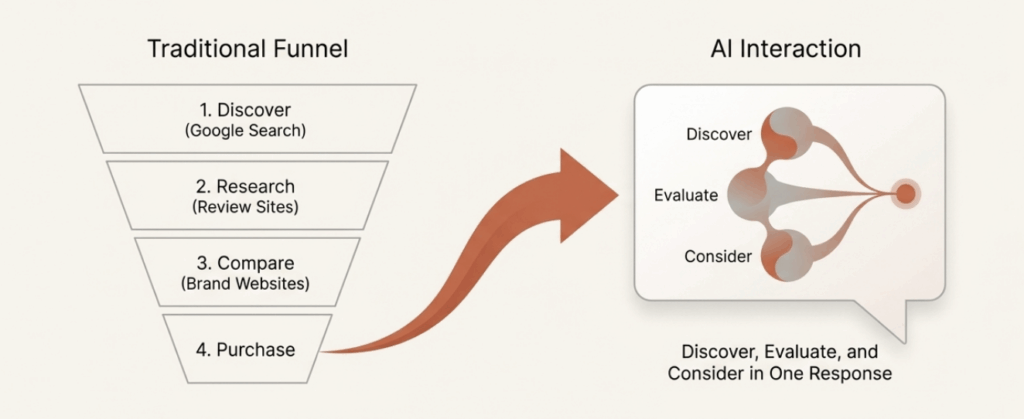
The most significant change introduced by generative AI is how it compresses the buyer journey. The traditional research funnel is now synthesized into one conversational step.
Influenced Buyers
Since AI-driven search gives shoppers a curated list of options, you have fewer chances to influence buyers. If your brand is not included in the AI overviews, you might not exist in the decision process. This compression means that for many eCommerce queries, you get only “one shot” to win the sale.
The old customer journey:
Google search → 2. Click article → 3. Read reviews → 4. Click another article → 5. Visit Reddit → 6. Compare prices → 7. Finally purchase
The new customer journey:
Ask ChatGPT → 2. Get three specific recommendations with reasoning → 3. Click to purchase
If you’re not in that AI-generated list of three, you’ve lost the customer before they ever knew you existed.
Visibility Paradox
Your brand might frequently show up in AI search, but your analytics may show flat traffic. That’s the Visibility Paradox: Not all AI visibility is equal.
| Visibility Type | Example | Purchase Intend |
| Mentioned without context | “Popular air fryer brands include Ninja and Cosori.” | Low |
| Cited as source | “According to Cosori’s specifications, the air fryer’s temperature range is 170-400°F.” | Medium-High |
| Recommended | “The Cosori 5.8-quart model is highly rated and costs around $120.” | High |
Getting mentioned is not the end goal; it’s about earning citations and product recommendations to drive real sales.
Attribution Gets Murky
When shoppers find products through generative AI tools but buy elsewhere, analytics tools struggle to track the whole journey. This is a problem for eCommerce businesses because it makes it difficult to prove the ROI of your optimization strategy and track search performance.
Tools like Semrush’s AI SEO Toolkit are trying to close this gap by monitoring how your brand and competitors appear in AI search.
Quick Recap!
AI SEO for Ecommerce is the foundation of visibility. The future of eCommerce search is conversational, contextual, and relies heavily on trusted data.
Here’s your next action plan to improve eCommerce SEO for AI search results.
- Audit Your Store: Check site structure, internal links, and technical performance. Identify gaps that reduce visibility for AI-driven search engines.
- Optimize Product Pages: Use comprehensive structured data and descriptive titles. Ensure your page optimization aligns with conversational queries.
- Content Strategy: Create detailed blog content, FAQs, and guides around user intent to connect your store with relevant customer queries.
- Improve User Experience: Ensure fast loading, smooth navigation, and secure checkout. A seamless journey improves conversions and supports AI-powered ranking signals.
- Measure and Adapt: Track click-through rate, conversions, and engagement. Adjust content creation and campaigns as AI-driven search evolves.
When you focus on these generative engine optimization strategies, your eCommerce store will rank not only in traditional search engines but also in conversational platforms.
This does more than boost rankings; it improves the customer experience and drives long-term loyalty, securing your place in the future of online shopping.
Need help?? Talk to our AI experts!






Post a Comment
Got a question? Have a feedback? Please feel free to leave your ideas, opinions, and questions in the comments section of our post! ❤️