

How AI Automation Helps Shopify Stores Grow Faster

Suppose you’re managing a B2B and D2C Shopify store, and your to-do list is overwhelming. You may be balancing inventory checks, ad campaigns, support tickets, and your next product launch, and something always slips.
You wonder if this is the cost of growth, or if there is a better way? Yes, there is, and it is AI automation helps Shopify stores. It frees you up.
By the end of this article, you’ll learn how real Shopify store owners use AI automation, what stops some merchants from doing so, and how you can test it safely in your own store.
The Essence of How AI Automation Helps Shopify Stores Operate Smarter
In textbooks or vendor pitches, “automation” is defined as “software that acts with minimal human intervention”. In the real world, it’s different.
Automation means the work is done when you are asleep.
You don’t log in every morning to manually send cart recovery messages, assign customer tags, or design email marketing templates for campaigns. Instead, you glance at dashboards. You see alerts (e.g., low stock warnings). You respond only when something exceptional happens.
It’s less “set and forget” and more “set, monitor, and only intervene when needed”.
AI automation helps Shopify stores operate smarter, not harder. It takes the repetitive, time-consuming tasks off your plate and keeps your business running efficiently in the background.
Automation doesn’t mean just integrating chatbots. The more valuable capabilities include:
- Smart recommendations (on-site, in emails, ad creatives)
- Predictive restock/demand forecasting
- Orchestrated ad campaigns: audience selection, budget shifts, ad creative swaps
- Dynamic pricing or timed promos
- Automated workflows for tagging, refunds, returns, and fulfillment
- Fraud detection, account protection, risk flagging
The automation runs in the background, making decisions for you.
You attend to it only when things go wrong.
A mini before & after sketch of a Shopify store AI automation
# Before automation
- You spend 2 hours every morning identifying products low on stock.
- You manually build ad segments and adjust budgets midweek.
- Support tickets pile up; some go unanswered for hours.
- You miss cross-sell opportunities because you don’t have time to analyze browsing paths.
# After automation
- A restock alert hits your inbox; a purchase order is auto-created for your top 3 SKUs.
- Ads reallocate budget dynamically based on performance and inventory constraints.
- Support chatbots handle common questions 24/7. They transfer queries to humans only when needed.
- On-site product suggestions adjust per visitor behavior, increasing average order value (AOV).
You shift from firefighting mode to design & strategy mode.
One misconception here is that deploying AI means removing humans. In reality, AI is a collaborator, not a replacement for humans. It handles the repetitive and rule-based tasks while you handle those that AI won’t be able to handle.
It is about promoting a human-in-the-loop or augmented intelligence model rather than a fully autonomous human out-of-the-loop one.
Why Some Merchants Hesitate to Adopt AI Automation?
Many store owners dismiss AI automation because of some genuine concerns. Here are the common doubts and how to counter them.
1. Fear of losing authenticity/sounding robotic
“What if emails sound like a robot? What if every user sees the same generic message?”
Well, that won’t happen. Start with templates that reflect your brand voice, then let the automation fill in personalized pieces (customer name, recent purchase, interest). Let the AI suggest, but you should review or adjust as needed. The goal is being relevant, not mechanical.
Some 78% of marketers say AI and automation save them time on manual tasks like data entry and scheduling. This underlines the power of AI automation.
2. Cost: “I’m small, so can I afford this?”
Yes, cost is a barrier. But there are many competitively priced tools on the market. Consider using these tools as investments, not costs. If automating cart recovery or restock forecasting brings a 5% to 10% growth in conversions or reduces stockouts, the ROI can pay for itself quickly.
You can start with free or lower-tier plans and test a narrow use case first, e.g., support chatbot or product recommendations.
3. Integration complexity/tool overload
You might be familiar with situations where your app store is in chaos with too many dashboards or requests.
One fix for this is to choose fewer and broader tools that cover multiple capabilities rather than one tool per function. Alternatively, pick tools that integrate cleanly with Shopify, such as Shopify Flow.
Also, start with one domain before expanding. Wait until your staff is comfortable. That reduces the cognitive overhead.
4. Trust: “Will AI goof up, cost me money, or upset customers?”
Using AI without safe practices is risky. That’s why ensuring supervised rollout of AI is essential. Use logging, audits, fallback rules like “if something fails, revert to manual practices”, and alerts.
You should never let automation run blindly 100% from day one.
5. Data privacy and compliance concerns
Customers’ data, like browsing, past orders, and preferences, resides in your system. You must follow rules and regulations, such as GDPR, CCPA, and local privacy laws, which is why many organizations implement structured AI governance for privacy and risk teams. Use anonymization, limit data access, and ensure the tools you pick are compliant.
Some merchants also worry about giving external services too much control. You mitigate that by sandboxing early, limiting permissions, and monitoring.
Core Domains Where AI Automation Delivers
Here’s a breakdown by merchant pain point including considerations around AI Compliance. For each one of them, we will discuss the struggle and how automation can help reduce it.
A. Customer experience & personalization
Pain point: You have 1,000 SKUs and thousands of visitors. You can’t show each visitor their ideal picks.
What AI automation can do:
- AI-driven product suggestions on site, in email, and in ads can show the “you may also like” or “others bought this” sections.
For better product insights and recommendations, many Shopify merchants use AI-driven review analysis apps, which serve as an equivalent to an Amazon review checker but for their own store data. These platforms analyze customer feedback and identify common keywords and sentiment trends to reveal which product features are most praised or criticized.
By uncovering recurring compliments and complaints, merchants gain a clearer understanding of what resonates most with shoppers. This insight helps them highlight top-rated items, refine product recommendations, and build stronger trust by showcasing products aligned with real customer experiences. Ultimately, it drives higher engagement, conversions, and satisfaction.
- Dynamic bundling/cross-sell offers based on browsing or past purchase behavior.
- Adaptive pages or flows: Home page or collection pages shift based on visitor segment (e.g., high spenders, first timers).
Payoff: Customers feel seen, and relevance reduces bounce rate. Also, your AOV and conversion go up.
B. Marketing & conversion optimization
Pain point: You run multiple campaigns, but you don’t have time to A/B test everything or manually move budgets.
What AI automation can do:
- Smart A/B testing: AI chooses headlines, images, and calls to action that will work.
- Automated audience segmentation + drip campaigns: High-risk cart abandoners get one flow; churn-risk customers get another.
- Dynamic pricing: Adjust pricing or promos based on demand, stock levels, and competition.
- Syncing with Google, Meta, etc., so campaigns adjust in real-time.
Payoff: Better conversion with less manual tuning. You catch micro-segments you’d otherwise miss.
C. Inventory, fulfillment, & operations
Pain point: You’re either overstocked or running out of stock. You can’t always foresee supply delays.
What AI automation can do:
- Demand forecasting + restock alerts. To make forecasting accurate, stores often rely on data ingestion tools to consolidate inventory data from multiple channels, warehouses, and suppliers. By feeding structured and clean data into the system, predictive restock alerts and auto-triggered purchase orders become much more reliable.
- Auto-triggered purchase or supplier orders
- Syncing inventory across channels, warehouses, and 3PLs
- Early warning system for supply chain disruption
Payoff: When demand changes, your supply chain doesn’t cause any problem.
D. Support & engagement automation
Pain point: Support tickets pile up. Therefore, you respond late, and your team is drained.
What AI automation can do:
- Chatbots/conversational AI for FAQs, order status, returns
- Escalation logic: Bot handles basics, escalates to a human when needed
- Post-purchase feedback/sentiment analysis
- Re-engagement messages based on customer behavior, e.g., “You viewed this six days ago. Are you still interested?”
Payoff: Support becomes faster, more consistent, and less labor-intensive.
E. Security, fraud & risk control
Pain point: Fraudulent orders slip through. Chargebacks hurt your margins.
What AI automation can do:
- Pattern analysis to flag suspicious orders
- Automated fraud decision rules + alerts
- Protection of accounts, login behavior, and bot detection
Payoff: You catch anomalies before they become costly.
Real World Snapshots and Tool Highlights
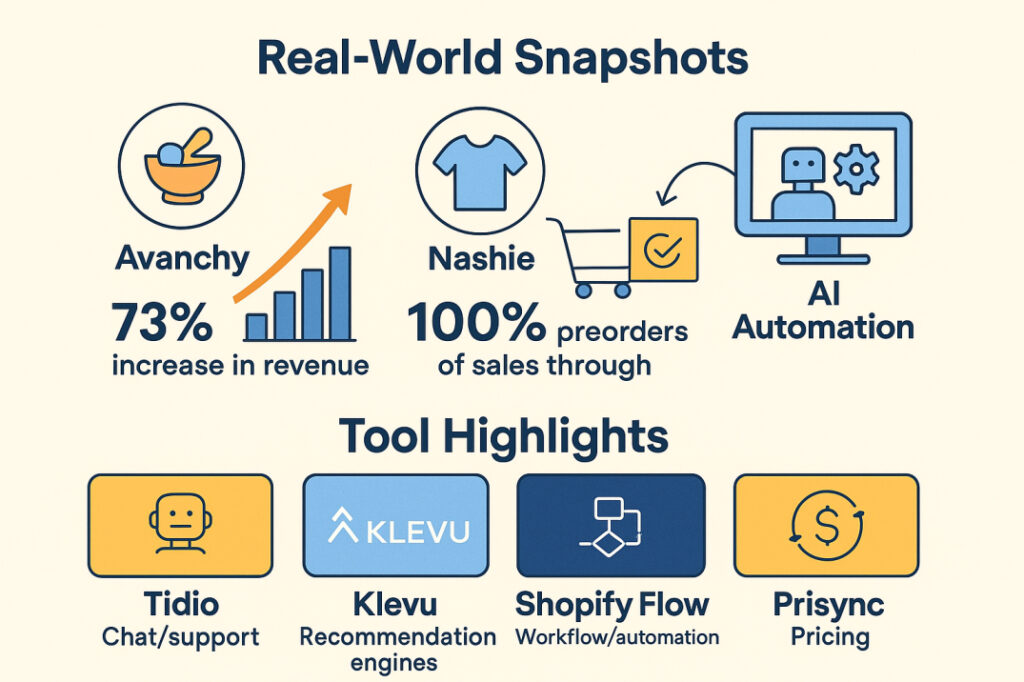
The following are brands for which AI automation helps Shopify stores achieve measurable growth and efficiency.
1. Avanchy: Increasing AOV With Product Recommendations
Avanchy is a Shopify store that sells eco-friendly baby dishes. They installed an app to display product recommendations in carts and via related items on product pages.
Within 30 days, Avanchy saw a 73% increase in revenue. And most importantly, the large part was driven by a higher average order value as customers were encouraged to add more items through relevant suggestions. This proves how AI automation helps Shopify stores personalize the shopping experience and lift sales.
2. Nashie: Preventing Lost Sales with Smart Preorders
Nashie is a Shopify brand known for its innovative swim shirts. They struggled with stockouts whenever demand increased or inventory was in transit between markets.
To avoid losing customers, they used preorder and back-in-stock automation. This allowed shoppers to place orders before items physically arrived.
Within a month, 100% of U.S. sales came through preorders, ensuring continuous revenue flow despite stock shortages.
3. Tool map
| Domain | Tools | Ideal Use Cases | Trade-Offs/Things to Watch |
| Chat/support | Tidio, Gorgias | Bot + human hybrid support | Cost per seat, complexity, scripting needed |
| Recommendation engines | Klevu, Clerk.io | On-site & email product suggestions | Requires clean product metadata; cost |
| Workflow/automation | Shopify Flow, Plus tools (e.g. Order Automator) | Trigger actions across orders, tags, and notifications | Doesn’t always handle complex logic elegantly |
| Pricing | Prisync, other dynamic-pricing apps | Adjust prices based on rules, demand | Risk of war pricing |
| Marketing & campaign | Klaviyo, Omnisend, and AI in ad platforms | Automated flows, predictive segmentation | Need good data, can get messy if unmonitored |
| Logistics/operations orchestration | (less mature tools) | Sync multi-warehouses, auto restock | Integration with suppliers, 3PLs can be tricky |
What Founders & Teams Actually Gain
What do you really get when you run AI automation well?
- Time & focus: You spend less on firefighting, more on thinking, growth, and partnerships.
- Consistency & fewer errors: The rules don’t slip, unless you change them.
- Better insights: Automation generates data, predictions, and patterns you might never see manually.
- Scalability: One person or a small team can manage more customers, SKUs, and channels.
- Competitive edge: As automation becomes standard, being good at it gives you an advantage.
In one survey, merchants using AI or automation reported higher productivity and lower manual burden.
Common Pitfalls of AI Automation & How to Overcome Them
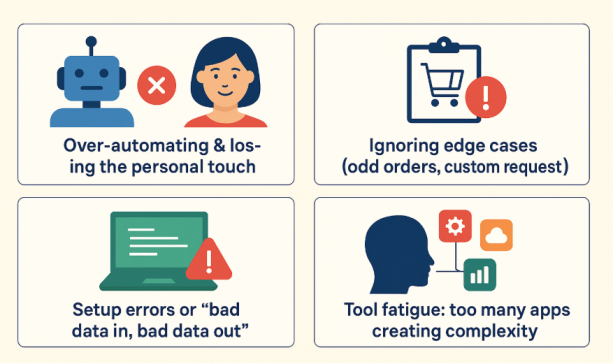
Even the best intentions can lead to problems. Here are some pitfalls and how you can steer clear of them.
1. Over-automating & losing the personal touch
The problem: Too much automation can make your brand feel robotic or distant. Customers still want human warmth when dealing with post-purchase issues or unique questions.
How to overcome it: Maintain human intervention in every workflow where customers are involved. Tag high-value customers or sensitive tickets for human review. Revisit automated messages quarterly to check tone and empathy.
2. Ignoring edge cases (odd orders, custom requests)
The problem: Automation works best on patterns, but edge cases, like gift notes or discontinued SKUs, can be forgotten and may cause frustration.
How to overcome it: Create exception rules that flag unusual orders or conditions for manual handling. Test workflows with dummy “weird” orders before rolling out fully. Keep a log to learn which exceptions repeat.
3. Setup errors or “bad data in, bad data out”
The problem: If your data is messy, the system will make bad calls. Faulty inputs lead to faulty automations.
How to overcome it: Start with a data cleanup sprint before activating automation. Standardize product tags, pricing rules, and naming conventions. Audit your data monthly, especially before major campaigns.
4. Tool fatigue: too many apps creating complexity
The problem: Installing multiple automation tools that overlap or conflict can create chaos instead of clarity. You waste time managing tools instead of results.
How to overcome it: Consolidate. Pick one platform for orchestration (like Shopify Flow) and a few focused apps that integrate well. Remove overlapping tools and document what each one handles.
5. Not monitoring performance
The problem: Automation may not produce effective results if left unchecked. Models lose accuracy, campaigns stagnate, and small errors grow over time.
How to overcome it: Set monthly performance reviews. Track success metrics such as conversion, fulfillment accuracy, and support resolution, and use alerts to catch anomalies. Refresh workflows quarterly.
A Simple Roadmap to Try AI Automation in Your Shopify Store
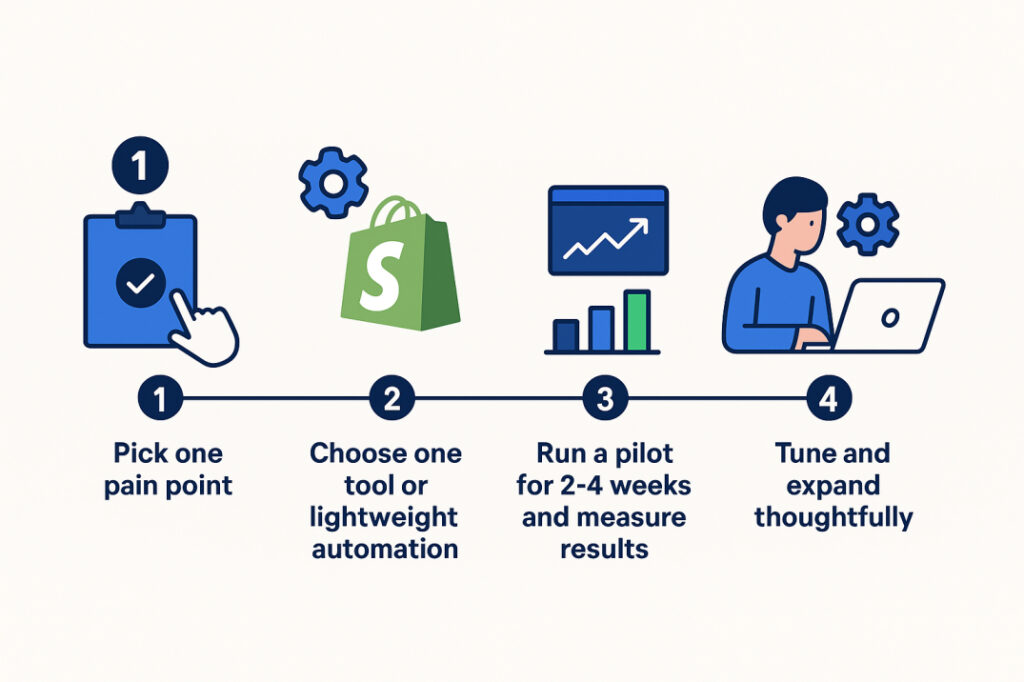
The following is a low-risk path you can follow to bring automation into your eCommerce operations.
Step 1: Pick one pain point
Instead of trying to automate every aspect of your store at once, begin by solving a single problem that is affecting the overall performance. It can be customer support, abandoned cart recovery, or personalized product recommendations.
Step 2: Choose one tool or lightweight automation
Select a trusted, well-reviewed AI automation tool that integrates smoothly with Shopify. You can even use Shopify Flow to create simple, rule-based automations. Make sure the tool aligns with your business goals and fits your technical comfort level.
Step 3: Run a pilot for 2-4 weeks and measure results
Implement the chosen automation on a small scale and monitor its performance over a few weeks. Pay close attention to measurable outcomes like conversion uplift, reduction in manual workload, customer satisfaction scores, or time saved on repetitive tasks.
Step 4: Tune and expand thoughtfully
Use the insights from your pilot to refine your automation setup. Fix issues that arise, adjust workflows or rules based on data, and gradually expand into other areas.
Step 5: Institutionalize automation
Once you’ve seen results, embed automation into your standard operating processes. Train your team to use and oversee the systems, set clear accountability for managing automations, and document fallback procedures or escalation paths for exceptions.
Key Takeaways
The most successful Shopify stores don’t hand over control completely. They build systems that learn, adapt, and let humans lead with empathy and creativity. AI automation helps Shopify stores strike that perfect balance, freeing up time while empowering teams to focus on innovation and customer experience.
You can start small, automate one pain point at a time, prove its ROI, and then scale. Know that AI should improve your decision-making, not replace it.
The future of eCommerce is hybrid: AI + human.
The businesses that bring this balance into their systems will outperform competitors.
Ready to see what that future looks like for your brand? Partner with Aureate Labs to build experience-driven and AI-powered commerce that performs and delights customers.






Post a Comment
Got a question? Have a feedback? Please feel free to leave your ideas, opinions, and questions in the comments section of our post! ❤️