

Full-Funnel Marketing Strategy for Sustainable eCommerce Growth
Most brands are not losing customers at the top of the funnel. They are losing them in the gaps between stages.
A typical eCommerce business leaks 60–80% of revenue between the first visit and repeat purchase. At the same time, customer acquisition costs have risen over 40% in the past few years, making every lost visitor more expensive than ever (Sticky Branding). Yet many teams still optimize for clicks and impressions, without a clear plan for what happens after.
This is where the problem starts.
Understanding the marketing funnel is the difference between chasing customers and keeping them. A full funnel approach is a complete, integrated plan that walks potential customers through their entire buying journey with your brand.
The goal is to take someone from the very first time they hear your name all the way to becoming a loyal customer who recommends you to others. You can see how this plays out in practice by exploring the modern eCommerce funnel.
When each stage works in isolation, brands generate traffic but fail to convert or retain it. The result is rising CAC, inconsistent revenue, and missed lifetime value. When the funnel is aligned, every touchpoint builds on the last, turning interest into action and customers into long-term revenue.
Key Takeaways
- A full-funnel strategy covers the entire customer journey, from first discovery to repeat purchase, not just the moment of sale.
- Siloed marketing creates gaps. When each team optimizes for its own metric, the customer experience breaks down between stages.
- Every funnel stage needs different tactics. Awareness, consideration, conversion, and retention each require their own messaging and channels.
- The post-purchase phase is where long-term revenue is built. Retention is significantly cheaper than acquisition, and loyal customers bring in new ones.
- Clean data is non-negotiable. Without reliable tracking, you cannot tell what is working or where customers are dropping off.
- A full-funnel approach works at any budget. The size of your spend matters less than having a connected, logical system across stages.
What Is Full-Funnel Marketing?
A full funnel marketing strategy covers the whole relationship-building process, from start to finish. It recognizes a basic truth about modern consumer behavior: the path to purchase is rarely a straight line. Someone might see your ad on Monday, read a blog post a week later, and sign up for your email list before ever thinking about buying.
When marketing efforts are siloed, they create a disconnected experience. Pouring money into ads to attract new visitors (Top of Funnel) is wasted if your website is confusing and they leave immediately (mid funnel). It is equally damaging if your checkout process is broken at the final stage.
The full funnel approach fixes this by making sure every touchpoint works together, from the moment a customer first discovers your brand to the point where they refer others.
A full funnel strategy is not just a marketing concept. It is a business growth engine. By aligning every stage with the right channels and the right message, brands create a predictable system for attracting high-value audiences and keeping them for long-term growth.
Why Does Full-Funnel Marketing Matter for eCommerce Growth?
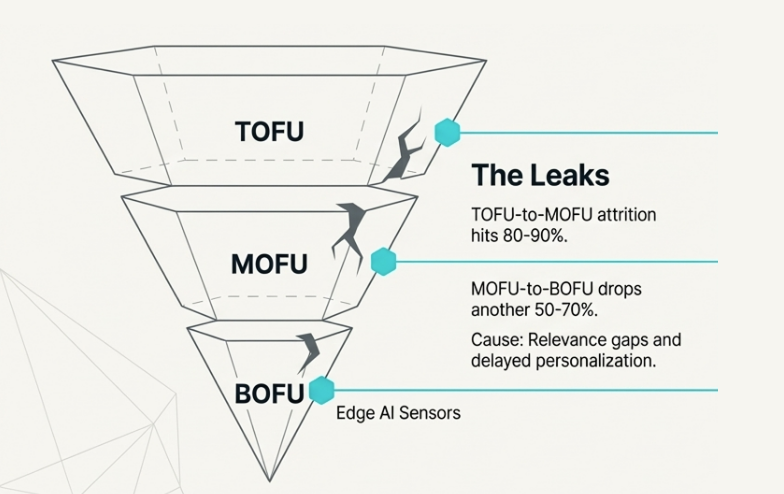
For D2C and B2C brands, this holistic view is essential for sustainable growth. It helps you avoid three common pitfalls:
- Leaky Buckets: Spending heavily on customer acquisition only to have those customers buy once and disappear.
- Missed Opportunities: Failing to nurture prospects who are genuinely interested into confident, ready-to-buy customers.
- Stagnant Revenue: Focusing only on the first sale while ignoring the value of existing customers and repeat business.
The shift from chasing short-term transactions to building long-term growth is what separates brands that scale from those that plateau. The result is higher customer lifetime value, stronger customer loyalty, and a more resilient business.
How to Map Your eCommerce Marketing Funnel?
Building a strategy that works starts with a clear map. The customer journey is not a single, linear path to the checkout. It is a relationship with distinct stages, each with its own purpose and context.
This visual shows the difference between a disconnected, siloed approach and a smooth, connected full funnel strategy:
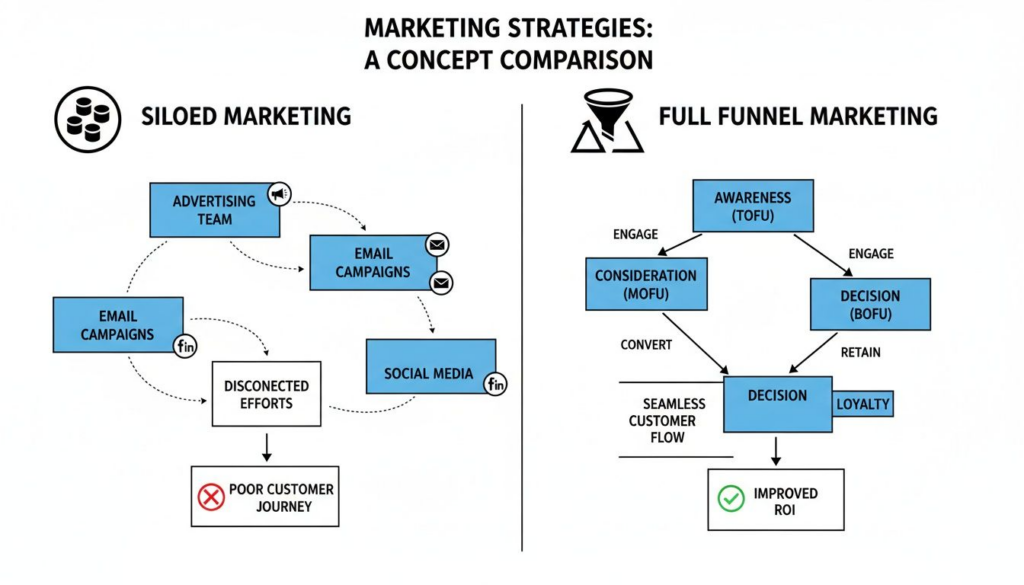
A connected strategy creates an efficient path to purchase and turns customers into advocates. Silos create friction and wasted spend. The modern framework has three core stages, followed by a fourth phase that powers the entire system.
Stage 1: Top of Funnel (TOFU): Igniting Awareness
The awareness stage, the top of funnel (TOFU), is focused on discovery. At this point, potential customers are either completely unaware they have a problem or just starting to realize they need a solution. They are not thinking about specific brands yet. They are focused on their own needs, questions, and interests.
Your goal here is to be discoverable and genuinely helpful. You need to show up where your target audience is already spending time, on platforms like Google, Meta, and TikTok, with valuable content that answers questions without a hard sales pitch. Increased brand awareness starts here, and awareness contributes to everything downstream in the funnel. This stage is about building consistent exposure across digital channels without asking for anything in return.
Stage 2: Middle of Funnel (MOFU): Nurturing Consideration
Once someone is aware of your brand, they enter the consideration stage, the middle of the funnel (MOFU), also called the mid funnel. A prospect now knows they have a problem and is actively weighing their options, including you.
Their mindset shifts from passive curiosity to active comparison. They are asking whether your brand is the right choice for them. Your marketing messages need to shift as well. Broad awareness tactics give way to trust-building and proof of your unique value. Personalized email marketing campaigns, detailed product guides, and customer testimonials become your most effective tools for turning that initial interest into serious consideration.
At its core, the mid-funnel is the bridge between a prospect’s initial curiosity and their final decision-making process. Successfully guiding them across that bridge requires a deep understanding of their pain points and a clear demonstration of how your product solves them.
Stage 3: Bottom of Funnel (BOFU): Driving the Purchase
The final stage, the bottom of the funnel (BOFU), is where the transaction happens. Your prospect is highly qualified and has done their research. They trust your brand and need one final reason to complete the purchase.
The customer mindset here is action-oriented: they are ready to buy but want to feel confident in the decision. Your job is to make this buying journey as seamless and reassuring as possible. That means optimizing your landing page, simplifying the checkout process, and using targeted messaging to address pain points and remove any last-minute friction. High-intent audiences at this stage convert at significantly higher rates when your messaging directly addresses their specific needs and simplifies the decision-making process.
Stage 4: The Post-Purchase Loop: Retention and Advocacy
The traditional funnel model stops at the sale. A true full funnel marketing strategy recognizes that the most valuable part of the customer journey happens after the first purchase. This is the post-purchase loop, focused entirely on retention and advocacy.
This is how a one-time buyer becomes a loyal, repeat customer and, eventually, a brand advocate. The goal is to deliver an exceptional post-purchase experience that validates their decision and encourages customers to return. According to Bain and Company, a 5% increase in customer retention can boost profits by 25% to 95% (Harvard Business Review). Satisfied customers come back and refer others. This feeds new, highly qualified prospects back into the top of your funnel, creating a self-sustaining growth engine.
“We see our customers as invited guests to a party, and we are the hosts. It’s our job every day to make every important aspect of the customer experience a little bit better.”
— Jeff Bezos, Founder of Amazon
Here is a quick summary of how the customer mindset and your marketing focus evolve at each step of the journey:
eCommerce Funnel Stages at a Glance
| Funnel Stage | Primary Goal | Customer Mindset | Marketing Focus |
| Top of Funnel (TOFU) | Generate awareness and attract new audiences | “I have a question or a problem.” | Educational content, SEO, social media, paid awareness ads |
| Middle of Funnel (MOFU) | Build trust and help prospects evaluate options | “Is this the right solution for me?” | Email/SMS nurturing, case studies, product guides, retargeting |
| Bottom of Funnel (BOFU) | Convert prospects into paying customers | “I’m ready to buy, I just need to be sure.” | CRO, optimized checkout, compelling offers, abandoned cart flows |
| Post-Purchase Loop | Drive loyalty, repeat purchases, and advocacy | “I made a great choice. I love this brand.” | Onboarding, loyalty programs, customer support, and community building |
Understanding this flow is the first step toward building a marketing system that acquires customers and keeps them for the long term.
What Tactics and Channels Work Best at Each Funnel Stage?
A full funnel strategy is not just a high-level map. It is an action-oriented playbook. This is where you align specific marketing channels and tactics with customer behavior at each stage of the buying journey. The goal is to create a seamless experience, guiding people from that first moment of awareness all the way to becoming loyal fans.
Every channel has a clear job to do. Here is a breakdown of the most effective tactics for each part of the eCommerce journey.
Top of Funnel Tactics for Capturing Attention
At the top of the funnel, the primary goal is getting noticed. You are generating increased brand awareness and introducing your brand to new audiences who are not yet looking for you. They are searching for answers or solutions to a problem they have recently identified. You need to be what they find across digital channels.
- Paid Advertising (Meta, TikTok): Platforms like Meta and TikTok are discovery engines for full funnel advertising. The approach is not a direct sell. It is content that entertains or educates. A skincare brand might run short video ads on TikTok showing a morning routine, focusing on the problem rather than just promoting a product.
- SEO and Content Marketing: This is how you show up when someone searches for their problem online. By creating genuinely helpful blog posts and guides that answer common questions, you become a trusted resource. A company selling sustainable home goods could rank for “eco-friendly cleaning tips,” attracting an audience that shares their values before those users even know they need a specific product.
- Influencer Collaborations: Partnering with creators your audience already trusts is an efficient path to authenticity. Focus on brand alignment over raw reach. A well-placed product in an influencer’s content feels more like a peer recommendation than an advertisement.
Which Middle of Funnel Tactics Build the Most Trust?
Once someone is aware of your brand, they enter the mid-funnel. The focus shifts here. It is no longer about discovery; it is about consideration and building genuine trust. They know who you are, but now they need to know why they should choose you.
Your tactics need to become more targeted. The goal is to show prospects you understand their needs and have the right solution. MOFU is the bridge between awareness and conversion, where you turn a first-time visitor into a serious potential buyer by providing proof that you understand their pain points.
- Email and SMS Nurturing: Once you have captured someone’s contact details, use them wisely. Automation tools can deliver value directly to their inbox: user-generated content, detailed product guides, and stories that build a genuine connection. The subject line matters more than many people realise. It is the first filter between your message and your prospect’s attention. A strong email marketing sequence does more to nurture leads than any one-off campaign.
- Paid Retargeting Campaigns: This is how you re-engage visitors who browsed without purchasing. Retargeting on Meta lets you show testimonials for the exact products someone viewed or highlight a feature they may have missed. Our guide on effective Facebook ad strategies covers this in detail.
- In-Depth Content: Case studies, comparison guides, and detailed product videos are effective here. For a B2C brand selling high-consideration products, a side-by-side comparison video provides the social proof and data that thoughtful potential buyers need. Free trials are also effective at this stage. They remove risk from the consideration stage entirely and accelerate the decision-making process.
What Bottom of Funnel Tactics Drive the Most Conversions?
At the bottom of the funnel, the prospect is close to purchasing. They have clear intent, they trust your brand, and they know what they need. Your job is to make that final stage as straightforward and compelling as possible, driving more conversions and ultimately more sales.
- Conversion Rate Optimization (CRO): This is the practice of making your landing page and website perform better. Simple changes, like reducing your checkout to a single step or making the “Add to Cart” button more prominent, can lead to significant improvements in conversion rates.
- Persuasive Copywriting: The copy on your product and checkout pages needs to be clear and benefit-driven. Do not just list features. Explain how each one solves a real problem for the customer. Use strong calls-to-action that create a degree of urgency.
- Abandoned Cart Recovery: According to the Baymard Institute, 70.19% of online shopping carts are abandoned (Source). Automated emails and texts reminding customers about items they left behind, sometimes with a time-limited offer, are among the highest-ROI activities in eCommerce.
What Post-Purchase Tactics Turn Buyers Into Brand Advocates?
The journey does not end at the point of purchase. The post-purchase phase is where you turn a one-time buyer into a lifelong advocate. This reinforcing cycle feeds your funnel with repeat business and word-of-mouth referrals.
- Lifecycle Marketing: Send personalized content based on what a customer has bought, using automation tools to trigger it at the right moment. Someone who bought running shoes might receive an email three months later about high-performance socks or a training guide. This kind of relevance builds trust and drives more sales from existing customers without spending on acquisition.
- Loyalty and VIP Programs: Reward your best customers. Points, exclusive access, or special perks make them feel valued and encourage customers to return regularly. It creates an emotional connection that goes beyond any single transaction. This is the foundation of genuine customer loyalty.
- Exceptional Customer Support: Fast, empathetic, and effective support can turn a negative experience, such as a shipping delay, into a brand-building moment. Creating meaningful interactions at every post-purchase touchpoint is what separates one-time buyers from long-term customers.
How To Build a Full Funnel Tech Stack?
A great strategy does not run on good ideas alone. It depends on the right technology.
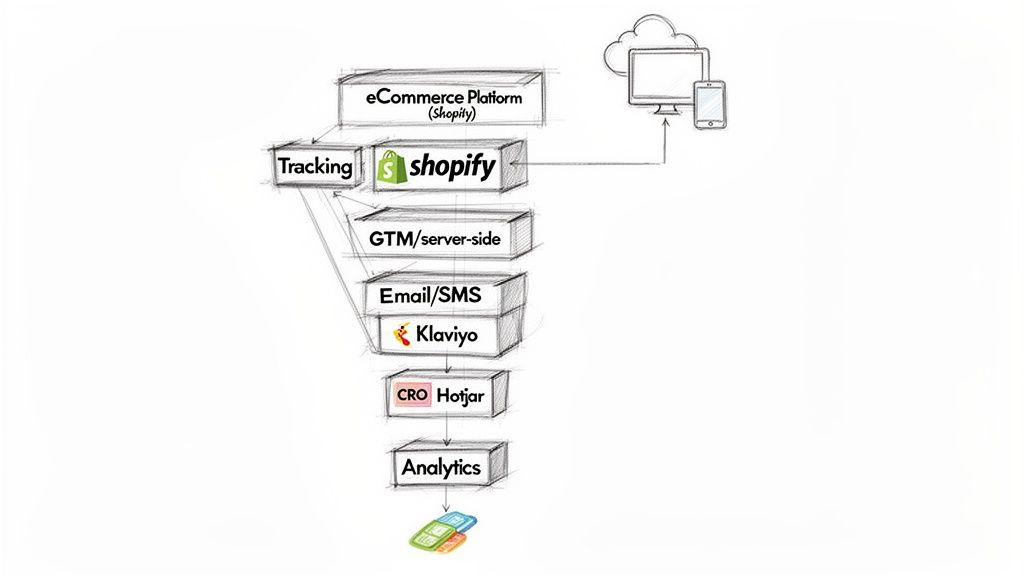
Your tech stack is the nervous system connecting every stage of the customer journey, from that first ad click all the way through a tenth repeat purchase. Get it right, and you have built a growth engine. Get it wrong, and you have created a bottleneck.
The goal is not to accumulate tools for their own sake. It is to build an integrated system where platforms share data and empower you to deliver a cohesive customer experience across all marketing channels. Here are the core components you will need.
What Should Be the Foundation of Your eCommerce Platform?
Your eCommerce platform is more than a digital storefront. It is the foundation your entire funnel is built upon. Your choice here dictates your flexibility, how easily you scale, and your ability to create the kinds of experiences that set you apart.
The two dominant players are Shopify and Adobe Commerce (formerly Magento). Shopify is known for its ease of use and large app ecosystem, making it a practical choice for brands that need to move quickly and scale without a large development team. Adobe Commerce offers deep customization and enterprise-level capabilities, suited to complex businesses with specific technical requirements.
For brands prioritizing user experience above all else, a headless architecture is worth considering. Headless separates the front-end presentation layer from the back-end commerce engine, allowing for faster site speeds and full creative control over the user interface. Both are critical for improving conversion rates and keeping existing customers engaged.
Why Is a Reliable Data and Tracking Layer Non-Negotiable?
You cannot manage what you do not measure. A solid data and tracking setup is the bedrock of any successful full funnel performance strategy. Without clean, reliable data, you are making decisions without visibility into how users move between funnel stages and which marketing channels are actually driving value.
Accurate tracking is not just a technical task. It is the foundation for data-driven insights and a clearer picture of the entire customer story. When you collect data properly, you are not just counting clicks. You are understanding online activity patterns that tell you exactly where to invest.
The essential tools here are:
- Google Tag Manager (GTM): A central hub for managing all your marketing and analytics tags, including pixels and tracking scripts, without requiring developers to edit site code each time. It puts control back in the marketing team’s hands.
- Server-Side Tracking: With privacy restrictions tightening and ad blockers growing more common, client-side tracking is becoming less reliable. Server-side tracking sends data from your server directly to platforms like Meta and Google, creating a more accurate and durable data stream. This is especially important for tracking users across mobile devices and multiple sessions.

Pro Tip: Server-side tracking is not just a technical upgrade. It is a competitive advantage. Are you tracking your events well? Get a FREE audit to check control over your website tags and data.
What Are the Essential Tools for Funnel Activation?
Once you have a solid platform and reliable tracking in place, you can add specialized tools to execute tactics at each stage of the funnel. Every tool should have a clear purpose tied directly to a specific funnel goal.
MOFU and Retention Tools (Email/SMS)
After capturing a lead or making a first sale, tools like Klaviyo become valuable for nurturing and retention. They let you build sophisticated email marketing campaigns and automated flows for welcome series, abandoned cart recovery, and post-purchase follow-ups. The ability to nurture prospects and nurture leads at scale, with personalized content, is what separates high-performing brands from those that rely on one-off campaigns.
BOFU Tools (CRO and Analytics)
To optimize the bottom of the funnel, you need to understand exactly how people behave on your site. Hotjar provides heatmaps and session recordings, showing you precisely where users click, scroll, and lose momentum. This qualitative data is invaluable for identifying conversion roadblocks and improving your landing page experience to drive more conversions.
Full Funnel Analytics Tools
Platforms like Google Analytics 4 (GA4) give you a high-level view of performance across the entire funnel. GA4 tracks users across devices and sessions to measure critical metrics like customer lifetime value and attribute conversions back to the correct top-of-funnel channels. A well-configured analytics setup is the final report card on your full funnel performance, showing what is working and what needs attention. You can build detailed reports on user flow using the GA4 funnel exploration report and its capabilities.
How to Measure Full Funnel Marketing Success
Rolling out a full funnel marketing strategy is a strong start, but only half the work. If you cannot measure what is working, you are not making data-driven optimization decisions. Without measurement, you are guessing.
To prove ROI and make smarter budget decisions, you need to look past vanity metrics. The goal is to build a dashboard that gives you a clearer picture of how customers find you, trust you, and buy from you across your owned channels and paid media.
Each stage of the funnel has a different job, which means each stage needs its own set of key performance indicators. Here is a breakdown of the essential metrics to track:
Full Funnel Marketing KPIs by Stage
| Funnel Stage | Primary KPIs | Secondary Metrics |
| Top of Funnel | Reach, Impressions, Website Traffic | CPM, Branded Search Terms Volume, Social Engagement Rate |
| Middle of Funnel | Email/SMS Subscribers, Lead Magnet Downloads, Add to Carts | Cost Per Lead (CPL), Email Open/Click Rates, Time on Site, Pages per Session |
| Bottom of Funnel | Conversion Rate (CVR), Customer Acquisition Cost (CAC), Average Order Value (AOV) | Return on Ad Spend (ROAS), Cart Abandonment Rate, Checkout Completion Rate |
| Post-Purchase | Customer Lifetime Value (LTV), Repeat Purchase Rate, Churn Rate | Net Promoter Score (NPS), Customer Satisfaction (CSAT), Referral Rate |
Focusing on these KPIs gives you a clear, stage-by-stage view of your marketing performance, so you can make targeted adjustments rather than guessing.
What Top of Funnel KPIs Measure Awareness and Discovery?
At the awareness stage, the primary goal is getting your brand in front of new, relevant audiences. Success at this stage is not measured in sales. It is measured in visibility and initial interest.
- Impressions and Reach: Foundational engagement metrics for awareness. Reach tells you how many unique people saw your content. A high number indicates your campaigns are successfully reaching new audiences.
- Website Traffic: An uptick in website traffic, especially from organic search and referrals, signals that your awareness efforts are bringing people to your brand.
- Click-Through Rate (CTR): This tells you how compelling your ads and content are. High reach with a low CTR means you are getting seen, but your message is not landing. This is a signal to adjust your creative or branded search terms strategy.
What Middle of Funnel KPIs Track Engagement and Consideration?
In the mid funnel, your measurement focus shifts from broad visibility to active engagement metrics. Are people showing a stronger interest? Are there clear signals of purchase intent?
Every email marketing open, every product page view, and every saved cart is a signal of confidence from a potential buyer. Your job is to measure these signals and nurture leads based on them.
- Lead Magnet Downloads: People downloading your guides or signing up for webinars signal genuine interest and tell you the quality of leads you are generating from your early-stage awareness work.
- Email/SMS Subscriber Growth: A growing subscriber list shows your TOFU traffic finds your brand worth returning to. It is a positive signal that your consistent messaging is working.
- Add to Carts: One of the strongest indicators of purchase intent. Tracking this helps you understand which products are gaining traction long before someone completes a purchase.
What Bottom of Funnel KPIs Measure Conversion and Acquisition?
At BOFU, everything comes down to the sale. These metrics are direct, financial, and tied straight to revenue. This is where you measure how efficient your customer acquisition engine really is.
- Conversion Rate (CVR): The percentage of visitors who complete a purchase. It is the core measure of how well your site turns visitors into paying customers. Small improvements here compound into more sales over time.
- Average Order Value (AOV): How much a typical customer spends in a single transaction. Improving your AOV is one of the most effective ways to grow revenue without needing additional traffic.
- Customer Acquisition Cost (CAC): On average, how much does it cost to land a new customer? A healthy strategy keeps your CAC comfortably below the customer’s customer lifetime value.
What Post-Purchase KPIs Measure Retention and Advocacy?
The most profitable part of your funnel happens after the first purchase. The post-purchase loop is where you build customer loyalty and measure the long-term health of your business.
- Customer Lifetime Value (LTV): The total revenue you can expect from a single customer over their entire relationship with your brand. A rising LTV is the clearest indicator of a healthy, sustainable eCommerce business.
- Repeat Purchase Rate: What percentage of your customers return for another purchase? This metric directly measures satisfaction and how well your retention marketing is working. A high rate means you have built a brand people genuinely trust.
Common Full-Funnel Strategy Mistakes to Avoid
Even a well-planned full funnel marketing strategy can fall apart in execution. Implementing a connected customer journey is more than buying tools and launching campaigns. It requires a fundamental shift in how your teams operate. Too many brands fall into the same traps, disconnecting their efforts and burning their budgets in the process.
1. Siloed Teams and Disconnected Budgets
This is the most common and costly mistake. The paid media team celebrates high click-through rates. The email marketing team focuses on open rates. But nobody asks the most important question: did any of this actually produce a satisfied, paying customer?
Siloed thinking creates a jarring, disjointed experience. A customer sees a strong ad, clicks through, and lands on a page that feels like it belongs to a different company. The marketing messages are off, the offer does not match, and trust disappears. Consistent messaging across all owned channels, from paid media to email to your website, is not optional. It is the foundation of a functional funnel.
2. Treating the First Sale as the Finish Line
Pouring all your energy into customer acquisition and then ignoring the customer after the purchase is short-term thinking at its most expensive.
Acquiring a new customer costs, on average, five times more than retaining an existing customer (Invesp). When you neglect the post-purchase phase, you are not just missing out on repeat sales. You are also losing your most cost-effective source of new business: word-of-mouth. A customer who feels valued after their purchase is the one who leaves positive reviews and recommends your brand to others. That is how you build a sustainable growth engine from existing customers.
3. Inconsistent Messaging and Broken Data
When your brand’s voice changes dramatically from one channel to the next, it undermines credibility. A playful TikTok ad that leads to a dry, corporate product page creates a jarring experience and undermines trust. Consistent messaging across all digital channels, on mobile devices and desktop alike, is what builds a believable brand story across every touchpoint.
The data side is equally important. The most expensive mistake in a full funnel strategy is not the ad that fails to convert. It is not known why it failed. Broken tracking means making budget decisions based on guesswork rather than data-driven insights.
Without solid tracking, three problems become inevitable:
- Misallocated Budget: You cut spending on a top-of-funnel channel that was introducing your highest-value customers, simply because it did not receive the final click credit.
- Undetected Leaks: You know customers are dropping off somewhere in the funnel, but you have no visibility into where or why.
- Growth Ceiling: You cannot confidently scale what is working because your data is unreliable. Growth stalls because you cannot prove ROI on anything. Full funnel performance requires trustworthy data at every stage.
Frequently Asked Questions
Putting a full funnel marketing strategy into practice raises practical questions. Here are direct answers to the most common ones.
What are the 5 stages of the marketing funnel?
The five stages of the marketing funnel are Awareness, Interest, Consideration, Conversion (or Purchase), and Retention (or Advocacy). This framework guides potential customers from discovering a brand to becoming loyal, repeat buyers and advocates.
What is the 40-40-20 rule in marketing?
The 40-40-20 rule is a direct marketing principle stating that campaign success relies 40% on the List (target audience), 40% on the Offer (value proposition), and 20% on the Creative (design, copy, and format). Developed by Ed Mayer, it prioritizes accurate targeting and irresistible offers over design polish, with 80% of success stemming from who you reach and what you offer them.
What is the 3-3-3 rule in marketing?
The 3-3-3 rule in marketing is a strategic framework designed to simplify campaigns and increase focus by concentrating on 3 core messages, 3 targeted audiences, and 3 key marketing channels. It aims to prevent resource dilution by ensuring consistency, improving audience engagement, and streamlining efforts for higher conversion rates.
What is a full-funnel structure?
A full-funnel structure is a holistic marketing strategy that addresses the entire customer journey, from initial awareness to final purchase and loyalty. By targeting the upper (awareness), middle (consideration), and lower (conversion) funnel stages simultaneously, it ensures tailored messaging, higher engagement, better ROI, and sustained growth.
How Long Does It Take to See Full-Funnel Marketing Results?
Results appear at different times depending on which part of the funnel you are working on.
Bottom-funnel activities, such as conversion rate optimization or abandoned cart flows, often show direct impact within 30 to 60 days. These tactics target people already close to a purchase, so the feedback loop is fast and more conversions come quickly.
Top-of-funnel efforts like SEO and content are longer-term investments. They typically show significant, measurable results after about 6 to 12 months of consistent work. Track leading indicators at each stage from the start, so you know the system is moving in the right direction before it fully shows up in revenue. This is just the beginning of a compounding payoff from your full funnel approach.
Can a Small Business Build a Full-Funnel Marketing Strategy?
Yes. A full funnel strategy is about having an integrated approach, not a large budget. A small brand can do this by focusing on one or two core channels per stage and connecting them logically.
For example, you could start with:
- TOFU: Use organic social media posts and basic SEO to build awareness with your target audience.
- MOFU: Capture emails with a simple newsletter signup and nurture leads with a basic welcome sequence. Even a three-email sequence qualifies as an email marketing campaign that nurtures prospects.
- BOFU: Optimize your product pages for clarity and more conversions. Address the obvious friction points first.
The real difference is not the size of your budget. It is the shift in perspective. Many marketers treat the funnel as a linear, one-way process. A full funnel approach is a cyclical system that treats the post-purchase experience as fuel for new customer acquisition, creating a growth loop that sustains itself with data-driven optimization over time.
Final Take!
A successful full funnel marketing strategy requires connecting every piece of the customer journey, from first touch to long-term growth. This is just the beginning of better performance marketing.
It is a fundamentally different way of thinking about growth. When your awareness stage efforts, mid funnel consideration tactics, and full funnel advertising play work together, and when you invest properly in what happens after the sale, you stop competing on price and start building something that compounds over time.
The brands that win treat the entire buying journey as one integrated system. They use data-driven insights to make smarter decisions, consistent messaging to build trust across all marketing channels, and smart retention marketing to maximize customer lifetime value from every customer they earn.
The expert team at Aureate Labs builds and executes these integrated growth engines for eCommerce brands. Discover how our team can help you drive measurable results.






Post a Comment
Got a question? Have a feedback? Please feel free to leave your ideas, opinions, and questions in the comments section of our post! ❤️