

Ecommerce Growth Strategy: Boost Revenue with Proven Tactics

Most eCommerce businesses plateau not because they’re doing things wrong, but because they’re doing disconnected things. Good tactics without a system behind them don’t compound. They just pile up.
An effective eCommerce growth strategy guides your online store toward success, helping you adapt to ever-evolving market trends and outperform competitors.
A real eCommerce growth strategy ties customer acquisition, on-site conversion, and customer retention into one measurable framework. When those three work together, eCommerce growth becomes repeatable, not random.
To cut through the complexity of eCommerce, focus on a few proven steps that drive real growth.
Effective eCommerce growth strategies focus on increasing traffic, maximizing conversion rates, and boosting customer retention through personalization, data analytics, and improved user experience.
This guide walks through exactly how to build that system, for D2C and B2C brands that want predictable, long-term eCommerce success.
Key Takeaways
- Regularly analyzing ecommerce strategies using analytics data helps businesses adapt and refine their marketing campaigns.
- Regularly tracking performance metrics allows ecommerce businesses to identify areas for improvement and adapt their strategies accordingly.
- Predicting future market trends through data analysis allows ecommerce businesses to proactively adjust their strategies to meet changing consumer preferences.
- Customer Lifetime Value (CLV) is the total revenue a business can expect from a single customer account.
- Regularly analyze your ecommerce strategies using analytics data to track website traffic, customer behavior, and sales patterns.
- AI tools can help ecommerce businesses predict future market trends and customer preferences by analyzing historical data.
- AI-powered chatbots can provide 24/7 customer service, enhancing the customer experience in ecommerce.
- AI tools can generate sophisticated content and optimize the timing of delivery for marketing campaigns in ecommerce.
- AI can help ecommerce businesses automate email marketing campaigns to engage both prospective and existing customers.
What Does a Real Ecommerce Growth Strategy Look Like?
Forget chasing the latest shiny object or launching a bunch of disconnected campaigns. The most successful eCommerce brands operate on a unified strategy where every marketing dollar and every minute of effort pulls in the same direction.
This isn’t some high-level concept. It’s the fundamental operating model for any eCommerce business serious about scaling. The entire system boils down to three core pillars that work together in a continuous cycle.
Successful eCommerce growth strategies leverage data for personalization, use social proof to build trust, and implement multichannel marketing to attract and retain customers.
This flow is the lifeblood of a healthy eCommerce business.
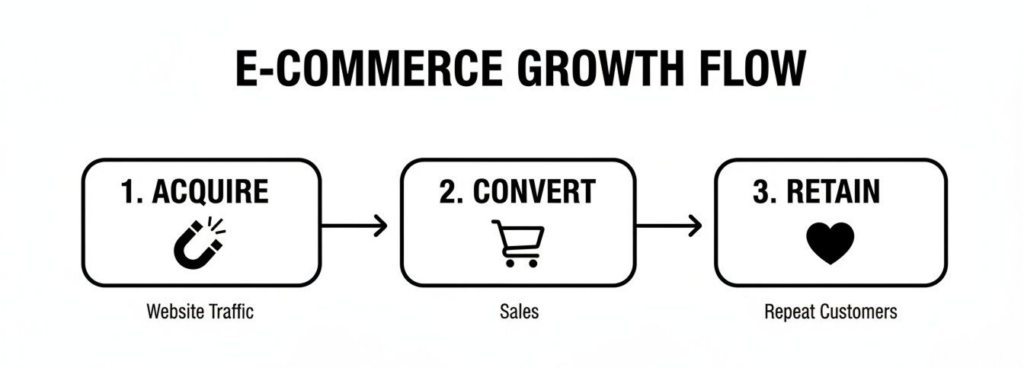
As you can see, growth isn’t a single event. It’s a flywheel where each stage fuels the next. Your job is to optimize the entire customer journey, not just one isolated piece of it.
What Are the Three Pillars of Ecommerce Growth?
To build an effective eCommerce strategy that actually works, everything you do should fit into one of these three areas:
- Profitable Customer Acquisition: This is your top-of-funnel. It involves a smart mix of paid advertising, SEO, and content marketing. The key isn’t just getting website traffic. It’s finding scalable sales channels that bring in new customers at a cost your eCommerce business can sustain.
- Seamless On-site Conversion: Once you’ve paid to get people to your online store, you have to turn that traffic into sales. This is all about CRO, user experience, and copy that sells. Every element, from your product page layout to your checkout flow, has to be as frictionless as possible.
- Loyalty-Building Customer Retention: Getting a customer to buy once is just the start. Sustainable eCommerce growth comes from turning one-time buyers into repeat customers who come back again and again. This is where email marketing, loyalty programs, and top-notch customer service come in to maximize Customer Lifetime Value (LTV).
PRO TIP: Audit each pillar separately before deciding where to focus. Most eCommerce brands assume their problem is acquisition, but the real leak is often on-site conversion or customer retention. Run the numbers on your conversion rate and repeat purchase rate first.
How Do You Build Your Strategic Roadmap?
A plan sitting in a document is useless. The next step is turning this framework into a concrete roadmap for your eCommerce store.
Building a growth strategy is just the beginning; to achieve real progress, connect your plans to specific actions and track the right metrics.
- Start with an honest audit of where you are right now. Where are you losing customers?
- Which sales channels show the most potential?
- What’s your current conversion rate, and how does it stack up against industry benchmarks?
Setting clear, achievable goals and key performance indicators (KPIs) is critical for measuring the effectiveness of eCommerce strategies.
Regularly assess and update your product line to align with current market trends and customer preferences.
Answering those questions will shine a light on your biggest opportunities and tell you where to focus first. From there, you build a plan that aligns your team, budget, and technology around your actual business objectives.
How To Build a Multi-Channel Customer Acquisition Engine
Relying on a single source of traffic is a recipe for stagnation. If you want to build a resilient eCommerce brand, you need to move beyond just “running ads” and start thinking like a portfolio manager. Your goal is to build a diverse, interconnected system for attracting new customers.
This means developing a balanced portfolio where your paid marketing efforts amplify a strong organic foundation. The goal isn’t just to get clicks. It’s to acquire target customers at a cost that actually fuels profitability.
AI tools can automate and improve the success of targeting, analytics, and personalization in eCommerce marketing.
For some brands, this might be a 70/30 split between paid and organic. For others, closer to 50/50. The right mix depends entirely on your business model, profit margins, and who you’re trying to reach.
1. Combining Paid and Organic Channels
Paid and organic channels should never operate in silos. When they work together, they create a flywheel effect that strengthens your entire acquisition engine.
Paid Channels (Google, Meta, TikTok): These are your on-demand powerhouses. Google Search and Shopping are exceptional for grabbing high-intent customers who are actively searching for what you sell. Social media platforms like Meta and TikTok are better for creating demand in the first place, introducing your brand to new audiences through targeted social media marketing.
Organic Channels (SEO and Content): This is your long-term asset. Organic search builds trust and delivers highly qualified website traffic over time without a direct cost-per-click. A strong foundation in eCommerce keyword research is essential. It’s how you attract real buyers through search and build a reliable online strategy that works even when ad budgets tighten.
Here’s how to think about it in practice: your paid ads bring in immediate traffic and sales data. You can use those insights, which keywords convert, what ad copy resonates, to inform your SEO and content strategy. As your organic presence grows, you become less reliant on paid advertising, which lowers your blended Customer Acquisition Cost (CAC).
2. Allocating Your Budget for Maximum Impact
Don’t follow the hype. Follow the data.
Your budget allocation should directly reflect channel efficiency. That means tracking two key performance indicators closely: Return on Ad Spend (ROAS) and Customer Acquisition Cost (CAC).
Utilizing media data can significantly enhance decision-making processes in eCommerce by providing insights into customer engagement and campaign effectiveness.
You can start by setting test budgets for your most promising channels. Simply run campaigns for a set period and track what happens:
| Channel | Test Budget | Leads/Sales | CAC | ROAS |
| Google Search Ads | $2,000 | 50 | $40 | 4.5x |
| Meta (FB/IG) Ads | $2,000 | 80 | $25 | 3.2x |
| TikTok Ads | $1,000 | 65 | $15.38 | 2.8x |
Based on this data, Meta and TikTok look cheaper for acquiring a customer. But Google Search is delivering a much higher return for every dollar spent. That doesn’t mean you cut TikTok. It might just mean TikTok is better for top-of-funnel awareness than direct sales. Your eCommerce strategy needs to be nimble enough to shift budgets based on performance realities.
PRO TIP: Never evaluate CAC in isolation. A $40 CAC might seem high, but if those customers have a $200 LTV, it’s far more profitable than a $15 CAC for customers with a $30 LTV. Always know your LTV: CAC ratio by channel before scaling.
Global retail eCommerce sales are projected to reach $6.42 trillion by 2025, up from $5.09 trillion in 2022. (Statista) This is precisely why D2C and B2C brands need a disciplined, multi-channel approach to capture their share of this growing eCommerce industry.
Our guide on how to lower customer acquisition cost covers more tactics for improving channel efficiency.
3. Crafting Ad Creative That Actually Converts
Your ads are often the very first impression a customer has of your brand. Generic, uninspired creative gets ignored.
- Lead with the Hook: Start your ad copy or video with the single most compelling benefit or the biggest problem you solve. Don’t bury the good stuff.
- Show, Don’t Just Tell: Use high-quality user-generated content (UGC), lifestyle photos, or simple videos that show your product in a real-world context. Authentic content usually wins on relevant social media platforms over polished studio shots.
- Match Message to Funnel Stage: A retargeting ad for someone who abandoned their cart needs to be different from a prospecting ad for a cold audience. The retargeting ad can be more direct, maybe with a small incentive. The prospecting ad should focus on building brand affinity with your target audience.
- Influencer Partnerships: Building partnerships with influencers can help eCommerce brands reach new customers and build credibility. Micro-influencers in particular often deliver better engagement rates at a fraction of the cost of traditional paid placements.
Building a customer acquisition engine is a process of continuous testing and refinement. Success means staying close to your customer data, understanding the unique role of each channel, and building a system that delivers consistent, profitable eCommerce growth.
How to Turn Website Visitors Into Paying Customers
Getting traffic to your eCommerce site is only half the battle. Countless brands pour money into paid advertising, only to watch those hard-won visitors bounce without buying anything. An effective eCommerce growth strategy hinges on what happens after the click.
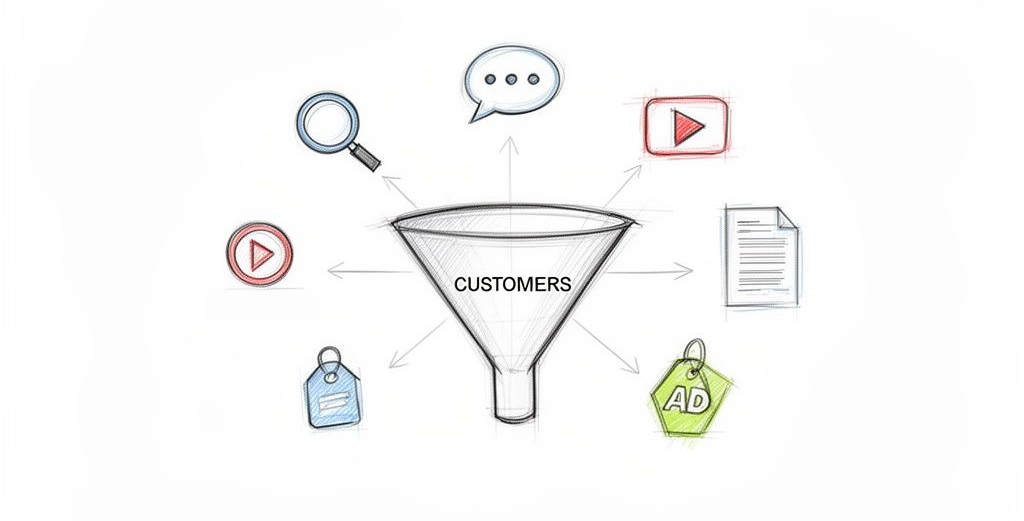
Personalizing the customer journey is crucial: 71% of online shoppers expect personalized experiences when purchasing products. If visitors aren’t converting, you’re not just losing online sales. You’re burning your acquisition budget.
90% of businesses across various industries have recognized the importance of customer experience, making it their top priority.
This is where Conversion Rate Optimization (CRO) becomes your most powerful lever for eCommerce growth. If you double your conversion rate, you’ve effectively cut your cost per acquisition in half. No extra ad spend required.
Here’s a breakdown of the core elements that drive conversions on any eCommerce website:
| Element | Objective | Key Tactics |
| Site Navigation and Search | Let users find what they want, fast | Intuitive menu structure, predictive search, smart filtering |
| Product Detail Pages | Answer questions and create desire | High-quality images/video, benefit-driven copy, social proof |
| Checkout Process | Make buying effortless and secure | Guest checkout, minimal form fields, multiple payment options |
| Mobile Experience | Create a flawless small-screen journey | Thumb-friendly design, fast load times, easy-to-read fonts |
| Trust Signals | Build confidence at every step | Customer reviews, security badges, clear return policies |
AI tools can analyze vast behavioral data to create individualized experiences for customers in eCommerce. It allows businesses to personalize recommendations that appeal to customers’ broader economic, social, and emotional goals.
1# Simplify The Path to Purchase
The single biggest enemy of conversion is friction. Every unnecessary step, every confusing field, every moment of hesitation is a chance for an online shopper to abandon their cart. Research shows that a complicated checkout process is one of the top reasons online shoppers leave without buying.
Optimizing your website for a seamless and user-friendly experience includes ensuring fast page load times and intuitive navigation.
Walk through your own checkout process in an incognito window. Pretend you’re a first-time customer.
Is it easy? Is it fast? Does it build trust or create anxiety?
Here’s what to look for:
- Guest Checkout is Non-Negotiable: Forcing users to create an account before they can buy is a classic conversion killer. Always offer a prominent guest checkout option.
- Minimize Form Fields: Only ask for what is essential. Every field you remove is a small win for your conversion rate.
- Offer Multiple Payment Options: Credit cards are table stakes. Online shoppers today expect options like PayPal, Apple Pay, and Buy Now, Pay Later (BNPL) services. If you don’t offer their preferred method, they’ll find an online store that does.
Our guide to eCommerce checkout optimization covers specific tactics that have a direct impact on online sales.
2# Craft Product Pages That Sell
Your product detail page (PDP) is your digital salesperson. It needs to do more than list features. It has to answer questions, overcome objections, and create genuine desire.
High-quality visuals are your first handshake. Customers can’t touch or feel your product online, so your images and videos have to do the heavy lifting. Show the product from every angle, in use, and with context that helps shoppers visualize it in their own lives.
Utilizing user-generated content, like reviews and testimonials, can add authenticity to your brand and influence purchasing decisions. Your product description should focus on benefits, not just specs. Instead of “Made with 100% cashmere,” try “Experience the softness and warmth of pure cashmere.” That’s the difference between listing a feature and creating desire.
Analyzing purchasing behavior and trends helps create tailored shopping experiences through AI-powered product recommendations.
Product bundling can increase perceived value and total items per cart. Consider bundling complementary products to drive a higher Average Order Value alongside personalized recommendation blocks.

Pro Tip: Treat your PDP like a conversation. Anticipate your customers’ questions and answer them proactively in the description, specs, and FAQ sections to keep them on your eCommerce site. Need a quick PDP Audit?
“A product page is often the make-or-break moment in the online shopping journey. Brands that treat it as a listing get average results. Brands that treat it as a conversion tool build a real competitive edge.”
— Kieran O’Brien, Head of CRO, Ecommerce Unlocked
3# Embrace a Truly Mobile-First Design
A “mobile-friendly” or responsive eCommerce site just isn’t good enough anymore. A staggering 60% of all eCommerce sales now happen on mobile devices. (Statista) The mobile experience can’t be an afterthought. It has to be your primary consideration.
Mobile optimization shapes every single design choice:
- Thumb-Friendly Navigation: Are your buttons large enough and spaced far enough apart to be easily tapped? Can users navigate your entire eCommerce store with one hand?
- Optimized Readability: Fonts have to be crystal clear on small screens without any pinching or zooming. Keep paragraphs short and scannable.
- Performance is Paramount: Mobile users are impatient. Every second of load time directly eats into your conversion rate. Research from Google and Deloitte found that a 0.1-second improvement in mobile site speed can increase conversion rates by up to 8%. (Google)
Google also prioritizes the mobile version of your eCommerce site for search rankings. Superior mobile optimization isn’t just good for CRO. It’s foundational to your entire eCommerce strategy.
How To Drive Lifetime Value With Smart Retention Marketing
Real, sustainable eCommerce growth isn’t just about chasing new customers. While acquisition feels exciting, customer retention is where you build a truly profitable business. It’s about getting your existing customers to come back, again and again.

Retaining a customer can cost up to five times less than acquiring a new one. That math alone makes retention marketing one of the highest-ROI investments in your eCommerce business.
Research shows that increasing customer retention rates by just 5% can increase profits by 25% to 95%. Every brand is fighting for its share. The brands that retain customers will win the long game.
Mapping Your Core Email And SMS Flows
Email marketing and SMS are the workhorses of your retention engine. When done right, they deliver personalized, timely messages that feel helpful, not intrusive. Forget batch-and-blast. Start by building out these essential automated flows:
- Welcome Series: This is your first impression after a signup. Use this multi-part series to tell your brand story, set expectations, and showcase your best-selling products. Don’t just throw a coupon at them.
- Abandoned Cart Sequence: This is the lowest-hanging fruit in eCommerce. A sequence of 2 to 3 automated emails or texts can recover a significant percentage of otherwise lost sales. The first message should be a friendly reminder. Later messages can introduce a small incentive or tackle common objections like shipping costs.
- Post-Purchase Follow-up: This flow kicks in the moment an order is placed. Confirm the order, send shipping updates, and circle back after delivery to ask for a review or offer tips on using the product. This direct communication builds customer relationships and paves the way for repeat purchases.
“A great welcome series doesn’t just sell. It educates and validates the customer’s decision to trust you. Share your brand values and mission. Make them feel like they’ve joined a community, not just a mailing list.”
— Aureate Labs
Segmenting Your Audience for Personalization
Sending the same marketing message to every customer is a fast track to the spam folder. The secret to making your digital marketing feel like a one-on-one conversation is audience segmentation, which means breaking your customer base into smaller groups based on customer behavior and purchase history.
Even basic segmentation has a massive impact on customer engagement. Here are a few high-value customer segments to build today:
- First-Time Buyers: Create a dedicated flow to nurture them toward their second purchase. Offer a “welcome back” discount or showcase products that complement what they just bought.
- High-Value Customers (VIPs): These are your best customers. Give them early access to sales, exclusive products, or a direct line to your customer service team. This is how you make customers feel valued and build genuine brand loyalty.
- Lapsed Customers: Find customers who haven’t purchased in 90 or 180 days. Target them with a campaign that includes a compelling offer to win them back before they’re gone for good.
Designing a Loyalty Program Customers Actually Use
A loyalty program should do more than hand out points. A good one makes customers feel valued and gives them a real reason to choose your brand over a competitor every single time.
The best programs are dead simple to understand and offer rewards people actually want.
- Point-Based Systems: The classic model. Customers earn points for every dollar spent, which they can redeem for discounts, free products, or exclusive experiences. It builds repeat business reliably.
- Tiered Loyalty Programs: A loyalty program rewards your most loyal customers with better benefits as they spend more. Tiers like “Silver,” “Gold,” and “Platinum” create a sense of status and incentivize customers to climb the ladder. This is one of the most effective ways to reward loyal customers and increase their lifetime value.
- Referral Programs: Turn your happy customers into your best marketers. Reward both the referrer and the new customer when a successful referral happens. It’s a cost-effective way to acquire new, high-quality customers from your existing customer base.
By building out these retention pillars, you shift the focus from making a one-time sale to building a lasting customer relationship. This is how you maximize LTV and create an eCommerce growth engine that’s built to last.
How To Choose a Tech Stack That Fuels Ecommerce Growth?
Your technology platform is either the engine powering your growth or the anchor holding you back. A slow, inflexible, or outdated eCommerce site can quietly sabotage every dollar you spend on marketing.
The platform you choose directly impacts your conversion rates, your team’s efficiency, and your ability to jump on new market opportunities.
Shopify vs. Magento: Which Is Right for Your Ecommerce Business?
For most brands, the platform conversation boils down to two names: Shopify and Magento (now Adobe Commerce). They represent two fundamentally different philosophies, and picking the right one depends entirely on your business stage, technical resources, and long-term ambition.
Shopify and Shopify Plus: This is the go-to for speed to market and ease of use. It’s a great choice for D2C brands that want to focus on marketing and product, not server maintenance. Its large app ecosystem makes it easy to add new features without custom development.
Magento (Adobe Commerce): This is the platform for ultimate flexibility and control. If you have complex product catalogs, unique business logic, or need deep integrations with systems like an ERP, Magento is a powerful option. But that power comes with complexity and needs a skilled development team to manage and optimize it.
What Is Headless Commerce and Why Does It Matter?
As customer expectations for site speed have risen, headless commerce has emerged as a significant architectural shift. This approach separates your frontend, what the customer sees, from your backend eCommerce engine.
This decoupling lets you build fast, deeply customized user experiences with modern frontend frameworks. Even for platforms like Magento, which historically had performance challenges, new tech is changing the game. Hyvä themes offer a complete frontend rebuild for Magento that delivers significant speed improvements, often at a fraction of the cost of a full headless build.
Our detailed guide on headless commerce and its benefits covers this in more depth if you’re evaluating your architecture options.
What Performance Signals Should You Track?
Your tech stack isn’t just the platform. It’s how you measure and optimize its performance. A slow eCommerce site kills conversions. Research shows that a one-second delay in page load time can reduce conversions by up to 7%.
Beyond speed, your eCommerce website needs meticulous customer data tracking. You can’t build a growth strategy on guesswork. Clean data is the foundation for everything from CRO to accurate ROAS calculations.
Key performance indicators to track on your eCommerce site:
- Conversion rate by device and traffic source
- Average Order Value (AOV)
- Customer Acquisition Cost (CAC) by channel
- Customer Lifetime Value (LTV)
- Cart abandonment rate
- Page load time and Core Web Vitals
- Repeat purchase rate
How Do You Know When It’s Time to Replatform?
Keep an eye out for these red flags on your current eCommerce site:
- Persistent Slowness: Your site is slow despite optimization efforts, and it’s visibly hurting your conversion rate.
- Integration Roadblocks: You can’t connect essential marketing or operational tools without a major development effort, creating data silos and manual workarounds.
- Poor Mobile Experience: The mobile site is clunky, slow, and a constant source of customer complaints.
- Constant Patching: Your dev team spends more time on maintenance than building growth-driving features.
If these problems sound familiar, your tech stack is no longer an accelerator. It’s a bottleneck. Replatforming might seem daunting, but it’s often the necessary step to unlock the next phase of eCommerce growth.
Answering Your Ecommerce Growth Questions
To cut through the noise, here are some straight, no-fluff answers to the challenges we see eCommerce leaders wrestling with every day.
What Is the Most Important Part of an Ecommerce Growth Strategy?
There’s no single magic bullet. A healthy eCommerce growth strategy is an ecosystem where acquisition, conversion, and retention all feed each other. But the highest-leverage place to start is almost always on-site conversion rate optimization.
Why? Because improving your conversion rate makes every marketing dollar work harder. If you bump your conversion rate from 1% to 2%, you’ve cut your cost per acquisition in half without spending a penny more on ads.
Start by digging into your customer journey to find the friction. Where are people dropping off? High checkout abandonment rates are a classic sign of trouble. From there, run A/B tests on your product pages, calls-to-action, and checkout flow. A solid conversion foundation is what allows your acquisition and retention marketing efforts to scale profitably.
How Do I Know Which Marketing Channels to Focus On?
Go where your target customers are already spending their time and looking for solutions. For most D2C brands, that means a combination of Google Ads for high-intent search traffic and Meta Ads for demand creation and retargeting.
Your own customer research is your best guide. Are your target customers discovering new brands on TikTok? Finding inspiration on Pinterest? If so, carve out a small budget and start testing those social media channels.
When Is It Time to Replatform My Ecommerce Store?
You’ll know it’s time when your current eCommerce site is actively holding your business back. The warning signs are usually clear:
- Persistent Slowness: Your site is sluggish even after optimization, and it’s killing your conversion rates.
- Integration Roadblocks: You’re struggling to connect critical marketing or operational tools, creating data silos and manual workarounds.
- Poor Mobile Experience: Your mobile eCommerce site is clunky and a constant source of customer complaints.
- Technical Debt: Your developers are spending more time patching bugs than building revenue-generating features.
If your current platform can’t support a modern, high-performance frontend or headless architecture, it’s time to start evaluating your options. Moving to Shopify Plus, a modern Magento build, or a custom headless stack could be the unlock your brand needs for its next phase of eCommerce growth.
Ready to Drive Ecommerce Growth That Actually Sticks?
Building a robust eCommerce growth strategy isn’t about doing more things. It’s about doing the right things in the right order, and having the discipline to measure what actually matters.
The brands that win long-term aren’t always the ones with the biggest ad budgets. They’re the ones who’ve built a system where acquisition, conversion, and customer retention reinforce each other. Every dollar spent works harder. Every customer is worth more, and interaction moves the needle.
Start with your biggest gap. Fix it. Then build outward from there.
We help D2C and B2C brands build and execute full-funnel eCommerce strategies, from paid ads and SEO to CRO and retention marketing. If you’re ready to turn your growth roadblocks into a clear path forward, talk to our eCommerce experts to see how we can help.






Post a Comment
Got a question? Have a feedback? Please feel free to leave your ideas, opinions, and questions in the comments section of our post! ❤️