

Organic vs PPC: Which eCommerce Strategy Actually Wins in 2026?
Every eCommerce brand eventually hits this crossroads: keep pouring money into eCommerce PPC campaigns, or bet on organic search and play the long game? The organic vs PPC debate has no shortage of opinions, but very few clear answers.
The wrong choice doesn’t just waste budget. It can stall growth for months.
This guide is for eCommerce leaders, marketing managers, and D2C brand owners who want a straight answer grounded in real experience. At Aureate Labs, we’ve worked with eCommerce brands across both channels, and what you’ll read here comes from that hands-on work, not theory.
Here’s what you’ll learn:
- Why organic search and PPC solve completely different problems.
- How AI Overviews are reshaping the organic vs PPC balance in 2026.
- The right channel mix for each stage of business growth.
- How to build a system where paid and organic work together.
Key Takeaways (TL;DR)
- PPC delivers immediate traffic and revenue; SEO builds a long-term asset that reduces your ad spend over time.
- Organic search drives 53% of all web traffic but takes 6 to 12 months to gain momentum.
- AI Overviews have cut organic CTR by up to 65% on affected search results pages, making paid search harder to ignore.
- The smartest brands don’t pick a side. They use PPC data to sharpen their SEO strategy and boost organic traffic, making retargeting cheaper.
Why are Organic and PPC so Fundamentally Different?
The fastest way to understand the difference: PPC is renting a prime retail spot. SEO is buying the building.
A Reddit user put it well: “Paid ads help you move faster. Organic decides how long you survive.” That tension is exactly what this guide breaks down.
Organic traffic vs paid ads in 2026 — honest take
by u/360Presence in WebsiteSEO
How PPC Works
With paid advertising, whether Google Ads, Meta, TikTok, or other search engines like Bing, you pay for placement and control exactly who sees your brand and when. Targeted ads let you reach specific audiences by intent, demographics, or behaviour.
The immediate visibility this creates is hard to argue with for a new brand trying to gain traction fast, and the immediate results make paid advertising the default choice for launches and time-sensitive promotions.
Turn the campaign on, traffic flows. Stop paying, it stops. Completely. There’s no residual value, no equity. But the precision is real.
When you frame it as paid search vs organic, the trade-off becomes clear: paid advertising gives you control and speed. Organic search gives you compounding returns and lower long-term costs.
How Organic Search Works
Organic search works on the opposite model. You invest upfront in technical SEO, content, and authority building. Rankings don’t come overnight. The typical ramp-up is 6 to 12 months. But once you earn those positions, the traffic continues without a per-click cost attached to it.
Neither model is inherently better. They solve different problems. The question is which one your business needs more right now, and how to build a system where each channel makes the other stronger.

Pro Tip: Your top organic traffic pages and your top revenue-generating pages are rarely the same list. Pull both reports in GA4 and compare them side by side. The gap between the two is where your SEO strategy is leaking money. Our guide on how to lower customer acquisition cost shows exactly how to close it.
How do Organic Search and PPC Compare on the Metrics that Matter?
Here’s a side-by-side view of how the two channels stack up for eCommerce:
| Metric | Organic Search (SEO) | PPC (Paid Search/Social) |
| Speed to Results | Slow (6–12+ months) | Fast (within hours) |
| Cost Structure | Upfront investment in content and technical work | Ongoing cost-per-click; traffic stops when you stop paying |
| User Trust | High, seen as earned, not bought | Lower, users know it’s a paid ad |
| Sustainability | High, builds a long-term asset | Low, no residual value once you pause |
| Best Use Case | Product launches, promotions, and rapid market testing | Product launches, promotions, rapid market testing |
| Conversion Profile | Broader funnel, exploratory intent | High-intent, closer to purchase |
Does Organic Search Actually Drive More Traffic than Paid Ads?
Yes. Organic search drives 53% of all web traffic, while paid search accounts for around 15% (Colorlib).
Click-Through Rate Gap
The top organic result earns an average click-through rate of 27.6% (Backlinko). Compare that to the average 3 to 6% CTR for a paid search ad (LinkDrip).
Part of this gap comes down to psychology. Over years of using search engines, users have developed what researchers call “ad blindness”, a learned tendency to skip over promoted content and go straight to organic search results.
On any search engine results page, users consistently trust organic search results more than paid placements, viewing them as Google’s editorial recommendation rather than a paid listing. When both paid and organic listings appear on the same page, the organic result almost always wins the click for non-commercial queries.
The difference between paid and organic listings isn’t just visual; it represents a fundamentally different level of credibility in the user’s mind. That perception translates directly into clicks.
Long-Term Value of Organic Presence
Organic search takes time. You won’t outrank competitors overnight. But that delayed payoff is precisely what creates defensible value. Once you earn a top position, it’s far harder for a competitor to displace you than to simply outbid you in an ad auction.
For eCommerce brands, a strong organic presence is like a high-footfall location in a busy shopping district. The traffic is consistent, the visitors are pre-qualified by their own search intent, and organic marketing keeps generating qualified leads without a toll on every visit.
Content marketing plays a central role here. Well-researched buying guides and product-focused blog posts are what earn those rankings in the first place. Unlike paid advertising, which requires an ongoing budget to sustain visibility, a strong content marketing foundation keeps working across other marketing channels long after it’s published.
If your eCommerce sales funnel has gaps in the middle, this is usually where to look.
Does PPC Deliver Better Conversion Rates Than Organic?
For high-intent, bottom-of-funnel searches, yes. PPC’s conversion advantage comes from targeting precision. Paid search ads intercept users at the exact moment they’re typing “buy [product] [size/variant]” into Google. These aren’t researchers or casual browsers. They have purchase intent and are closer to a buying decision.
Because of this, paid search campaigns consistently outperform organic traffic on direct conversion rate benchmarks, particularly for specific product searches with clear commercial intent. A well-structured ad campaign paired with a high-converting landing page can take a user from a paid search results listing to checkout in minutes.
If your landing pages aren’t set up to capitalise on that intent, read through these advanced CRO techniques for eCommerce before scaling your ad spend.
Monitoring a campaign’s performance at this level of granularity, which keywords convert, which landing page variants win, is something organic search simply can’t match for speed. Organic traffic tends to span a wider range of intent, including users in research or comparison mode who aren’t ready to buy yet.
When PPC Is the Right Tool
This doesn’t mean organic conversions are bad. But it does explain why PPC is the right tool for specific situations:
- Validating new products: Launch a paid search campaign and get real conversion data within days, not months.
- Clearing inventory: Run targeted paid ads during a flash sale to move stock with urgency.
- Capitalising on seasonal demand: Capture Black Friday, Diwali, or end-of-season spikes without waiting for organic rankings to catch up.
- Testing messaging: A/B test ad copy to find out what actually converts before you commit it to long-form content.
The core strength of PPC is its directness. It shortens the path from awareness to purchase by placing your offer in front of ready-to-buy users at the exact right moment.
What does Organic vs PPC Actually Cost & Which has Better ROI?
The common shorthand “PPC is expensive, SEO is free” is misleading enough to cause real strategic mistakes.
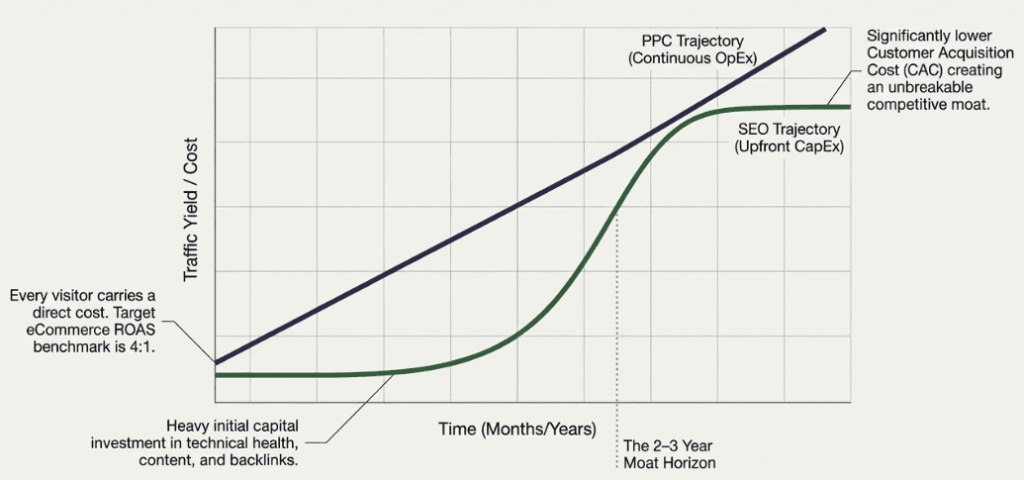
A more useful framing: PPC is a continuous operational expense; SEO is an upfront capital investment.
True Cost of Paid Search
With paid search, every visitor has a direct cost. That cost doesn’t go away. It scales with your traffic goals and typically increases as competition in your category grows.
You also need to factor in the management overhead, whether that’s an in-house specialist, an agency retainer, or your own time. The moment your ad spend stops, your paid traffic stops with it.
Investment Model of SEO
SEO has higher upfront costs that spread across three areas:
- Technical site health: Development resources for site speed, mobile experience, and crawlability.
- Content creation: Product pages, buying guides, and blog content that genuinely help potential customers.
- Authority building: Earning backlinks and building the kind of domain trust that search engine algorithms reward over time.
Once that foundation is in place, the organic traffic generated isn’t tied to a daily budget. It compounds. Each piece of content and each backlink you earn adds to your site’s authority, which generates more traffic, which adds more value, without a proportional increase in spend.
If you want to understand how this authority-building process works in the context of AI-driven search, our guide on eCommerce AI SEO strategies to rank in AI search covers the updated approach in detail.
For ROI modelling, PPC gives you a clear, short-term Return on Ad Spend (ROAS) calculation. SEO’s ROI is harder to measure in the first 6–12 months, but delivers a significantly better cost-per-acquisition over a 2–3 year horizon. Organic search traffic consistently lowers customer acquisition costs for mature brands, creating a competitive moat that’s expensive for new entrants to replicate.
How are AI Overviews Changing the Organic vs PPC Balance in 2026?
This is the biggest shift in the paid and organic search landscape right now, and it’s moving faster than most brands have adapted to.
Impact on Organic Click Share
Google’s AI Overviews (AIO) now appear at the top of a large portion of search results pages, directly answering user queries before organic listings even appear. The impact on organic click share has been severe.
On search results pages featuring AI Overviews, the average organic CTR has dropped by 65% (Dataslayer).
What Brands Need to do Now
- Ranking #1 organically no longer guarantees meaningful traffic volume for informational or top-of-funnel queries.
- PPC has become more essential for capturing high-intent commercial searches where every click counts.
- SEO needs to shift focus toward long-tail, specific queries that AI Overviews are less likely to fully resolve, niche product comparisons, detailed buying guides, and specific use-case content.
- Schema markup has gone from best practice to near-mandatory. Structured data is how you increase your chances of being cited within an AI Overview rather than displaced by it.
Adapting to this shift requires more than just tactical changes. It requires rethinking your full-funnel approach. Our guide on full-funnel marketing strategy for eCommerce walks through how to structure that integration from top to bottom.
In other words, there’s no secret shortcut. The fundamentals are still important.
What is the Right Organic vs PPC Mix for your Business Stage?
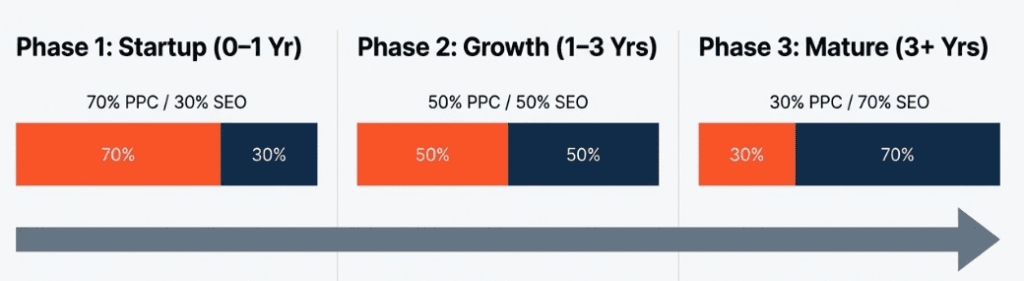
There’s no universal answer, but there are clear patterns by stage of growth. The right channel mix is really just one piece of a broader eCommerce growth strategy, and how you sequence your investments matters as much as the ratio itself.
Startup / Launch Phase (0–1 Year)
Recommended mix: 70% PPC / 30% SEO
At this stage, you need cash flow, validation data, and speed. PPC gives you all three. Run paid search campaigns to test messaging, find your converting keywords, and generate early sales. In parallel, invest that 30% into foundational SEO, technical site health, core product page optimisation, and a basic content plan.
You’re not expecting organic results yet; you’re building the infrastructure that will pay off in year two.
Growth Phase (1–3 Years)
Recommended mix: 50% PPC / 50% SEO
Your organic rankings are starting to build. You have keyword data from your PPC campaigns that tells you exactly which terms convert. Now you feed that data into your SEO content strategy, creating content you know will generate revenue rather than just traffic.
Use paid campaigns more strategically, targeting competitor keywords, running retargeting campaigns for organic visitors who didn’t convert, and testing new markets.
Mature / Enterprise Phase (3+ Years)
Recommended mix: 30% PPC / 70% SEO
By this stage, organic search should be your primary traffic driver. PPC becomes a surgical tool for defending branded terms, promoting major sale events, and targeting the highest-competition commercial keywords that are worth paying for rather than grinding toward organically. Your PPC spend is lower as a percentage, but it’s more precisely deployed.
How to build a Feedback Loop Between Paid and Organic?
The integrated strategy isn’t just about running both channels. It’s about making them inform each other continuously. Integrating paid and organic search into a single system, rather than managing them as separate budget lines, is what drives sustainable growth over the long term.
When you combine paid data with organic insights, the result is a digital marketing strategy that’s more efficient than either channel could be on its own, and more resilient than relying on other marketing channels in isolation.
The feedback loop works in both directions:
PPC informs SEO: Your paid search campaigns generate real conversion data. Paid search data tells you which keywords drive purchases, which ad copy angles resonate, and which product page structures convert. This eliminates the guesswork from your organic content strategy. You’re creating content for terms you already know convert, not terms you hope might.
SEO informs PPC: Your organic content builds an audience of qualified visitors who’ve already engaged with your brand. These visitors are your best retargeting segment. A user who read your detailed buying guide but didn’t purchase is far more likely to convert on a follow-up paid ad than a cold audience. Strong organic traffic makes your paid retargeting campaigns more efficient and lowers your effective cost per acquisition.
Frequently Asked Questions
Should I pause PPC once my SEO starts working?
No. This is one of the most expensive mistakes growing brands make. The moment you pull back on paid campaigns, competitors fill that visibility gap quickly. Instead, get more strategic with your PPC budget. Use it to defend branded keywords, target competitor terms, and retarget organic visitors who didn’t convert. SEO and PPC working together consistently outperform either channel running alone.
How long does organic search take to show results?
Organic search typically takes 6 to 12 months to generate meaningful traffic, though this varies significantly by domain age, competition level, and how aggressively you invest in content and technical SEO. For brand new domains, 12 months is a realistic minimum before you see substantial organic volume.
Does paid search affect organic rankings?
No, running Google PPC ads does not directly influence your organic search rankings. Google’s search algorithm and its advertising system are separate. However, PPC can indirectly benefit SEO by driving traffic that generates engagement signals, and by giving you data that helps you create better-optimised content.
What is a good ROAS benchmark for eCommerce PPC campaigns?
Industry benchmarks vary significantly by category, but a general rule of thumb for eCommerce is a target ROAS of 4:1 (four dollars in revenue for every dollar in ad spend). Mature brands with strong organic presence and high customer lifetime value can be profitable at lower ROAS because PPC is supplementing, not replacing, other acquisition channels.
How does Aureate Labs approach the organic vs PPC strategy for eCommerce brands?
At Aureate Labs, these aren’t treated as competing channels. The process starts with diagnosing your growth stage, acquisition costs, and gaps in paid and organic funnels. From there, an integrated plan is built with clear metrics and proper cross-channel attribution to track what’s truly driving revenue.
Is organic traffic better than paid traffic?
Not categorically. Paid traffic often has higher purchase intent at the moment of click, while organic traffic tends to span a wider range of intent. The better question is: what does your business need right now? Both types of traffic have a role in a healthy eCommerce marketing mix.
Conclusion
The organic vs PPC debate is a false choice. In 2026, with AI Overviews reshaping search results pages and competition rising in most eCommerce categories, neither channel alone is enough.
Paid search gives you speed, precision, and real-time conversion data. Organic search builds the kind of brand authority and sustainable traffic engine that lowers your acquisition costs over time and creates a competitive position that’s hard to replicate. The brands that win are the ones that stop treating these as budget line items in competition with each other and start building the feedback loop between them.
If you’re an eCommerce brand trying to figure out the right balance, whether you’re just launching, scaling, or defending market share, the starting point is always the same: understand your current business stage, get your attribution model right, and make your PPC and SEO teams share the same data.
Ready to build a paid and organic search strategy that actually compounds over time? Talk to the Aureate Labs team about how we’ve helped eCommerce brands reduce their paid dependency while growing organic revenue.
Resources:






Post a Comment
Got a question? Have a feedback? Please feel free to leave your ideas, opinions, and questions in the comments section of our post! ❤️