

How AI Search Works and Why It’s Different from Google Search?

Search is no longer about finding the top pages on Google.
Millions of users now ask AI platforms like ChatGPT, Perplexity, and Claude one direct question and trust the answer they receive.
That single response decides which brands get attention and which brands get ignored.
For example, when someone searches for a vacation destination, they no longer see only blue links. They get destination ideas, itineraries, and estimated budgets in one clear answer from AI that feels like advice from a human expert.
For growing brands, this shift creates a new challenge. Your website may rank on Google, yet your brand may remain invisible inside AI answers that buyers trust.
This is why understanding how AI search works matters today and why it is different from Google search. We’ve broken down the key differences between AI search and SEO in detail if you want to go deeper on that comparison.
AI search does not show links the way Google does. It studies intent, context, and authority signals. And then mentions brands that feel most reliable to the user in one direct answer.
If your brand is not among them, your competitors quietly take your place.
Let’s understand what AI search is and how it is changing the way people search.
What is AI Search?
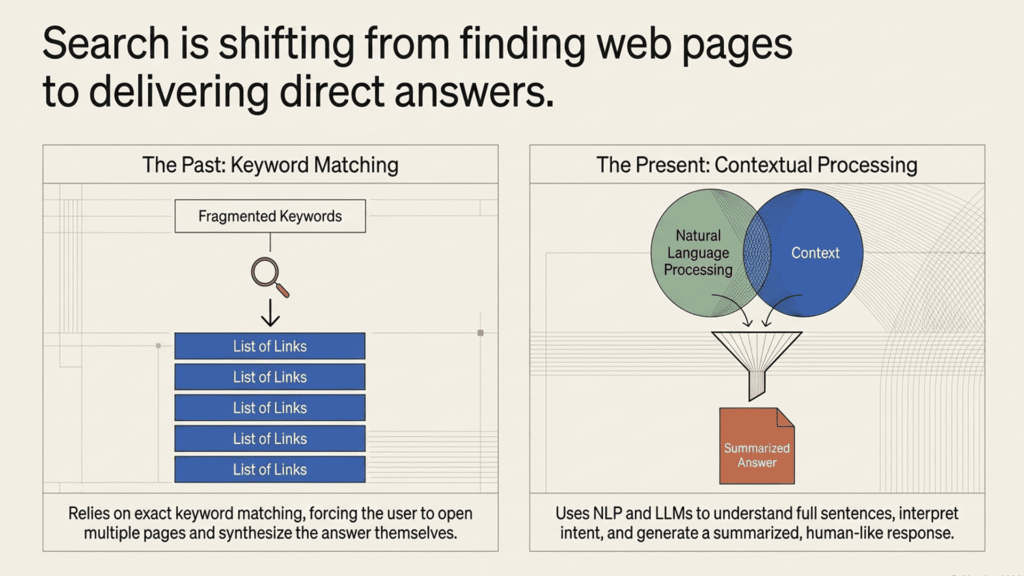
AI search is a modern way of finding information using AI generative models instead of basic keyword matching. It understands language, intent, and context to deliver direct, summarized, human-like answers instead of a list of web links.
Unlike traditional search, AI search can understand full sentences, complex questions, and vague queries without relying on exact keyword matching. This means users no longer need to open multiple pages. They receive one clear answer that often includes explanations, comparisons, or recommendations.
AI search uses technologies like Natural Language Processing (NLP) and Large Language Models (LLMs) to interpret what a user really means and generate summarized responses that feel conversational and clear.
It can also handle follow-up questions, remember context, and personalize results based on user behavior.
Some popular AI search platforms include ChatGPT, Gemini, Perplexity AI, and AI-powered Bing.
Understanding how AI search works makes the shift easier to navigate.
In simple words, how AI search works makes search faster, more personalized, and more helpful by giving users one clear answer instead of many pages to browse.
How AI Search Works?
AI search doesn’t show a page of blue links like Google.
It directly provides a summarized answer that highlights a small group of businesses and explains why they fit the query.
When someone asks an AI tool a question, it does not simply list options. It studies the intent behind the query, scans large volumes of data, and then narrows the results down to a few reliable recommendations.
This happens because Generative AI search looks beyond keywords. It evaluates deeper trust signals such as:
- Intent: What the person is really trying to find
- Context: Location, past searches, and profile-related details
- Conversation flow: Follow-up questions in real time
- Proof points: Reviews, photos, certifications, awards, and other verified business data
For example, when someone searches for “tracking AI mentions tools, Google shows a list of blog posts. However, AI search generates a short list of top recommended tools with a quick summary of what each one does and who it is best for.

Pro Tip: When someone searches in AI, and their brand does not appear, one question comes up: how to rank in AI search so we can also appear there?
Types of AI Search Engines
Here are the main types of AI search engines with examples:
| Type of AI Search Engine | What It Does | Examples |
| Generative AI Search Engines | Create clear answers in natural language | ChatGPT, Perplexity AI, Google Gemini |
| Conversational AI Assistants | Hold real-time conversations | Microsoft Copilot, Meta AI |
| Semantic Search Engines | Understand intent, not just keywords | Bing AI |
| Industry Specific AI Search Engines | Serve specific use cases | Elicit for research, Phind for developers |
| Behaviour-Based AI Search Engines | Adapt answers based on behavior | Brave Search AI |
| Multimodal AI Search Engines | Understand text and images | Google Gemini, Perplexity AI |
| Enterprise AI Search Engines | Search company files and tools | Microsoft Copilot for Search, Elastic Search |
What is the Difference Between AI Search and Google Search
AI search vs Google search serve the same purpose, but they work in very different ways, i.e.;
- Google shows information.
- AI search gives users the information directly.
Here’s the key difference you need to know:
| Google Search | AI Search | |
| Core Purpose | Helps users find websites and information sources | Delivers direct answers and guided recommendations |
| Results Format | List of links, ads, and page snippets | Summarized answers with explanations |
| Query Handling | Works mainly on keywords and short phrases | Understands full questions, intent, and context |
| User Involvement | Requires browsing, reading, and comparing | Minimizes effort by doing the research |
| Output Type | Pages, maps, ads, videos, and listings | Summaries, comparisons, and suggestions |
| Brand Discovery | Based on ranking position | Based on authority, relevance, and trust signals |
| User Experience | Navigation and exploration focused | Conversational and guidance-focused |
| Personalization | Based on cookies and search history | Based on conversation flow and preferences |
| Ads and Noise | High ad presence | Minimal or none |
| Conversation Memory | Does not retain past queries | Remembers and builds on earlier questions |
| Accuracy and Verification | Users verify by visiting sources | May summarize sources, still needs verification |
| Best For | Broad browsing and quick lookups | Research, comparisons, and decision making |
This single shift shows how AI search works in brand discovery, comparing options, and making decisions. Think of it this way: Google is a librarian who points you to the right shelf. AI search is a research assistant that reads the books and writes you a summary.
Why AI Search Matters for Brands?
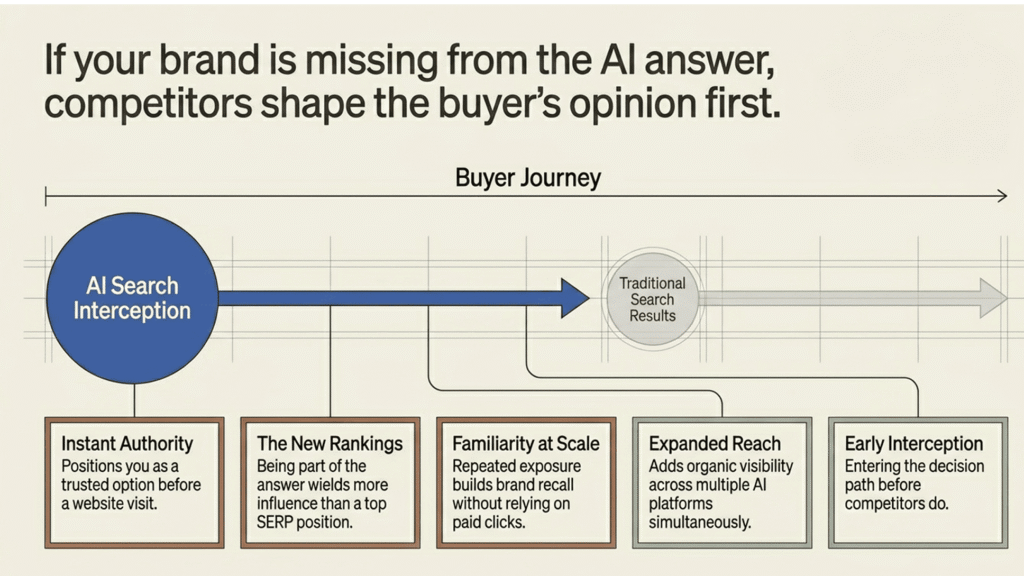
AI search is not just another search feature. It is quietly becoming the first place where buying decisions begin.
People now ask AI tools which product to choose, which company to trust, and which service fits their needs. The answer they receive often becomes their decision.
This means brand visibility is no longer defined only by Google rankings. It is defined by whether AI systems mention your brand inside their answers.
If your brand is not present there, your competitors shape the buyer’s opinion before you even get a click.
Here are five key reasons why AI brand mention matters:
1. AI Mentions Create Instant Authority
When your brand appears inside AI answers, it is positioned as a trusted option before a user ever visits a website. This early credibility shortens the trust-building phase and increases the chances of being chosen.
2. Mentions Are the New Rankings
High rankings no longer guarantee attention if your brand is missing from AI responses. Being part of the answer now delivers stronger influence than holding a top position on a results page.
3. Mentions Build Brand Recall at Scale
Repeated AI exposure builds familiarity without relying on clicks or ads. Over time, this familiarity turns into brand preference and improves conversion readiness.
4. Mentions Expand Organic Reach Beyond Google
AI mentions add a new organic visibility layer that works alongside SEO. This allows your brand to earn attention across multiple AI platforms at once.
5. Mentions Enter the Buyer Journey Early
AI search often becomes the first place buyers seek guidance. When your brand is introduced at this stage, you enter the decision path before competitors do.
However, just knowing that AI mentions matter is only half the work. The real challenge is understanding how your brand actually appears inside AI answers today.
Because analysis can’t be measured with guesses.
Pro Tip: Many businesses are using an AI visibility checker to check their AI visibility scores to ensure that their analysis is not just based on guessing and that it may be possible to rank in AI answers.
That’s where brands use Track My Visibility, a tool to check is theri brand mentions in AI platforms.
You can simply enter your brand website and keywords where you want to appear in AI. Then, the tool starts scanning your brand on major AI tools like ChatGPT, Gemini, Claude, and Perplexity, and shows you where your brand is visible.
This gives you clarity on where you stand today and what you need to improve to earn more AI mentions tomorrow.
Plus, you’ll also get some useful tips to improve your brand visibility.
Latest Market Statistics about AI Search Adoption and Impact
The following statistics explain how AI search works in user behavior and brand discovery:
- Up to 60% of searches now end without users opening any website
- Many publishers have seen traffic drops between 25% to 55% after AI summaries launched
- AI summaries appear in 58% of informational searches but only 17% of commercial searches
- Around 50% of consumers already use AI-powered search for buying decisions
- ChatGPT crossed 400 million monthly active users by early 2025
- Only 12% of users fully trust AI-generated answers.
Pros and Cons of AI Search
Here are the actual Pros and Cons that reveal how AI search works today:
Pros
- Faster Answers: AI search reads thousands of sources and returns a clear answer in seconds. This removes the need to open many pages and speeds up research.
- Better Understanding of Intent: It understands full questions, synonyms, and context, not just keywords. This means results match what people truly want, not just what they typed.
- Personalized Discovery: AI search adapts answers based on location, behavior, and past searches. Over time, it learns what matters to each user and becomes more accurate.
- Decision Support: It compares tools, summarizes reviews, and highlights pros and cons in one place. This helps users make confident decisions faster.
- Cleaner Search Experience: AI search reduces ads and clutter. Users see focused answers instead of sponsored distractions.
Cons
- Loss of Website Traffic: When AI gives direct answers, fewer users click websites. This reduces traffic for publishers, ecommerce stores, and service businesses.
- Risk of Incorrect Answers: AI can sometimes invent details or show outdated information. Important decisions still require manual verification.
- Bias and Low Transparency: AI does not always explain why it chose certain sources. This can create unfair visibility and trust concerns.
- Data Privacy Concerns: AI search collects large volumes of personal data to personalize results. This raises privacy, storage, and misuse risks.
- Changing Visibility Rules: Strong Google rankings no longer guarantee AI visibility. Brands must now optimize for being cited inside AI answers, not just ranked.
How To Stay Visible in Google and AI Search? 6 Ways
Here are six useful ways to stay visible in Google and AI Search:
1. Write for Answers, Not Pages
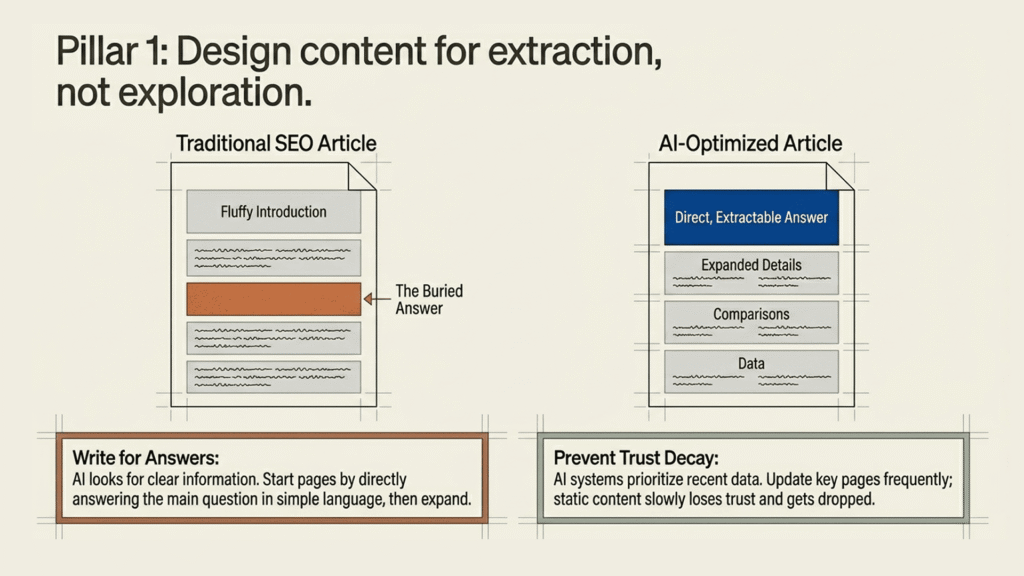
AI does not “read” your blog the way people do. It looks for clear, extractable answers that it can reuse in its own responses. If your content hides the answer in long paragraphs, AI will skip it. Start your pages by directly answering the main question in simple language. Then expand with examples, comparisons, and details. This makes your content safer for AI to trust and quote.
2. Build Real Topical Authority
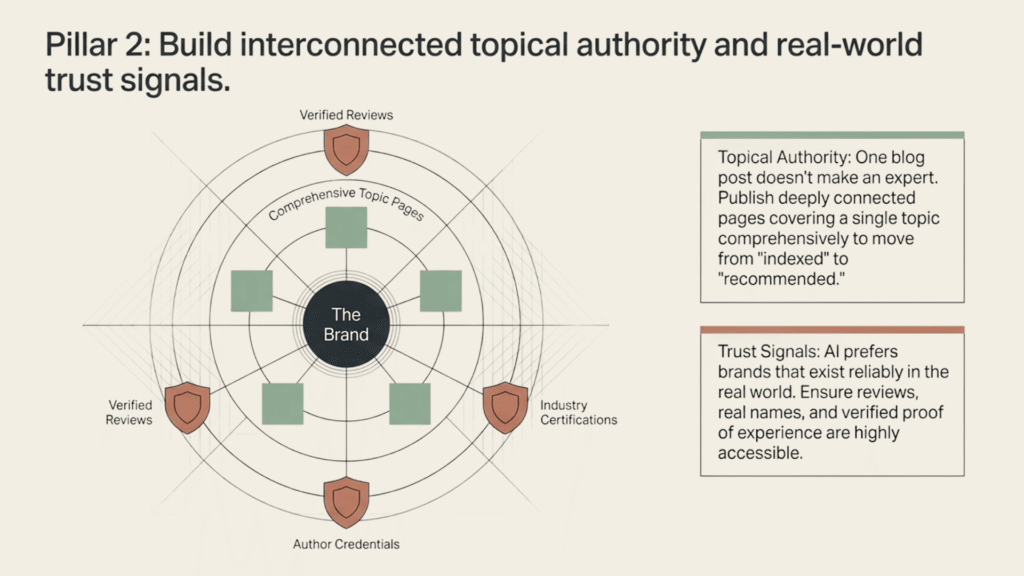
One blog post does not make you an expert in AI’s eyes. AI systems look for patterns across your website. When they see many connected pages covering one topic deeply, your brand becomes a known authority. This increases your chances of being recommended instead of just indexed.
3. Strengthen Trust Signals
AI prefers brands that look reliable in the real world. This means visible reviews, real author names, credentials, company details, and proof of experience. These elements help AI understand that your brand is not just publishing content, but actually delivering value.
4. Keep Your Content Fresh
AI systems prefer recent and reliable information. When your content stays unchanged for a long time, it slowly loses trust, even if it once performed well on Google. Updating key pages with new data, examples, and current insights signals that your brand is active and relevant. This increases your chances of being included in AI answers.
5. Structure Your Site for AI Understanding
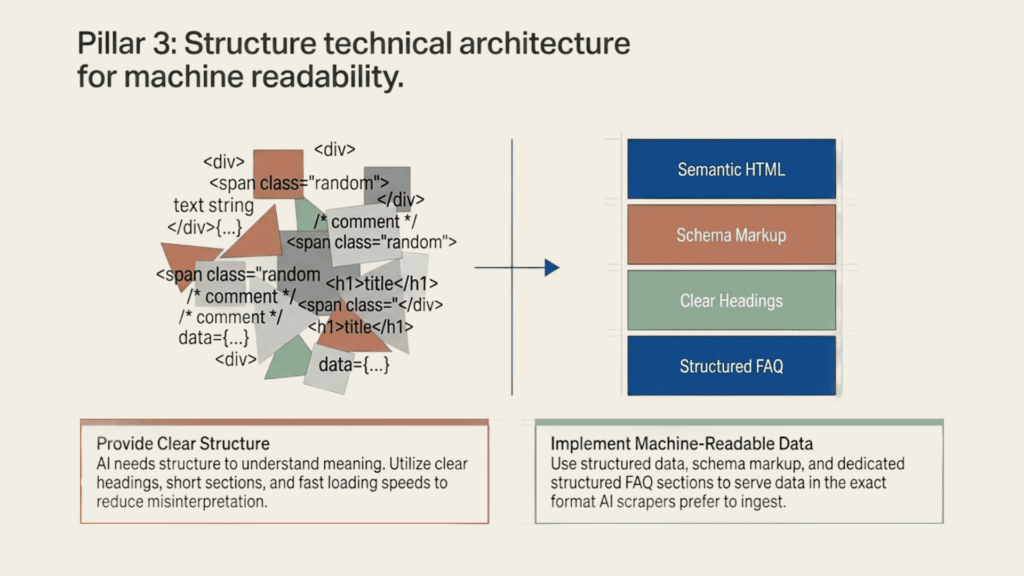
AI needs structure to understand meaning. Clear headings, short sections, schema markup, and fast-loading pages help AI correctly interpret your content. A structured site reduces misinterpretation and increases your chances of being chosen. Use semantic HTML, FAQ sections, and structured data to make your content machine-readable.
6. Track and Improve Your AI Visibility
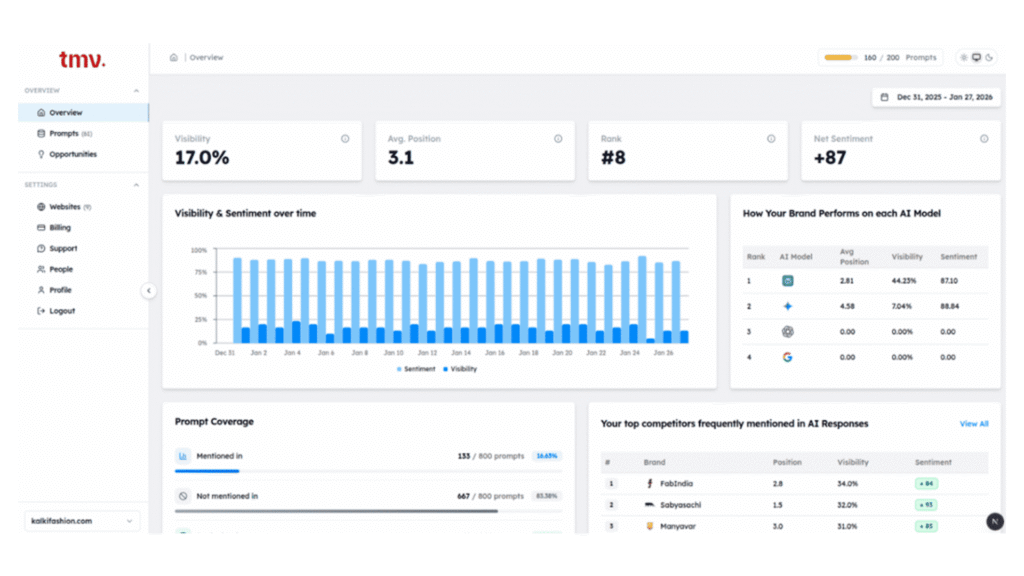
AI visibility is invisible to most brands. Track My Visibility lets you see how your brand appears inside AI answers, what competitors are being recommended, and where you are missing. This gives you real data to improve your AI presence instead of guessing.
Pro Tip: Your real competitors are the brands AI recommends instead of you. Monitoring brand mentions inside AI platforms reveals how your authority is perceived and where trust gaps exist, so your content optimization efforts for AI directly influence real buyer discovery instead of chasing empty rankings.
The Future of AI Search
Search is changing faster than most brands realize. People are moving away from clicking through pages and are starting to trust one clear answer from AI.
This behavior will only grow. AI will soon become the first place people go when they want advice, comparisons, or recommendations.
AI tools will not just give information. They will help people plan trips, compare services, and choose products. Many buying decisions will begin with the AI answers.
For businesses, this changes everything. Visibility will no longer depend only on Google rankings. It will depend on whether AI systems understand and trust your brand enough to mention it.
Conclusion
How AI search works has changed how people discover brands, compare options, and make decisions.
Users no longer browse pages the way they used to. They ask one question and trust the answer they receive. That single answer now shapes which brands feel reliable and which ones get ignored.
This means visibility is no longer defined only by Google rankings. It is defined by whether AI systems understand, trust, and mention your brand inside their answers.
We hope this guide helps you understand how AI search works, how it differs from Google, and why brand mentions in AI shape visibility, demand, and conversions.
If you want to understand how AI tools are talking about your brand today, Track My Visility is built for this new search reality. It shows your AI mentions, competitors, and visibility gaps across major AI platforms in one place.
Brands that adapt to this shift today will not only stay visible. They will become the default choices tomorrow.
FAQs
1. What is AI search?
AI search is a newer way of finding answers online. Instead of making you open ten different websites, it tries to understand what you actually want and then gives you one clear reply. It can also compare options and suggest brands that feel reliable.
2. How is AI search different from Google search?
Google mainly shows you websites. AI search gives you the answer itself. It also explains things in simple words and often points you to the best choices instead of leaving you to figure it out on your own.
3. Will AI search replace Google completely?
No, not fully. Google will still be useful for maps, directions, and detailed research. But for quick learning, comparisons, and decisions, many people are already starting with AI.
4. How does AI search affect brand visibility?
Your brand now needs to show up inside AI answers. Even if your site ranks on Google, you can still be invisible if AI does not mention you. This is why tracking your AI search visibility matters.
5. How can businesses improve their AI search visibility?
By writing clear content, showing real proof like reviews and credentials, keeping pages updated, and building authority in their space. These things help AI trust your brand. You can also learn more about the difference between traditional SEO and AI search optimization.
6. How can I check if my brand appears in AI answers?
You can use Track My Visility to see how AI tools are talking about your brand, which competitors are being shown instead, and what you can improve.






Post a Comment
Got a question? Have a feedback? Please feel free to leave your ideas, opinions, and questions in the comments section of our post! ❤️