

What is AI Search Tracking? A Complete Guide for Brands

Search is no longer only about links and rankings on Google.
People now ask AI platforms like ChatGPT, Gemini, and Perplexity – what to buy, who to trust, and which brands are worth their money.
Unlike traditional search, where blue links appear, AI systems directly give answers and mention brands that feel most reliable to users.
That answer decides which brands get remembered and which brands get ignored.
For brands, the real question is no longer only about Google rankings. It is about how to optimize content for the AI answer, whether your brand appears in AI search and how it is presented.
This is why AI search tracking matters. It helps brands monitor how often their brand is mentioned, cited, and trusted across AI platforms.
If you do not use AI search tracking to track your brand inside AI answers, you risk losing visibility, trust, and pipeline to competitors.
In this guide, you will learn:
- What AI search visibility really means
- How AI search differs from traditional search
- Why AI search tracking now matters more than rankings
- Which metrics define your real AI presence
- Key factors that make content get cited by AI
- How you can track and improve AI discovery
But first, let’s begin with a basic understanding of what AI search visibility is and how it’s different from traditional search.
What is AI Search Visibility?
AI search visibility means how often, where, and in what way your brand appears inside AI-generated answers across platforms like ChatGPT, Gemini, Google AI Overviews, Perplexity, and other answer engines.
Unlike traditional SEO, which focuses on ranking links on a results page, Generative AI SEO focuses on whether your brand becomes part of the answer itself.
When people ask AI tools for recommendations, comparisons, or buying advice, these systems summarize the web and actively choose which brands to mention, cite, and recommend.
Your brand can appear inside AI answers in two ways.
- Mentions – Your brand is named as a relevant option even when no link is shown.
- Citations – Your website is linked as a trusted source used to build the AI answer.
Both signal that your content is reliable, authoritative, and useful enough for AI systems to trust.
In simple words, your visibility in AI search tracking is no longer decided by keyword rankings alone. It is decided by how AI systems understand, trust, and describe your brand.
How Does AI Search Differ from Traditional Search?
Let’s see how AI search works differently from traditional search:
| Traditional Search | AI Search | |
| Core behavior | Matches keywords to web pages and ranks links | Understands intent and context, then generates answers |
| Query style | Short keyword-based searches | Full natural language questions |
| Typical query length | 4 – 5 words | 15 – 25 words |
| Result format | List of blue links | Direct, synthesized answers |
| Brand exposure | The user must click pages to discover brands | Brands are mentioned or cited inside the answer |
| User action | Click, scan, compare multiple pages | Read the answer and take action immediately |
| Decision making | Happens after visiting websites | Happens inside the AI response itself |
| Optimization focus | Keywords, backlinks, technical SEO | Content clarity, authority, trust, and citations |
| Success signals | Rankings, clicks, traffic | Mentions, citations, sentiment, and influence |
| Primary goal | Drive traffic to websites | Deliver the best possible answer to the user |
Why Does AI Search Tracking Matters the Most Now?
Here are the seven key reasons why AI search tracking is now critical for brand growth:
1. Zero Click Discovery Is Now the Default
Most users now get their answers directly from AI tools like ChatGPT, Gemini, and Perplexity without visiting any website.
In fact, around 50-60% of searches end without a click in 2025.
Whether it’s product suggestions, comparisons, or buying advice, users get answers directly from AI. That means discovery, evaluation, and trust are already formed inside the AI response.
If you are not using AI search tracking to track whether your brand appears inside these AI answers, you have no way to know if you are visible when buyers make decisions.
Even strong Google rankings cannot protect your business if your brand is silently missing in AI responses.
2. AI Mentions Build Trust Before the Click
When an AI tool mentions your brand, it feels like a recommendation from an expert.
People trust AI answers. Because they believe the brands mentioned by AI are already verified and reliable. This trust is built even before a user visits your website.
So when your brand appears inside an AI answer, you begin the conversation with trust already on your side. That makes people more likely to remember your brand and choose you over competitors.
But if you are not tracking these mentions, you do not know whether your brand is gaining or losing that early trust.
3. AI Now Shapes Your Brand Narrative
AI tools do not just show top links like Google. They also describe your brand in their own words.
The way ChatGPT, Google AI, or Perplexity talks about your business, your product, and your services directly shapes how people see and trust you.
When your brand is described clearly and positively, it builds credibility. But if an AI answer uses outdated or incorrect information, it can quietly harm your brand image.
That’s why AI search tracking helps you see how your brand is being described and fix anything that is wrong.
4. Early Visibility Compounds Into Long-Term Advantage
Brands that use AI search tracking to build visibility inside AI answers today gain a long term advantage.
AI platforms prefer to reuse brands they already trust. When your brand is mentioned early, it becomes familiar to these systems. Over time, this leads to more mentions, stronger authority, and higher trust.
This creates a compounding effect where your brand slowly becomes the default choice in your category, and competitors find it harder to replace you.
It means AI search tracking protects your long-term position.
5. Competitive Intelligence You Cannot Ignore
AI search tracking shows which competitors are being recommended by AI tools and where they appear.
It helps you see which brands are winning attention, which content is influencing AI answers, and where your brand is losing visibility.
This gives you clear insight into what competitors are doing better and what you need to improve.
Without this data, you are competing blind in AI-driven search.
6. New Metrics Replace Old SEO Signals
Traditional SEO metrics like rankings and traffic are no longer enough to show how buyers actually discover brands.
AI search requires new metrics such as:
- Mention frequency
- Citation coverage
- Sentiment scoring
- Visibility share across prompts
Tracking these KPIs shows how often your brand is being selected by AI, how it is being described, and which competitors are being preferred instead.
They reveal your real market influence, long before traffic or conversions appear.
In simple words, tracking these metrics predicts your future pipeline, not just your current website performance.
6 Key Metrics You Should Be Monitoring in AI Search
These six metrics give you a clear picture of your true visibility inside AI answers:
1. AI Visibility and Impression Share
This metric in AI search tracking tells you how often your brand appears in AI answers like ChatGPT, Gemini, and Perplexity. It tells you whether your content is actually being used by AI systems to form answers, especially in zero-click searches where users never visit websites.
2. Citation Rate
Citation rate measures how often AI systems link to your website as a source. A higher citation rate means AI systems trust your content and use it as a reference, which also brings high intent traffic when users choose to click.
3. Semantic Relevance and Intent Match
This metric tells you whether your content matches what people are really asking. If your content matches the real intent behind their questions, AI tools are more likely to show your brand in answers.
4. Content Accuracy and Factual Consistency
AI tools depend on correct information. If your content has old or wrong details, it can damage your brand trust. Tracking this helps you make sure AI is using accurate and updated information from your website and not spreading incorrect details about your brand.
5. Post-AI User Engagement
When users click through from AI citations, this metric shows the quality of that traffic by tracking how long they stay on your page, whether they convert, and if they leave quickly, helping you understand whether AI-driven visitors are truly valuable for your business.
6. Share of Voice in AI Search
Share of Voice shows how much visibility your brand has inside AI answers compared to competitors. It reveals whether your market presence inside AI platforms is growing or shrinking and highlights where competitors are gaining ground.
Now that you know what to measure, the next step is learning how to track all of this in one place.

Pro Tip: Checking your AI visibility once gives you a snapshot. Checking it consistently gives you a strategy. This guide on how to track AI search visibility over time covers what to monitor, how often, and what changes actually move the needle.
How to Track Visibility Across AI Platforms with TMV? Step-by-Step
Follow these simple steps to begin AI search tracking for your brand visibility across AI platforms:
Step 1: Add Your Website Domain and Sub-domains
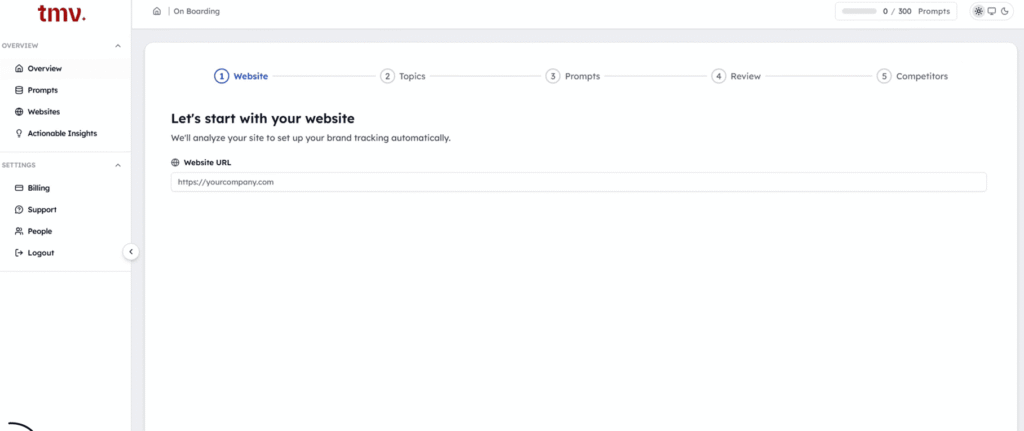
Start by adding your website to Track My Visibility.
Enter your main domain, for example, www.aureatelabs.com.
If your brand also uses subdomains like blog.abc.com, add them here and separate them with commas so the system does not miss any mentions or citations.
This tells the system which sites belong to you and where it should track your AI mentions and citations.
Next, choose the AI platforms you want to track, such as ChatGPT ranking, Claude, Gemini, and Perplexity. You can select one, several, or all four depending on your AI search tracking needs, then click Save.
The AI search tracking system has now connected your brand.
Step 2: Create Prompts that Mimic Real User Questions
Click on Add Prompts. Here, add the real questions people ask AI tools when they search for businesses like yours.
You can add prompts in three ways:
- Write a custom prompt.
Example: Who are the best photo editing tools?
- Generate persona-based prompts.
Select a persona like a startup founder or Marketing manager and generate 20 to 50 realistic questions at once.
- Upload prompts in bulk.
Paste or upload a CSV file if you already have a list of questions.
Click Save.
These prompts become the foundation of your AI search tracking.
Step 3: Run these Prompts Across Multiple AI Models
Once your prompts are ready, run them with one click.
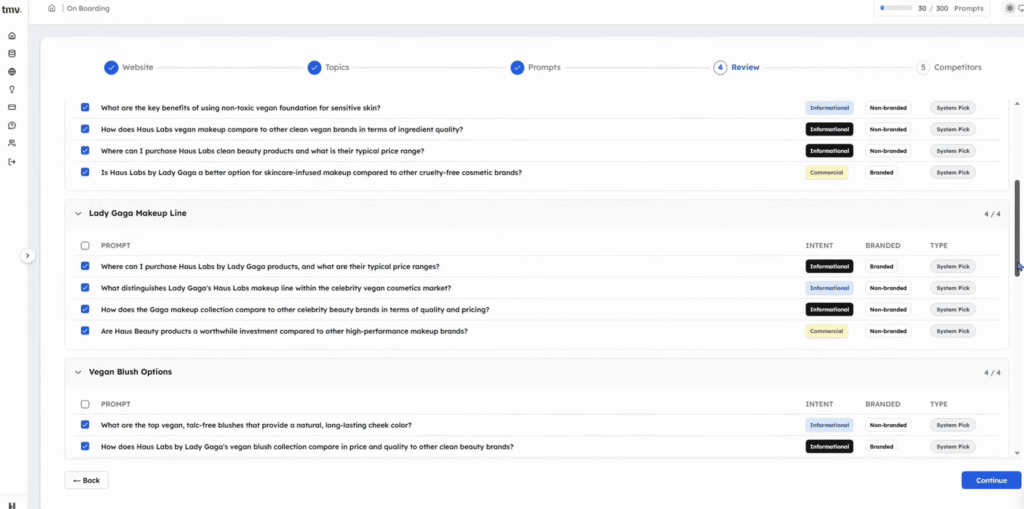
Track My Visibility sends your prompts across different AI platforms at the same time.
This shows how your brand appears on ChatGPT, Gemini, Perplexity, and other AI engines for the same questions.
Within a few minutes, you will see results without testing each platform separately. Use AI search tracking to clearly see where you are visible and where competitors are preferred.
Step 4: Track Brand Mentions and Citations
At this step, you can see where your brand and competitors appear.
Open the responses to view:
- Which of your URLs are cited
- How your brand appears inside AI answers
- Which competitors are shown above or alongside you
This gives you a clear picture of your real AI visibility through AI search tracking.
Step 5: Analyze Performance at Page Level
Go to the Pages section to review how your content performs.
Here you can see:
- How many times each page is cited
- Which pages are trusted by AI models
- Which pages have low or zero citations
- AI readiness scores for every URL
This shows you exactly which pages need improvement.
Step 6: Review Actionable Recommendations
Track My Visibility provides clear recommendations based on your AI visibility tracking. It tells you what to fix, why it matters, and what to prioritize first.
Make the suggested updates on your website.
After updating, click Refresh or Re-score to see if your visibility improves.
Step 7: Track Improvement and Trends Over Time
Open the Overview Dashboard.
Here you can track:
- Overall AI visibility
- Share of voice by AI model
- Top performing pages
- Competitors that AI trusts
- Visibility trends over time
This helps you measure progress and protect your long-term AI visibility with AI search tracking. Knowing your visibility is only half the job. Now, let us look at what helps content get cited by AI.
What Makes Content Get Cited by AI? 5 Key Factors
Here are five key factors that make content cited by AI:
1. Authority and Trust Signals (E-E-A-T signals)
AI tools prefer content from brands that already look trusted on the web. When your website has expert authors, real company details, industry mentions, backlinks, and a stable publishing history, AI systems feel safer using your content as a source. The stronger your brand authority, the higher your chance of being cited in AI answers.
2. Clear Structure and Machine Readability
AI prefers content that is easy to scan and extract. Content that places direct answers at the top, uses clear headings, bullet points, lists, and schema markup makes it simple for AI tools to understand and reuse information. Make your content easy for machines to read to increase the likelihood of it being cited.
3. Original Data and Factual Depth
AI looks for real facts, not surface-level explanations. Use statistics, original research, case studies, and verified data sources to give AI models unique and reliable information. Make your content more factual and original to increase your chances of being referenced.
4. Intent Alignment and Semantic Clarity
AI chooses content that directly answers what people are really asking. When your content matches user intent, uses clear language, and fully explains a topic, AI can confidently pick your page over others. Clear and focused content gets cited more often.
5. Content Freshness and Updates
AI trusts content that stays current. Pages that are updated with new data, recent examples, and visible updates are more likely to be cited. Keeping your content fresh within AI search tracking signals that your information is accurate and reliable.
Conclusion
AI search has changed how brands are discovered.
People now rely on AI answers to decide what to buy and who to trust. Your real visibility is no longer about rankings alone. Focus on whether your brand appears in AI answers and how those answers describe it.
Use AI search tracking to understand where you stand and identify which competitors are being preferred. Then determine what you need to improve to earn more mentions and citations.
We hope this guide helped you understand how AI search visibility works and why AI search tracking matters.
If you want to know exactly how AI tools are talking about your brand today, Track My Visibility is built for this new search reality. It shows your mentions, citations, competitors, and visibility gaps across ChatGPT, Gemini, and Perplexity in one dashboard.
Brands that invest in this visibility today will become the familiar and trusted names tomorrow.
FAQs
1. What does brand visibility in AI Search mean?
Brand visibility in AI Search refers to how often and in what context your brand appears inside AI-generated answers across platforms like ChatGPT, Gemini, Perplexity, and Google AI Overviews. It includes direct mentions, citations, and recommendations. These appearances strongly influence buyer trust and purchase decisions.
2. How is AI Search visibility different from SEO rankings?
SEO rankings focus on where your website appears in a list of links. AI Search visibility focuses on whether your brand becomes part of the AI answer itself. It measures mentions, citations, sentiment, and authority rather than only rankings and clicks.
3. Why is tracking brand visibility in AI Search important now?
AI tools now answer many buying and comparison queries directly, often without users visiting websites. If your brand is not appearing inside those AI answers, you are invisible at the moment decisions are made. Tracking visibility protects discovery, trust, and revenue.
4. Can I track AI visibility in Google Search Console?
Not fully. Google Search Console mainly shows traditional SEO data. AI platforms do not yet clearly report AI answers or AI Mode visibility. You need dedicated AI search tracking tools to monitor mentions, citations, and competitor presence within AI answers.
5. What is the best way to improve my brand’s AI search visibility?
Track your current AI visibility, identify where competitors are being preferred, and optimize your content for authority, structure, factual depth, freshness, and user intent. Track My Visibility helps you monitor and improve all of this in one place.






Post a Comment
Got a question? Have a feedback? Please feel free to leave your ideas, opinions, and questions in the comments section of our post! ❤️