

7 Best Google Ads Agencies for 2026

Google Ads still controls roughly 80% of the global PPC market share heading into 2026. That single number explains why choosing the best Google Ads agencies is a revenue decision, not a branding exercise. For most businesses, this is still the primary paid acquisition channel, and who manages it directly affects what comes back.
The problem with most “top agency” lists is that they rank logos, awards, and partner badges. They don’t tell you how an agency operates once the account is live, the feed breaks, conversion tracking drifts, Performance Max starts blending signals, or your site speed drags down paid efficiency. That’s where bad-fit agency hires happen. Focusing solely on clicks rather than sales is a red flag when selecting a Google Ads agency.
This list evaluates the best Google Ads agencies for 2026 by operating model, ad spend efficiency, and how they actually run campaigns. Some have built serious internal tooling amd some connect media with CRO. Some are easier to buy because pricing is public. And for eCommerce brands, some are more useful because they fix both acquisition and the store experience that turns clicks into sales.
If you’re also reviewing your branded search strategy, this breakdown on the benefits of running search ads for brand keywords is worth reading.
1. Aureate Labs
Aureate Labs is the strongest fit on this list of best Google Ads agencies for eCommerce brands that need more than media buying. If your Google Ads performance is tied to product feed quality, store speed, tracking accuracy, landing page UX, lifecycle follow-up, and platform constraints, this is the kind of partner that solves the whole system instead of managing only the ad account.
Their model is full-funnel and platform-agnostic, covering the full scope of digital marketing, paid ads, SEO, CRO, conversion-led design, content, email, SMS, data tracking, and customer journey consulting, while also building and scaling stores on Magento, Adobe Commerce, Shopify, and headless stacks. That combination is rare.
For D2C teams, it matters because paid media rarely fails in isolation. It usually fails because the site, data, and post-click experience aren’t built to support scale.
Why Aureate Stands Out
Aureate Labs has shipped to 400+ stores, reports up to 1200% sales growth for clients, and maintains a 95% client retention rate. Those numbers matter less as vanity proof than as a signal of operating range. They’re not just running PPC campaigns. They’re working inside the infrastructure that affects campaign economics.
For brands specifically looking for an eCommerce-focused paid media partner, Aureate also offers dedicated Google Ads management and paid media management for eCommerce brands.
If your agency can’t discuss tag governance, platform limitations, landing page performance, and retention flows in the same meeting, it’s probably a channel vendor, not a growth partner.
Their technical depth is a real differentiator. They support Hyvä builds, headless storefronts, performance optimization, migrations, and dedicated Magento and Shopify development. When product pages are slow, event tracking is incomplete, or the checkout experience leaks intent, they can actually fix the problem. Pure-play PPC shops usually can’t.
Best Fit and Trade-offs
This is the best option on this list for growth-focused D2C and B2C brands, especially merchants on Shopify, Magento, Adobe Commerce, or headless setups that need one team across acquire, convert, and retain.
Full-funnel execution is the headline strength. Paid media, SEO, CRO, lifecycle, and technical implementation sit under one roof. The platform capability is genuinely deep, making them a strong fit for brands with real eCommerce complexity, not just campaign complexity.
Their measurement discipline around Tag Manager, event setup, and tracking also supports better optimization decisions. And because they’re platform-neutral, they can recommend the right commerce stack instead of defaulting to one answer.
The main trade-off is buying complexity. Pricing isn’t published, and the scope is custom. Smaller businesses that only need lightweight campaign management may find this more than they need. But if your growth is constrained by both traffic quality and store performance, Aureate Labs is the most complete partner on this list.
2. Tinuiti
Tinuiti is one of the clearer picks for businesses seeking a performance marketing agency that has outgrown standard PPC management and needs an agency built for scale. Their operating model is the point.
They combine paid search, Shopping, retail media, and measurement under one system, which makes them more useful for large eCommerce teams than smaller firms that only optimize campaigns inside Google Ads.
That distinction matters once spend is high enough that channel overlap, attribution gaps, and merchandising calendars start affecting performance. At that stage, a good agency isn’t just adjusting bids. It’s coordinating budget decisions across platforms, feeding cleaner data back into optimization, and giving the internal team a clearer view of what’s driving revenue.
Where Tinuiti Fits Best
Tinuiti fits established retail and D2C brands with enough volume to benefit from structured testing, segmented account builds, and tighter reporting discipline. Their proprietary Bliss Point platform sits at the center of that model. It includes rapid media mix modeling, always-on incrementality testing, creative insights, and forecasting tools. The appeal isn’t the software by itself.
The appeal is having a team that uses it to make media decisions across a broader portfolio instead of treating paid search as an isolated channel. In late 2025, they also launched AdCopy AI, powered by Google Gemini and integrated into Bliss Point, which generates and tests search ad copy at scale.
For teams still dealing with basic execution issues, that level of structure can be premature. This breakdown of common eCommerce PPC mistakes is a useful check before paying for enterprise agency overhead.
Trade-offs
Tinuiti makes the most sense when the internal marketing team needs a strategic operator with process, reporting discipline, and cross-channel coordination.
They’re a strong fit for scaled retail programs where Shopping, Performance Max, search, and retail media need to work together. Their measurement maturity is a real advantage for teams that care about incrementality and budget allocation across channels. The trade-off is a heavier operating model.
Custom pricing, more stakeholders, and a more involved onboarding process can slow things down for smaller accounts. Brands that only want campaign management may pay for strategy depth they won’t fully use.
3. Wpromote
Wpromote earns a spot on any list of the best Google Ads agencies for a specific reason. Its model is built around proprietary software plus agency execution, which puts it in a different category from firms that mainly sell account management hours.
That matters for brands running large budgets across search, Shopping, paid social, and retail media. Once spend scales, the problem is rarely campaign setup alone. It’s budget pacing, anomaly detection, reporting consistency, and catching performance drift before it becomes an expensive quarter. Wpromote’s Polaris IQ platform is built for that kind of operating environment.
It handles real-time monitoring, forecasting, budget allocation, creative evaluation, and benchmarking against peer sets, all connected through cross-channel integration.
In late 2025, Wpromote also acquired Giant Spoon, a Cannes Lions-winning creative agency, to form Wpromote x Giant Spoon. The deal adds brand strategy and experiential creative capability to Wpromote’s performance model, which makes them a broader option than they were a year ago. They also bring strong search marketing and social media marketing capabilities under one roof.
Why Teams Choose Wpromote
Wpromote fits organizations that want tighter controls around performance management. Their value is less about flashy tactics and more about process, monitoring, and decision support across a larger paid media program.
If a brand has channel managers, finance oversight, and leadership asking harder questions about efficiency, that model is useful. The agency isn’t just changing bids. It’s helping the team spot waste faster, pressure-test creative and budget shifts, and keep reporting aligned across stakeholders.
Trade-offs
Wpromote is usually a better fit for brands that already have an internal structure. Teams that can move through approvals, share clean data, and work within a more formal process tend to get more from this type of partner.
Smaller advertisers or founder-led eCommerce teams may find the model heavier than they need, especially if the actual requirement is hands-on testing, landing page iteration, and quick changes inside a narrower account.
On this list, Wpromote earns its place because the agency is clear about how it operates. It’s a strong option for businesses that want a Google Ads partner with real systems behind the service, not just more hands in the ad account.
4. Logical Position
Logical Position earns its place for one practical reason. It makes budgeting easier than most agencies do.
A lot of agency buying friction comes from vague scoping, hidden add-ons, and a sales process that won’t discuss fees until the third call. Logical Position takes a more transparent route with public pricing structures and defined deliverables.
That won’t matter to every brand, but for SMB and mid-market teams trying to forecast spend responsibly, it matters a lot.
Why Transparency Matters Here
Published pricing doesn’t automatically mean better performance. It does mean fewer surprises. Logical Position is a good fit for brands that want packaged PPC management with clear expectations around reporting, tracking, remarketing support, and Google Shopping campaigns.
This is especially useful when internal teams need approval before they buy. A transparent fee model shortens decision cycles and reduces friction between marketing, finance, and leadership. Agencies with public pricing aren’t always the most advanced. They are often the easiest to evaluate honestly.
Best Fit and Limitations
Logical Position works best for businesses that want a predictable engagement model. Their packaged approach suits eCommerce and lead-gen brands that don’t need a highly customized experimentation framework right away.
Budget clarity is the core strength. Their defined scope also works well for teams that want clean deliverables instead of open-ended consulting. For smaller organizations without procurement layers, the accessible buying process removes a real barrier.
The limitations are real. Complex brands may outgrow the package model, and some advanced eCommerce needs may require additional scope beyond what’s included. If your main obstacle is decision friction and you want a Google Ads partner with fewer unknowns, Logical Position is a sensible pick.
5. WebFX
WebFX stands out because it sells Google Ads management as a tech-supported operating model, not just a monthly service package.
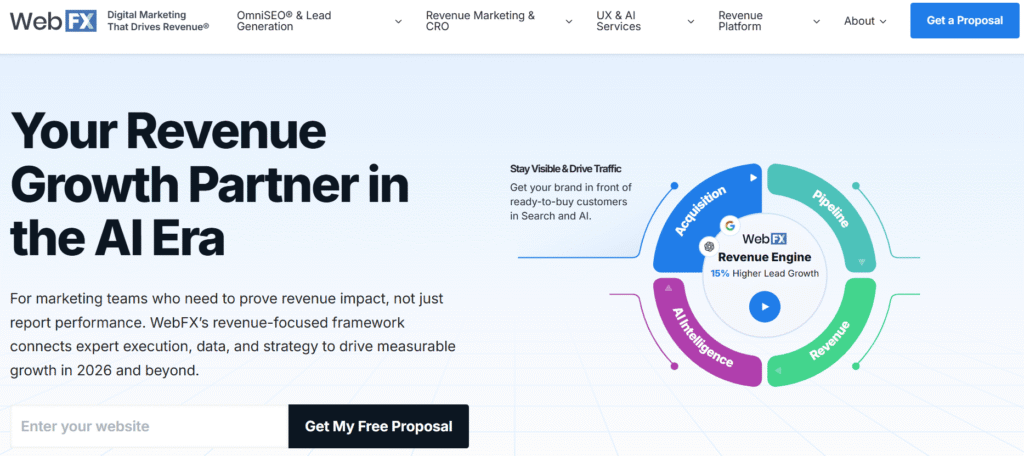
That matters for buyers comparing agencies by how they run accounts. WebFX fits the category of platform-backed performance management. Their flagship platform, RevenueCloudFX, is built to connect marketing activity with downstream business outcomes.
It integrates with your CRM, unifies sales, marketing, and advertising data, and gives teams visibility into revenue outcomes rather than just clicks and conversions.
MarketingCloudFX sits alongside it as a complementary suite handling lead management, call tracking, content analytics, and AI-assisted optimization, backed by over a billion data points.
What WebFX Does Well
For mid-market companies, connecting ad spend to real business data is a meaningful advantage. Google Ads gets harder to manage once multiple channels, sales touchpoints, and offline follow-up start affecting performance. Agencies that work from connected performance data usually make better budget decisions than agencies optimizing inside Google Ads alone.
WebFX is also accessible by design. Published starting prices and audit offers make early evaluation easier, especially for teams that need to compare several agencies quickly. That’s where it differs from firms like KlientBoost, which lead with a CRO-first model, or Tinuiti, which skews toward enterprise scale.
The Practical Trade-off
A structured service model helps with onboarding and consistency, but highly specific funnels can push against that structure. Brands with unusual attribution rules, complex product catalogs, or heavy internal data dependencies should ask detailed questions about implementation depth before signing.
Teams wanting a highly bespoke engagement should also confirm how flexible the account structure really is beyond the entry-level scope.
WebFX is a sensible choice for businesses that want a technology-backed Google Ads partner with enough structure to stay organized and enough data connectivity to support smarter growth decisions.
6. KlientBoost
KlientBoost is the best fit on this list for brands that know the ad account isn’t the only problem. Their operating model tightly links paid media with landing pages, CRO, and aggressive testing. That’s useful because many Google Ads accounts don’t fail on targeting.
They fail on the handoff from click to conversion. That’s where conversion rate optimization becomes as important as the campaign itself.
Their proprietary Kite software continuously monitors accounts, surfaces performance anomalies, and powers their Growth Grid model, which maps where additional budget should be deployed to hit specific KPIs like revenue, ROAS, and pipeline targets. The bigger differentiator, though, is their culture around rapid testing. If your team can move quickly on creative, pages, and approvals, KlientBoost can be a strong partner.
Why KlientBoost Works
Some agencies optimize media and leave the landing experience untouched. KlientBoost doesn’t. That usually leads to better feedback loops because ad insights and conversion insights live closer together. The agency also has a strong educational footprint through their blog and BoostU content, which is useful for in-house teams that want visibility into the method.
Fast-testing agencies only work if your team can approve pages, copy, and offers without bottlenecks.
Watch-outs
KlientBoost isn’t ideal for every organization. Their pace can strain slow-moving teams. If legal review, brand review, or internal sign-off takes too long, the testing advantage shrinks quickly.
If your business is serious about paid traffic and serious about post-click conversion, KlientBoost deserves a close look.
7. Disruptive Advertising
Disruptive Advertising sells accountability hard, and their process is built to support that claim.
Their model starts with diagnosis. That matters because plenty of Google Ads accounts don’t have a media buying problem. They have an offer problem, a tracking problem, a landing page problem, or they’ve never done proper keyword research to validate demand in the first place.
Disruptive’s audit-first approach is useful for companies that want that sorted early, before months of budget get spent treating symptoms instead of the actual bottleneck.
They also operate beyond paid search. Search, paid social, CRO, and lifecycle support sit closer together in their service mix, which puts them in a different category than agencies that only tune campaigns inside Google Ads.
Aureate Labs is the stronger fit for eCommerce brands that need technical execution tied tightly to revenue, but Disruptive is a credible option for businesses that want one partner managing a broader performance program.
Where Disruptive Fits
Disruptive fits best with brands that want clear performance conversations from the start and are willing to be examined closely. Their structure tends to work well for teams that want an outside partner to pressure-test the funnel, not just report on CPC and ROAS.
The Trade-off
This is usually not the best fit for a company looking for a lightweight vendor relationship. Disruptive makes more sense when there’s enough budget, enough funnel complexity, and enough internal buy-in to support ongoing testing and cross-channel coordination.
The guarantee angle also needs a careful read. It can help frame expectations, but it should never replace questions about attribution, scope, decision rights, and what happens when performance stalls. If you want an agency that starts with diagnosis and builds toward sustained revenue growth, Disruptive is worth a conversation.
From Shortlist to Partnership
The best Google Ads agencies and top Google Ads agencies generally aren’t the ones with the most recognizable names. It’s the one whose operating model fits your business, your team, and the constraints behind performance.
For large retail or multi-channel programs, Tinuiti and Wpromote are built for governance, measurement, and scale. When simplicity in purchasing matters, Logical Position and WebFX offer more transparent commercial structures. Where conversion is the primary bottleneck rather than traffic volume, KlientBoost and Disruptive Advertising go deeper into CRO and full-funnel performance.
For eCommerce brands, the decision should go beyond media management. Ask how the agency handles feed quality, event tracking, site speed, checkout friction, and lifecycle follow-up. Ask who fixes the technical issues that undermine paid efficiency, and how they use Google Analytics to track what’s actually working. Those questions separate ad operators from growth partners.
That’s where Aureate Labs stands out. They combine paid acquisition, CRO, lifecycle retention, web design, and deep Shopify and Magento development under one roof. For D2C and B2C brands where the store experience and the ad account are tightly connected, that’s the kind of partner worth talking to first.
FAQs
How do I choose the best Google Ads Agencies?
Look beyond credentials and focus on track record and results. Select agencies certified by Google as ‘Google Partner’ or ‘Premier Partner’ for high performance. The right agency should offer transparent reporting, handle landing page optimization alongside campaign management, and integrate paid search with your broader digital advertising efforts. Ask how they reduce wasted ad spend and whether their marketing services extend across content marketing, shopping ads, and cross-channel integration.
How much does Google Ads Agency charge?
Pricing varies based on scope and ad spend. Most agencies charge a flat monthly fee or a percentage of your Google Ads budget, typically between 10-20%. Larger programs involving Google Shopping, Google search, and cross-channel integration will cost more than basic PPC management. Always ask for transparent reporting so you know exactly what you’re paying for.
Should I have my own Google Ads account?
Yes. Maintain administrative ownership of your Google Ads account for data portability and visibility into agency work. If you’re running complex Google Ads campaigns across multiple channels, an experienced agency brings the tools and expertise that most in-house teams can’t easily replicate.






Post a Comment
Got a question? Have a feedback? Please feel free to leave your ideas, opinions, and questions in the comments section of our post! ❤️