

Optimize Your Google Adwords PPC Cost for D2C Growth

You open Google Ads in the morning and see one campaign eating budget, another barely serving, and revenue that doesn’t line up with spend. Search terms look mixed. Shopping is pulling volume, but branded search is masking whether prospecting is actually profitable.
That’s a normal D2C situation, and the fix isn’t guessing at bids.
Understanding Google Ads pricing means understanding that every click is priced dynamically, not listed on a rate card. Understanding Google Ads pricing means understanding that every click is priced dynamically, not listed on a rate card. If you’ve been wondering whether paid search is even the right channel to prioritize, that’s worth settling first.
Google’s advertising business generated $238 billion in 2023, accounting for $238 billion of Alphabet’s $307.4 billion in total revenue, which suggests this is still where high-intent demand is captured at scale (Statista).
Controlling your Google AdWords PPC cost starts when you stop asking ‘What does Google Ads cost?’ and start asking ‘What does a profitable customer cost to acquire, and which levers change that?’
Key Takeaways (TL;DR)
- Google Ads runs on a live auction, not a fixed rate card. Your CPC varies based on Quality Score, competitor bids, landing page relevance, and the cleanliness of your conversion data.
- The average CPC for eCommerce non-brand search runs $3 to $4. A lower CPC doesn’t mean lower acquisition cost; what matters is your margin after the conversion, not the click price.
- Smart Bidding needs at least 30 conversions per month to optimize properly. Underfunding the account doesn’t save money; it starves the algorithm and keeps you stuck in testing mode.
- Your real Google Ads budget includes more than media spend. Management fees, feed work, landing page optimization, and measurement setup all affect your true cost of acquisition.
- Measure customers, not sessions. Connecting acquisition cost to lifetime value is what separates D2C brands that scale profitably from those that just buy traffic.
Why Is My Google Ads Spend So Unpredictable
Most D2C teams don’t have a spend problem. They have a modeling problem.
A campaign can look expensive one day and efficient the next because Google Ads doesn’t charge a flat rate; it prices every click inside a competitive auction, and the variables shift constantly. Search demand changes. Competitors enter and leave auctions. Product margins vary by category. Even a weaker landing page can raise what you end up paying.
If you’re looking for a rough idea of what you should be spending, industry benchmarks can help set expectations, but they only become meaningful once you map them to your own margin, repeat purchase behavior, and conversion path.
Cost volatility usually comes from a few controllable issues. Teams blend intent levels, treating brand, non-brand, competitor, Shopping, and remarketing as one spend bucket. They scale before measurement is clean, which causes Smart Bidding to make expensive decisions on bad data. They send paid traffic to slow or mismatched pages. And they optimize for lower CPC instead of profitable revenue, which is not the same thing.
A volatile account usually isn’t random. It’s reacting to signals you’re feeding it. This is also why PPC services matter beyond just setting bids and walking away.
How the Google Ads Auction Actually Works
Google Ads works like a silent auction with a quality filter on top. The highest bid doesn’t automatically win. Google also weighs whether your ad is relevant and whether the landing page delivers a good experience.
This matters because it changes the economics entirely. If your product feed is clean, your ad copy matches intent, and your product detail page is fast and relevant, you can hold strong positions in search results without simply outbidding everyone.
What Decides Who Shows
Google calculates Ad Rank for each eligible Ad. Three inputs matter most in daily account management:
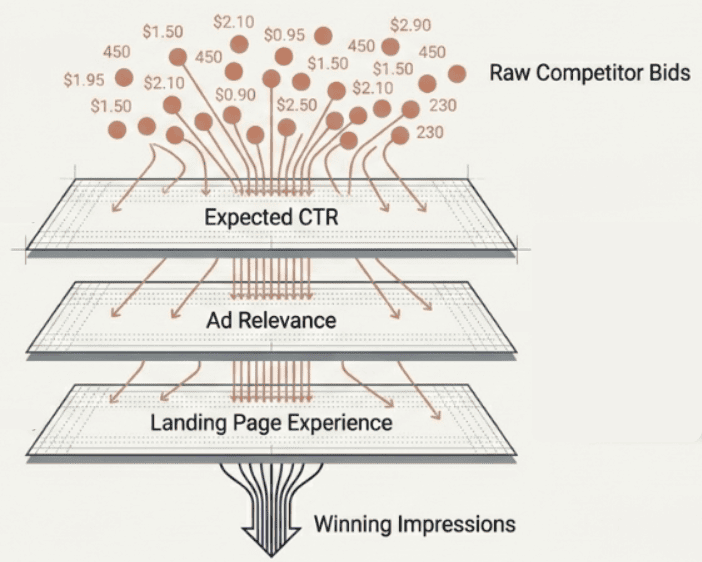
- Expected Click-through Rate: Google evaluates how likely people searching for your product are to click your ad based on historical data. A strong expected click-through rate signals relevance and lowers what you pay.
- Ad Relevance: Your keyword, ad copy, and landing page need to align with each other.
- Landing Page Experience: Google wants the click to land somewhere useful, fast, and consistent with the query.
If someone searches for a specific product and your ad lands them on a generic homepage, you’re making the auction harder on yourself. The same query landing on a fast, relevant product page improves your economics.
What you Actually Pay Per Click
Your actual CPC is not your max bid. The actual amount you’re charged is calculated as: (Ad Rank of the advertiser immediately below you / Your Quality Score) + $0.01. That’s why advertisers with stronger Quality Scores can hold higher positions at lower costs.
| Auction factor | What weakens it | What improves it |
| Bid competitiveness | Arbitrary caps with no intent segmentation | Bids aligned to margin and funnel stage |
| Quality Score | Generic ads and mismatched landing pages | Tight ad groups, relevant copy, strong UX |
| Position efficiency | Paying to brute-force rank | Earning rank through relevance |
If your first instinct is always “raise bids,” you’re usually paying to compensate for a relevance problem.

Pro Tip: Before raising your bids, check your Quality Score in the Keywords tab. If it’s below 7, you’re likely paying a premium on every click. Fix the landing page relevance first; it’ll drop your CPC faster than any bid change will. If your landing pages are slow or mismatched, this breakdown of eCommerce website performance shows exactly where to start.
5 Key Drivers of Your PPC Cost
Once you understand the auction, the next question is straightforward. What pushes your cost up or down before Google even calculates your actual CPC?
For D2C brands, five drivers shape most of the spend volatility.
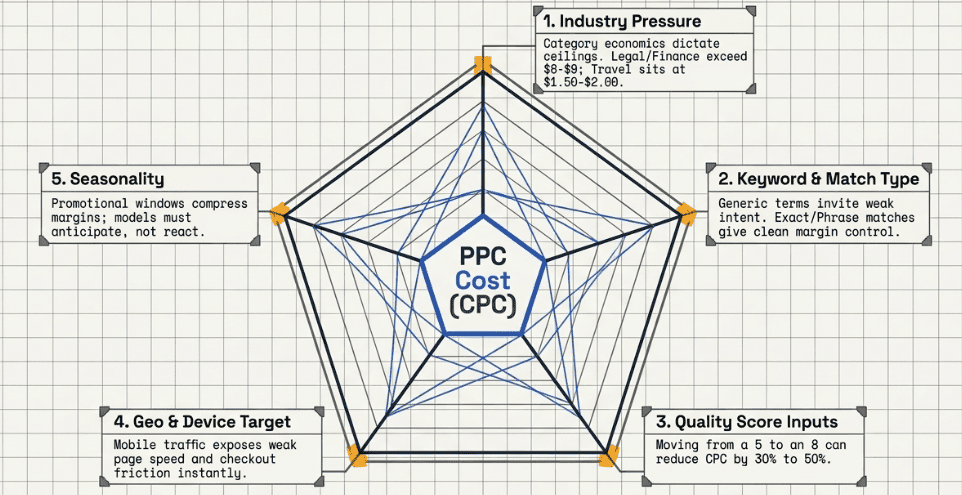
1. Industry and Competitive Pressure
Some categories attract more bidders because each customer is worth more over time. A beauty brand, home goods retailer, and specialty electronics store can all run solid Google Ads campaigns but face very different cost ceilings.
Highly competitive keywords in categories like insurance, finance, and professional services can cost significantly more per click than the same-intent queries in less-saturated markets. If your category has aggressive resellers, marketplaces, and established competitors, CPC pressure rises quickly.
2. Keyword Strategy and Match Type
Keyword choice is where many accounts leak budget. Generic terms invite weaker intent and broader competition. Long-tail terms tend to narrow traffic and align better with product pages, and in categories with fewer competitors, they can be significantly cheaper too.
Use match types strategically. Broad match can work when measurement is strong, and negatives are maintained. Phrase and exact match give cleaner control when the margin is tight. Relevant keywords that align tightly with your product and audience consistently outperform broad, vague terms.
If you want to understand where most accounts go wrong at this stage, our breakdown of common eCommerce PPC mistakes covers the patterns we see most often.
3. Quality Score Inputs
Quality Score isn’t just a reporting metric. It affects what you pay at every auction. Ad copy that mirrors the query, a landing page that matches the promise, and a clean mobile experience all push your costs down. If your ad says “organic cotton baby onesies” but the click lands on a slow all-products page, you’ve created friction at exactly the wrong moment.
High quality ads, ones that match search intent, load fast, and deliver on their promise, aren’t just good for users. They’re cheaper to run.
4. Geo and Device Targeting
The same keyword can behave very differently by market and device. Geographic targeting reveals this quickly: urban markets often have heavier competition and higher CPCs, while less-contested regions offer better efficiency.
Traffic from mobile devices can drive high volume but also exposes weak page speed and checkout friction faster than desktop does. Treating “one campaign for all locations and devices” as a neutral setup rarely is.
5. Timing and Seasonality
Promotional periods, gift windows, product launches, and consumer trends all change auction pressure. Most businesses underestimate how dramatically seasonal demand shifts their cost structure. If you sell products with strong seasonal demand, your model needs to anticipate more expensive periods rather than react after the margin has already been compressed.
What Should eCommerce Brands Expect to Pay?
Benchmarking matters, but only if you use it as a range, not a verdict.
The average Google Ads CPC across all industries in 2024 was $4.66 (Wordstream). For eCommerce and retail on the Google Search Network, non-brand search typically runs $3 to $4 per click, with Shopping campaigns often coming in cheaper. Display Network campaigns generally run at much lower CPCs but also convert at lower rates, so they serve a different purpose in the funnel.
Travel-related commerce sits around $1.50 to $2.00. Legal services remain among the most expensive verticals, often exceeding $8 to $9 per click.
These are directional starting points. Your actual CPC depends heavily on how well your account is structured, how competitive your product category is, and how relevant your ads and landing pages are.
How to Interpret These Numbers
A lower average cost per click does not automatically mean lower acquisition cost. A lower-priced click can still convert poorly if the search intent is weak or the landing page doesn’t close the sale.
Category economics matter more than averages alone. Lower AOV categories need tighter query control and stronger conversion rates. Higher repeat-purchase categories can tolerate higher front-end acquisition costs. High-consideration products often need remarketing and lifecycle follow-up before revenue shows up cleanly in reporting.
The benchmark is a reference point. Your margin structure decides whether that click is cheap or expensive.
How to Set a Realistic Google Ads Budget
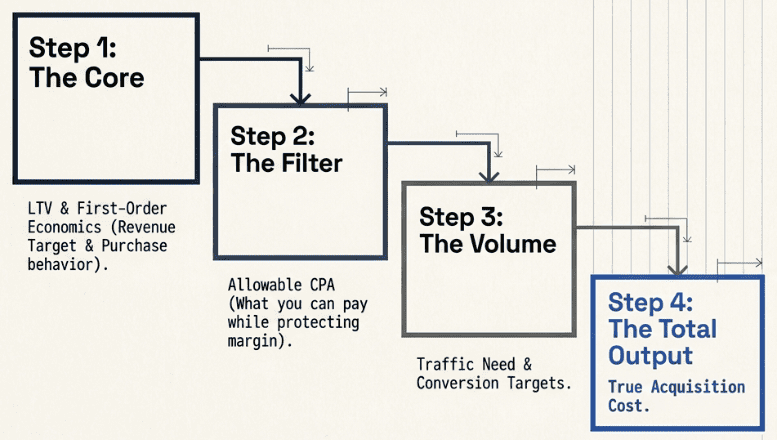
A budget should come from unit economics, not from what feels reasonable in a planning meeting. Understanding how Google Ads determines the right investment for your business starts with what a customer is actually worth to you, not with a competitor’s number or a platform default.
1. Start with What a Customer Is Worth
For D2C, budget planning should begin with four inputs:
- Average first-order economics: Know what a first purchase contributes after product cost, shipping, discounts, and payment fees.
- Repeat purchase behavior: If buyers reorder or subscribe, your allowable acquisition cost can expand. Building customer lifecycle value into your model changes what you can afford to spend up front.
- Target acquisition ceiling: Decide what you can afford to pay to acquire a customer without creating a cash-flow problem.
- Campaign role: Search, Shopping, and remarketing do different jobs. Don’t force a single CPA target across every campaign type.
2. Build the Budget Backward
| Planning input | Question to answer |
| Revenue target | What can you pay and still protect the margin? |
| Conversion target | How many first purchases does that require? |
| Allowable CPA | What can you pay and still protect margin? |
| Traffic need | How many clicks are required to generate that many purchases? |
| Monthly budget | What spend level gives enough data to optimize? |
3. Minimum Viable Budget
Understanding how much Google AdWords PPC costs at a minimum to work properly matters before you start. Budgets under $1,000 per month in monthly ad spend often fail for D2C brands. Smart Bidding needs at least 30 conversions per month for Maximize Conversions strategies to work properly, and 50 conversions per month for Target ROAS.
If your budget can’t generate that volume, the algorithm is working with incomplete data and making expensive guesses.
A user mentioned on Reddit, running three Performance Max campaigns for an industrial eCommerce brand with a 900% minimum ROAS requirement, but was only spending $418 of their $1,710 daily budget. With an AOV of $320 and frequent bulk orders above $5,000, they suspected the high ROAS floor was limiting spend and growth.
Their instinct was right: an overly aggressive ROAS target doesn’t protect margin, it just starves Smart Bidding of the data it needs to find profitable volume.
Scaling Google Ads while balancing client ROAS expectations. Am I on the right track?
by u/Fickle-Courage-9223 in googleads
Note that Google enforces a monthly spending limit equal to your average daily budget multiplied by 30.4, so daily average budgets set too low can stall campaigns before they ever learn. It also means Google may spend slightly more on high-traffic days, making it important to set your daily budget with your true monthly marketing budget in mind.
That doesn’t mean every brand must scale aggressively from day one. It means underspending creates a different risk: the account never gathers enough signal, pacing becomes uneven, and automation works against you instead of for you.
4. Account for the Hidden Costs
Ad spend is only one line item. Real acquisition cost also includes agencies’ charge for management (typically 10–20% of monthly spend), creative and feed work for Shopping and Performance Max, landing page optimization so the traffic can convert, and measurement setup so Smart Bidding uses trustworthy conversion data.
Other factors like attribution gaps, delayed conversion windows, and creative fatigue also affect your true cost of acquisition, and they don’t show up in the campaigns tab. Current trends like rising CPCs across most categories and fewer people converting on first touch make this kind of full-cost thinking even more important.
Campaign spending limits that only account for media often leave brands surprised when blended CAC comes in higher than expected.
If your budget only covers clicks, it’s not a full Google Ads budget.
Practical Strategies to Reduce Your Google Ads Cost
The most reliable way to lower PPC costs isn’t finding a secret bid trick. It’s improving the inputs Google uses to price your traffic. A well-run PPC campaign doesn’t just spend less; it earns lower costs through relevance.
1. Push Quality Score Up Before Pushing Bids Up
This is the most impactful action in most D2C accounts. Moving Quality Score from 5 to 8 or higher can reduce CPC by 30 to 50%, depending on your category and competition level (eXaalgia). For eCommerce brands, the biggest gains usually come from landing page speed, message match between ad and page, and feed quality for Shopping and Performance Max.
If you’re trying to lower CAC sustainably, these are the same levers that help conversion rate, too. They compound.
2. Tighten Keyword and Audience Control
Bad traffic is expensive even when CPC looks low. To avoid wasting budget on unqualified clicks, three habits consistently help.
Aggressive negative keywords keep spending away from irrelevant informational traffic. An intent-based campaign structure separates branded, non-branded, competitor, Shopping, and remarketing into distinct buckets with distinct goals. Audience layering helps you value the same query differently based on shopper context.
Reviewing competitors’ ads periodically also helps you understand where you’re losing impressions and why. The Auction Insights report can show you exactly which competitors are entering your auctions and with what frequency. A broad generic keyword can still have a role, but only if you watch search terms closely and route traffic to pages that can absorb exploratory intent.
3. Give Smart Bidding Clean Data
Automation is powerful when conversion tracking is accurate. It’s expensive when it isn’t. Use Google Tag Manager, validate purchase events, reconcile platform numbers against your store backend, and make sure the account optimizes toward the action that actually matters.
Paid search rewards clean data more than almost any other channel. The average number of conversions flowing into your campaigns each month directly affects how well Smart Bidding can optimize.
| Optimization area | What good looks like |
| Conversion tracking | Purchase values and counts match backend data |
| Campaign segmentation | Different intent buckets are not blended |
| Bid strategy | Matches campaign maturity and conversion volume |
| Landing pages | Fast, relevant, mobile-friendly |
Don’t ask Smart Bidding to solve a measurement problem. It will automate the error at scale.
Measuring True ROI Beyond Cost Per Click
CPC is useful, but it’s not the scorecard.
A lower click cost can produce worse economics if those visitors buy once, return products, or never repurchase. D2C brands win when they connect acquisition cost to customer lifetime value, not just first-session efficiency.
This changes how you evaluate advertising campaigns entirely. Brand search may look brilliant on last-click reporting, while prospecting appears weaker, but prospecting may be the campaign creating net-new customers who later return through email, SMS, and direct traffic. If you optimize only for the cheapest visible click, you’ll gradually underinvest in the campaigns that grow the customer file.
Even small businesses spend enough on Google Ads to make proper attribution worth the effort. Whether you’re a small business owner running a lean operation or scaling a funded D2C brand, the difference between optimizing for first-click and lifetime value can shift your whole budget allocation.
Measure the Customer, Not Just the Session
A stronger ROI model tracks new-customer acquisition cost, first-order contribution margin, repeat purchase behavior, revenue by campaign type over time, and assisted impact across paid, email, and organic channels. This is where digital marketing accountability actually lives.
You also need a tracking setup that the media team actually trusts. Server-side tracking, clean Google Tag Manager implementation, and disciplined analytics review matter because they shape every bidding decision and every budget conversation. A budget report that only shows sessions and revenue without attribution context is missing most of the story.
If your reporting layer is messy, profitable growth looks random when it isn’t.
The best way to think about Google Ads PPC cost is simple: it’s not what you pay for traffic. It’s what you invest in to acquire qualified leads and customers who generate profitable revenue over time.
Conclusion
You came here looking for clarity on Google AdWords PPC cost, the same question most D2C teams wrestle with every morning when they open their accounts and see spend that doesn’t line up with results. The answer hasn’t changed: Google Ads isn’t expensive because the platform is broken. It’s expensive when the inputs are wrong.
Clean measurement, tight campaign structure, relevant landing pages, and a budget built from unit economics; those four things do more than any bid adjustment ever will. D2C brands that win on Google aren’t outspending their competitors. They’re outbuilding them.
The next step isn’t a bigger budget. It’s knowing exactly where your current one is leaking.
Aureate Labs works with D2C brands to build Google Ads programs that connect click cost to contribution margin, from account structure and feed optimization to tracking setup and landing page performance.
If you want to see where your current spend is working and where it isn’t, request a free Google Ads audit from Aureate Labs and walk away with a prioritized list of leaks and the exact order to fix them.
Because the brands growing profitably on Google aren’t the ones spending the most. They’re the ones measuring the right things.
FAQs
How to optimize PPC ads?
Start with the inputs Google uses to price your traffic: improve Quality Score through better ad-to-landing-page relevance, tighten keyword match types, add aggressive negative keywords, and make sure Smart Bidding is optimizing toward actual purchase events with clean conversion data. Lowering CPC through relevance consistently outperforms simply adjusting bids.
How much does PPC cost on Google?
For eCommerce and retail, non-brand search on Google typically runs $3 to $4 per click in 2024-25. The overall platform average across all industries was $4.66. Your actual cost depends on your category’s competition level, your Quality Score, and how well your ads match the intent of the query. Legal, finance, and insurance verticals can exceed $8 to $9 per click.
Is $500 a month enough for Google Ads?
For most D2C brands, $500 a month is below the minimum viable threshold. Smart Bidding needs at least 30 conversions per month to optimize properly, and $500 rarely generates that volume in competitive eCommerce categories. At that budget, the algorithm works with incomplete data, and the account struggles to learn. A budget of $1,000 or more per month gives campaigns a realistic chance to gather signal and improve.
Is $10 a day enough for Google Ads?
$10 a day ($300 per month) will generate impressions, but it’s unlikely to produce meaningful results for most eCommerce brands. At that daily spend level, campaigns frequently hit budget caps early in the day, miss high-traffic windows, and never accumulate enough conversion data for Smart Bidding to function. It can work for very niche products with low competition and high conversion rates, but it’s the exception rather than the rule.
Resources:






Post a Comment
Got a question? Have a feedback? Please feel free to leave your ideas, opinions, and questions in the comments section of our post! ❤️