

Mastering PPC Advertising Campaign Management for eCommerce

Global search ad spending is projected to hit $218.3 billion in 2026, and the returns justify it: businesses earn an average of $2 for every $1 spent on PPC, rising to $8 per $1 when focused on the Google Search Network specifically (PPC Chief). The money is clearly there.
But those are average numbers.
The brands that take PPC advertising campaign management seriously are seeing strong returns. The median Google Ads ROAS across eCommerce sits at 3.68x (Triple Whale), and well-optimized campaigns regularly beat that by a wide margin. Everyone else is funding their success.
This guide breaks down the exact framework we use at Aureate Labs, built from managing multi-million dollar ad budgets and learning from the eCommerce PPC mistakes that cost brands the most.
In this guide, you’ll learn:
- How to build a strategic foundation before touching a single campaign setting
- How to choose the right PPC platform based on your actual business goals
- How to structure campaigns on Google, Meta, and beyond for maximum performance
- How to align your ad creative and landing pages to improve conversions
- How to measure what actually matters and prove PPC value to stakeholders
Key Takeaways (TL;DR)
- PPC advertising campaign management today is about building a full-funnel growth system, not just bidding on keywords.
- Your campaigns perform as well as the data you feed them. First-party signals and value rules give the algorithm real direction.
- Platform choice should follow your business objective. Google captures demand. Meta and TikTok create it.
- The message match between your ad copy and landing page directly affects your quality score and conversion rate.
- Blended ROAS across all channels, not individual campaign ROAS, is the metric that tells you whether your paid media program is actually healthy.
What Has Changed About PPC Advertising Campaign Management?
PPC used to be simple. Pick keywords, write ads, set a bid, and watch the clicks come in. But that model is gone.
Why Clicks and CTR Are No Longer Enough
Keywords are the backbone of any successful search ad campaign. But they’re one input into a much larger system now. A campaign with a 10% CTR that attracts bargain hunters who never return is worth less than one with a 2% CTR that consistently brings in high-value buyers.
The shift happened because eCommerce data got richer. You can now measure not just who clicked, but who bought, how much they spent, and what they were worth over 12 months. Once you can measure all of that, optimizing for clicks alone starts to look like a poor use of your budget. Pay-per-click advertising was never really about the click; it was always about what happened after.
What a Full-Funnel PPC Strategy Actually Looks Like
A full-funnel approach means running intentional campaigns at every stage of the customer journey, not just at the bottom, where someone is ready to buy.
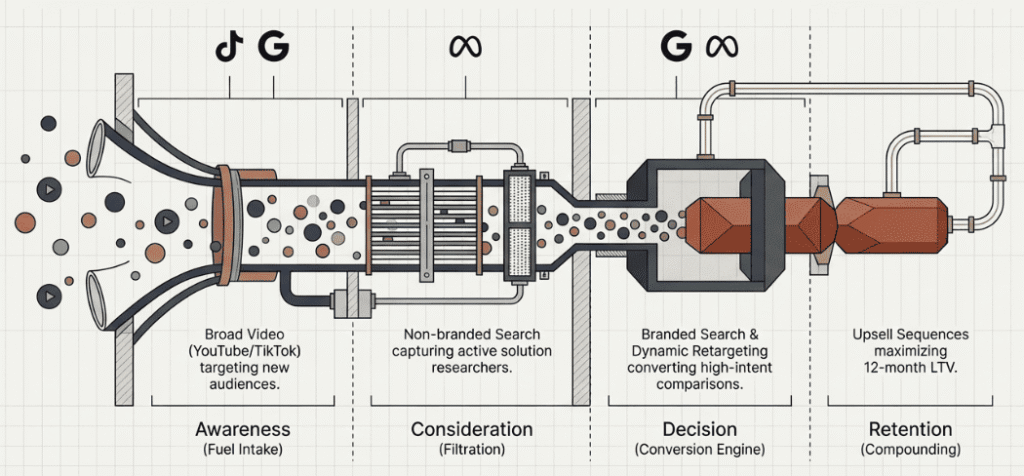
- Awareness: Broad video ads on YouTube or TikTok for people who don’t know your brand yet.
- Consideration: Search ads on non-branded terms for people actively researching solutions.
- Decision: Branded search and retargeting ads for people comparing you against competitors.
- Retention: Past-purchaser campaigns and upsell sequences for customers you’ve already won.
PPC is one piece of a larger system. If you want to see how paid media connects to every other growth channel, our guide on full-funnel marketing strategy for ecommerce growth covers the complete picture.
How to Build a Strong Foundation for PPC Campaign Management
Jumping into campaign setup without a strategic foundation is one of the most expensive mistakes in paid media. The foundation work happens before you touch a single campaign setting.
Setting Goals Tied to Actual Business Numbers
Effective PPC management involves defining clear goals and conducting thorough keyword research. Without them, budget management becomes guesswork, and every decision is made in a vacuum.
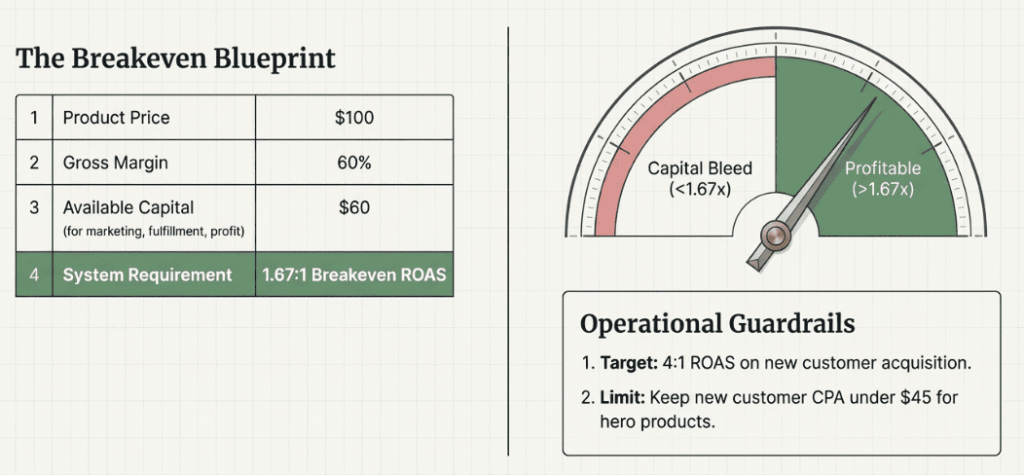
Vague goals produce vague results. Here’s what a real PPC goal looks like:
- Achieve a 4:1 ROAS on all new customer acquisition campaigns this quarter
- Keep new customer CPA under $45 for the main product line
- Generate $50,000 in new customer revenue from top-of-funnel Meta and TikTok campaigns by the end of Q3
These numbers become your decision-making framework. Every budget call, every bid strategy, every creative test gets evaluated against them.
How to Conduct Keyword Research for eCommerce PPC
Keywords are the backbone of any successful search ad campaign, and finding the right keywords is crucial for effective PPC management.
Start with Google Keyword Planner to understand search volume and competition for your core product terms. Then go deeper, look at the actual search intent behind the terms, not just their volume.
Finding the right relevant keywords is about matching what your potential customers are actually typing, not what you assume they’re searching for. Long-tail keywords like “best running shoes for flat feet under $100” have lower search volume but much higher purchase intent and are significantly cheaper to bid on. Organize your research by funnel stage:
- Informational keywords for awareness (how to, best way to, what is)
- Comparative keywords for consideration (X vs Y, best X for Y)
- Transactional keywords for decision campaigns (buy X, X price, X near me)
Building a Financial Model Around Your Ad Spend
Your budget for PPC campaigns should be based on your industry, goals, and competition, starting with a modest daily budget to gather data. You need to know your numbers before you spend anything.
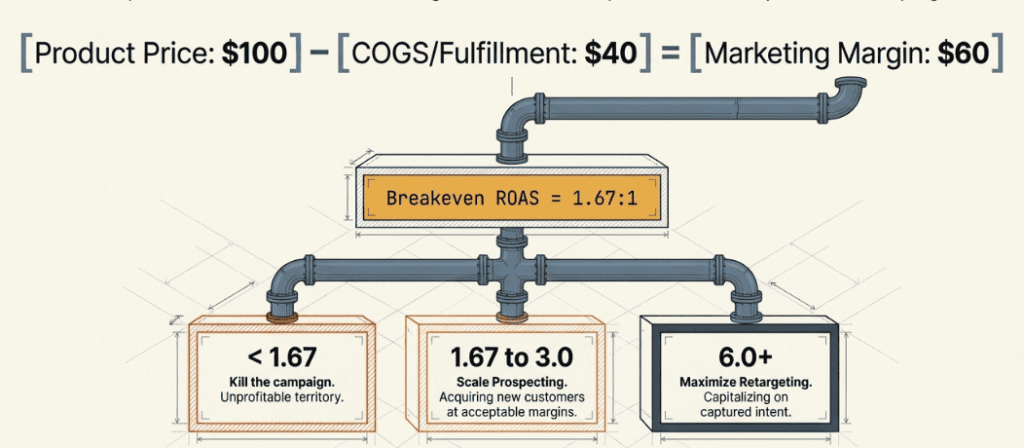
With a 60% gross margin on a $100 product, you have $60 to work with across marketing, fulfillment, and profit. That tells you your breakeven ROAS is 1.67:1.
This simple math gives you a clear line between profitable and unprofitable campaigns. It also tells you how much you can afford to pay to acquire a new customer and whether a lower initial ROAS on prospecting campaigns is justified by the long-term lifetime value of those customers.
How Do You Choose the Right PPC Platform for Your Business Goals?
Platform choice should follow your objective, not just where your audience spends time. Your digital marketing strategy should determine where you show up, not the other way around.
Matching Your eCommerce Goal to the Right Platform
Different platforms serve different purposes in online advertising, and treating them the same way is one of the most common reasons campaigns underperform.
| eCommerce Goal | Primary Platform | Key Tactic |
| New customer acquisition | Google Ads | Use value rules to bid higher for new customers. Feed first-party CRM data as audience signals. |
| Drive high-margin sales | Google Ads (segmented PMax) | Isolate high-margin products in separate campaigns with aggressive ROAS targets. |
| Build brand awareness | TikTok / Meta | Native-feeling video creative. The goal is views and recall, not clicks. |
| Retarget high-intent users | Meta / Pinterest | Dynamic product ads showing the exact products users viewed or added to cart. |
| Reach younger audiences | TikTok / Snapchat | Spark Ads and interactive formats. Authenticity outperforms polished production here. |
Google Ads
It remains the foundation for most eCommerce brands because you’re capturing demand that already exists. Shopping ads pull directly from your product feed and show product images, pricing, and brand right in the search results. Search engine marketing on Google is still the highest-intent channel available.
Meta
It is where you create demand. Broad targeting with strong creative and clean conversion data now outperforms narrow audience segmentation in most cases. The algorithm finds your target audience. Your job is to give it excellent, creative, and accurate signals. Social media ads here work best when you stop fighting the algorithm and start feeding it.
If you want to go deeper on what that looks like, our breakdown of Facebook ad strategies to maximize ROI covers the specific formats and audience setups worth testing in 2026.
Microsoft Ads
It gets overlooked, which is part of what makes it worth testing. CPCs are typically lower, and the audience skews older with higher purchasing power. If you’re running profitable Google search campaigns, importing them takes about 30 minutes. For a deeper play-by-play, see our guide on Microsoft Ads strategies for 2026.
That said, Microsoft’s audience behaves differently enough that you’ll want to monitor performance separately and adjust bids once you see the data, rather than assuming Google results will carry over directly. Diversifying PPC efforts beyond Google Ads by testing platforms like Bing, TikTok, LinkedIn, and Meta reaches audiences more effectively.
How Do You Execute Campaigns Across Multiple PPC Platforms?
Execution is where strategy meets reality. Getting this right means building a system where every platform, every campaign, and every data source works together rather than in isolation.
Why Tracking Comes Before Everything Else
Before spending a dollar, your tracking needs to be solid. Server-side tracking, ideally set up through Google Tag Manager, captures conversion data more reliably than browser-based tracking because it sidesteps signal loss from iOS updates and ad blockers.
This also matters in a cookieless environment. Use CRM data and custom match lists for improved targeting precision in a cookieless environment. Upload your customer lists, sync purchase data back to the platforms, and use hashed email matching to connect ad exposure to actual conversions. The advertisers getting clean results right now have rebuilt their data setup around first-party signals, not browser-based pixels.
Connect your Google Ads account to Google Analytics to track the full customer journey beyond the click. This is what lets you see whether a TikTok ad drove a branded Google search three days later, which completely changes how you evaluate and fund each channel. A good analytics tool doesn’t just report what happened; it helps you understand why.
How to Structure Google Performance Max Campaigns
Organizing campaigns by theme or product line and maintaining small, tightly themed ad groups improves relevance. The most common mistake is throwing all products into one Performance Max campaign. When you create campaigns this way, you lose visibility and control over where your budget goes and which products are actually driving results.
Instead, structure campaigns around business objectives:
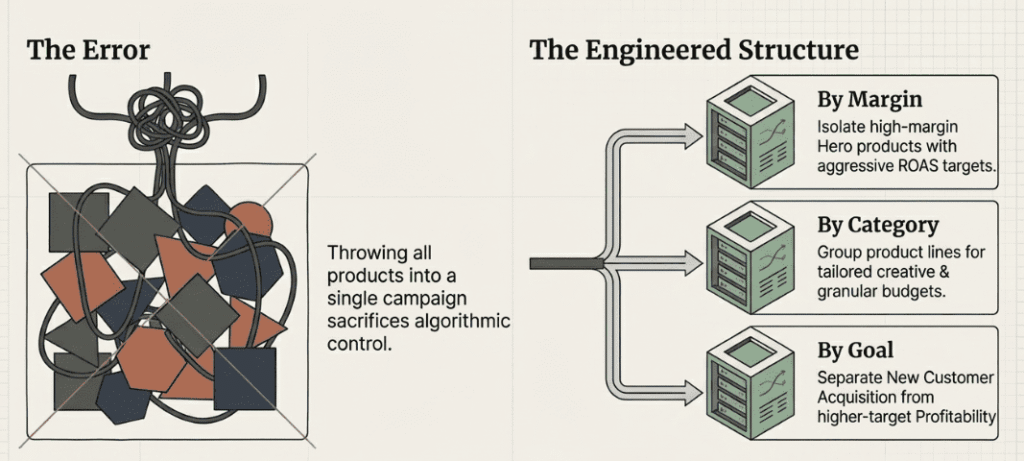
- By margin: Separate campaigns for high-margin hero products and lower-margin items, with different ROAS targets for each.
- By product category: Isolate categories into their own campaigns for granular budget control and tailored creative.
- By goal: A new customer acquisition campaign with a lower acceptable ROAS running alongside a profitability campaign with a higher target.
As of 2025, Google’s PMax reporting gives you more channel visibility. You can now distinguish between Shopping placements in search results and dynamic product ads on YouTube or Display. Use this to understand where your budget is actually going.
How to Use Negative Keywords and Audience Exclusions
Negative keywords and audience exclusions are two of the fastest ways to improve ad quality and efficiency without touching your budget.
For search campaigns, review search term reports weekly and add irrelevant queries as negative keywords. For all campaigns, build these exclusions in:
- Recent purchasers from prospecting campaigns.
- Visitors who bounced in under 10 seconds from retargeting.
- Your existing customer list from new customer acquisition campaigns.
How Do You Write Ad Copy and Creative that Actually Converts?
Even the best campaign structure falls flat with weak creative. Ad creation is where your strategy becomes visible to the customer, and it’s often the fastest lever you have to pull when performance dips.
What Makes Ad Copy Work
Write ad copy that highlights benefits and includes a clear, action-oriented call to action. Don’t bury your value proposition. Lead with it, and make sure potential customers know exactly what they’re getting and what to do next.
Ad relevance also affects your quality score, which directly impacts your ad rank and cost per click. Tight alignment between your keyword, ad copy, and landing page lowers your CPC and improves your position in the search results. It’s one of the few things in search engine marketing where doing the right thing for the user also happens to be cheaper.
Use ad extensions, sitelinks, callouts, and structured snippets to take up more real estate on the search results page. They don’t cost extra but significantly improve visibility and CTR.
How to Build a Simple A/B Testing Framework
Creating engaging ads consistently requires a system, not luck. Isolate one variable at a time.
Here’s a sequence that works:
- Test the hook first: Benefit-focused headline vs. problem-focused headline.
- Test the visual: Polished studio photography vs. authentic user-generated content.
- Test the copy: Short and punchy vs. longer and story-driven.
The same logic of isolating one variable at a time extends well beyond ads.

Pro Tip: The ad test that looks like a winner in week one is often not the winner by week four. Find out why in our eCommerce A/B testing guide, and what to measure instead before calling a test done.
Why Your Ad Creative and Landing Page Should Tell the Same Story
Getting someone to click your ad is only half the job. What happens on the other side of that click determines whether you convert website traffic into revenue or just pay for visits that go nowhere.
What Message Match Means in Practice
If your ad says “50% off sustainable yoga mats,” your landing page needs to show those yoga mats, at that discount, immediately, without the customer having to scroll or search. Any disconnect breaks trust and sends them back to the search results.
Here’s what a mismatch looks like in practice: an ad promoting a limited-time offer on running shoes that lands on a generic footwear category page with no mention of the promotion. The customer has to work to find what they were promised. Most won’t bother.
Message match isn’t just a conversion issue. Google measures the relevance between your ad and landing page as part of your quality score calculation. Poor match means higher CPC and lower ad rank. A tight match reduces what you pay and improves where you appear.
What a High-Converting Landing Page Actually Needs
Every landing page should have one clear call to action, optimizing for load speeds and mobile responsiveness. Multiple CTAs split attention and hurt conversion rates. Landing pages must be user-friendly and optimized to convert traffic into actions, not just receive it.
Beyond that, focus on:
- Fast Load Speed: Every additional second reduces conversions.
- Mobile Optimization: More than half of eCommerce traffic is mobile.
- Social Proof Above the Fold: Reviews and trust signals visible without scrolling.
- Transparent Pricing and Shipping: Surprise costs at checkout are the top cause of cart abandonment.
Turning Ad Test Winners Into Landing Page Improvements
Your A/B test results are a direct window into what your audience actually responds to. If “free and fast shipping” consistently beats “10% off” in your ad tests, that’s telling you something important. Put that message front and center on your landing page, find reviews that mention shipping speed, and make delivery information impossible to miss.
How Can AI Improve Your PPC Campaign Performance?
Successful PPC campaign management in 2026 emphasizes AI-driven automation and strategic human oversight. Smart Bidding strategies adjust bids in real time, drawing on historical conversion data to find the right price for every single auction. No human can do this at scale.
What Data Inputs Actually Guide the Algorithm
Leverage Smart Bidding strategies to optimize bids in real-time based on historical conversion data. No human can replicate this at scale, but the algorithm is only as good as what you give it. The three most impactful inputs you can provide:
- Offline Conversion Data: Import phone and in-store sales back into your ad platforms. This shows the algorithm that clicks actually turned into revenue.
- First-party Audience Signals: Upload your best customer lists from your CRM. Platforms use these as seed audiences to find more people who match your most valuable customers.
- Value Rules: Tell the platform explicitly that a new customer is worth more than a repeat buyer, typically 1.5x. This nudges the algorithm to bid more aggressively for new customer acquisition.
One thing worth noting: The quality of your conversion data matters more than the quantity. If you’re feeding the algorithm a mix of high-value purchases and low-intent micro-conversions like page views or add-to-carts, it will optimize for the wrong thing. Keep your primary conversion action tied to actual revenue or purchase events, and use micro-conversions only as secondary signals.
What the PPC Manager’s Role Looks Like Now
When you manage PPC campaigns today, the work looks very different from what it did five years ago. The questions worth asking every week are no longer “what should I bid?” They’re:
- Is the algorithm receiving accurate, complete conversion data?
- Are our audience signals current and representative of our best customers?
- Is our creative fresh, or are we seeing ad fatigue?
- Is our budget allocation still aligned with where customers are in the funnel?
The shift is from tactical button-pushing to strategic oversight. Your value comes from feeding the system the right data and keeping its objectives aligned with your business goals. PPC campaign management is a continuous process that requires ongoing refinement to achieve profitable results and a positive ROI.
How Do You Measure PPC Performance and Prove Its Value?
Reporting is where many PPC managers lose stakeholder trust, not because results are bad, but because they’re presenting the wrong numbers to the wrong people.
The Metrics That Actually Matter
Stop leading with CTR and CPC in reports meant for business stakeholders.
The key metrics that connect to business health are:
- Blended ROAS: Total revenue divided by total ad spend across all channels. This is what tells you whether your overall marketing engine is working.
- New Customer Revenue: How much revenue came from first-time buyers? This shows whether you’re genuinely growing the customer base.
- New Customer CPA: What does it cost to acquire a brand-new customer? Compare this to LTV to determine whether your acquisition economics are sustainable.
How to Handle Attribution
Attribution isn’t about finding one perfect model. It’s about getting a directionally accurate picture of how channels contribute to revenue and applying that model consistently.
Last-click attribution undervalues top-of-funnel channels like YouTube and TikTok that introduce customers to your brand but rarely get the final click. A data-driven attribution model distributes credit more accurately across touchpoints. Whichever model you use, consistency matters more than perfection. Your trends need to be comparable over time.
How to Report Results to a C-Suite Audience
Frame every report around revenue, profit, and growth. A structure that works:
- What did we spend?
- What new customer revenue did we generate, and at what CPA?
- What is our blended ROAS trend over the last 90 days?
- What are we doing next based on what the data is showing?
When you can clearly show how every dollar of ad spend is generating profitable new customers, the conversation shifts from justifying your budget to figuring out how to scale it.
Conclusion
PPC Advertising Campaign Management has moved well past bidding on keywords and hoping for clicks. The brands winning right now treat paid media as a system, clean data, the right signals, creative that matches the landing page, and measurement tied to real business outcomes.
The fundamentals don’t change whether you’re a small business running ppc ads on one platform or scaling across five: know your numbers, feed the algorithm quality data, and stay aligned with where the customer is in their journey.
PPC advertising management compounds over time. The brands that commit to ongoing refinement are the ones that turn it into a reliable engine for business growth.
If you’re ready to build that kind of system, we’d like to show you what it looks like for your store.
See how Aureate Labs has helped ecommerce brands build profitable PPC systems.
The brands that treat PPC as a growth system rather than a line item will always have an edge. The question is whether yours is one of them.
Frequently Asked Questions
What Is a Good ROAS for eCommerce?
A good ROAS is whatever makes you profitable after accounting for your margins and costs. With a 60% gross margin, your breakeven ROAS is 1.67:1. Prospecting campaigns can accept 2:1 to 3:1. Remarketing campaigns should return 6:1 or more. What matters most is your blended ROAS across all channels.
How Long Does It Take for PPC to Show Results?
You’ll see traffic almost immediately, but stable, profitable performance typically takes 60-90 days. Google’s Smart Bidding typically needs 2-4 weeks and around 50 conversions to stabilize. Avoid making major changes during this learning phase, as it resets the clock.
How Often Should You Adjust Bids?
Bidding strategy is a pillar of successful PPC management, allowing you to tell the ad platforms how much you’re willing to pay for a click or a conversion. With automated bidding like Target ROAS, you rarely need to adjust bids manually. Focus instead on adjusting budget allocation between campaigns, updating audience signals as your CRM data changes, and refreshing creative when you see performance decay.
What Is the Difference Between PPC and SEO?
Pay-per-click PPC advertising drives immediate website traffic at a per-click cost. The moment you stop spending, the traffic stops. Search engine optimization builds organic rankings that generate traffic without a direct cost per click, but takes months to show results. Most eCommerce brands benefit from running both. PPC keyword data also informs which terms are worth pursuing through search engine optimization.
How Does Aureate Labs Help eCommerce Brands with PPC?
Aureate Labs is a PPC management company that manages full-funnel campaigns for D2C and B2C ecommerce brands across Google, Meta, TikTok, and beyond. Our campaign strategies start with your financial model, your margins, LTV, CPA targets, and build a paid media system around profitable growth, not platform metrics.
Resources: Optimizing Performance Max for eCommerce: High-impact tips (w/ Kirk Williams)






Post a Comment
Got a question? Have a feedback? Please feel free to leave your ideas, opinions, and questions in the comments section of our post! ❤️