

Benefits of Having a Custom Amazon Storefront Design for Your Brand

You’re doing everything right, optimizing listings, running ads, and managing reviews. Yet somehow, your brand still feels invisible on Amazon.
Here’s what most sellers never stop to think about:
Over 300 million global consumers shop on Amazon at least once a year (Shiprocket). That’s an enormous crowd walking past your storefront every day. But if it looks like every other generic template out there, they’re not stopping.
This blog is for brand owners, private label sellers, and eCommerce merchants with 10+ SKUs who are serious about building a real brand on Amazon. If you’re already considering investing, you can explore our Amazon storefront design services to see what a professionally built store looks like.
Here’s what you’ll learn in this blog:
- What an Amazon brand store actually is and who can create one
- Why a custom Amazon storefront design outperforms templates every time
- The seven real benefits that move the needle on sales and loyalty
- What separates a high-converting store from a forgettable one
- The mistakes most sellers make and exactly when to invest in a redesign
Key Takeaways (TL;DR)
- A custom Amazon storefront is the only competitor-free space you have on the platform.
- High-quality Amazon store design generates up to 97% more sales than low-quality stores, according to Amazon’s own data.
- Multi-page stores with strong visual flow see 83% more shopper dwell time and 32% more attributed sales per visitor.
- Your storefront URL is a real marketing asset; use it in email, social, and influencer campaigns.
- Brands that update their store regularly see measurably better performance than those that set it and forget it.
What Is an Amazon Storefront?
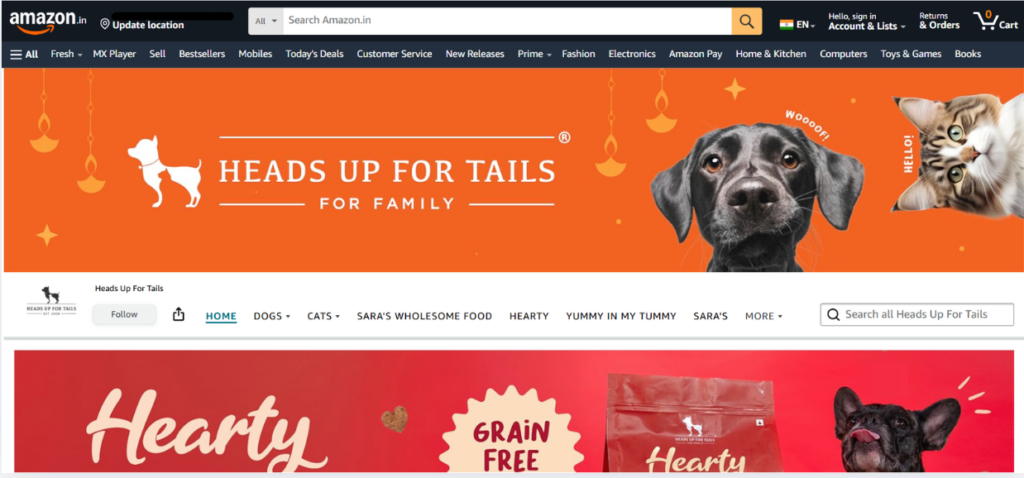
An Amazon storefront is a free, multi-page branded microsite that lives inside the Amazon platform. It is available exclusively to sellers enrolled in Amazon Brand Registry. It is like your own mini website inside Amazon, where you control the layout, imagery, messaging, and product organization.
But here’s what makes it different from everything else on Amazon: it’s the only page where competitor ads do not appear. No “Sponsored” products from rivals. No “Customers also bought” distractions pull shoppers away; just your full catalog, your story, and your brand.
Each storefront comes with its own web address, a custom Amazon URL you can use in marketing initiatives outside of Amazon, too. You can use it to promote new launches, seasonal campaigns, and brand moments, all outside of Amazon’s own ecosystem. That makes it a real piece of digital real estate, not just an internal Amazon feature.
Unlike your own ecommerce website, your Amazon storefront puts your brand in front of millions of Amazon customers who may never visit your DTC website at all.
If you’re still getting started with selling on Amazon, Brand Registry is one of the first milestones worth hitting. It unlocks the storefront along with several other brand protection tools.
Why Custom Amazon Storefront Design Matters
Amazon gives you a store builder with ready-made templates. And yes, you can use them. But templates do only one thing: they get you live. They don’t get you sales.
A template says, “We sell products.” A custom Amazon storefront design says, “We are a brand.” That gap is more important than most sellers realize.
Competitor ads show up everywhere on Amazon on your product listing pages, in search results, and even on your competitors’ pages. The only place they cannot follow your shoppers is inside your storefront. And if you have a generic, low-effort store, it wastes that advantage completely.
High-quality Amazon brand stores generate up to 97% more sales than low-quality ones (Amazon Ads). That’s not a marginal improvement; that’s nearly double the output from the same traffic.
A Reddit user put it well:
“Many sellers treat storefronts as decorative brand assets. The highest-performing brands treat them as conversion systems. The difference lies in how well the storefront aligns with buyer psychology, shopping behavior, and decision flow.”
That’s exactly the shift worth making. A custom Amazon storefront design isn’t a cosmetic upgrade; it’s a buying environment you control inside a marketplace that usually gives you very little control.
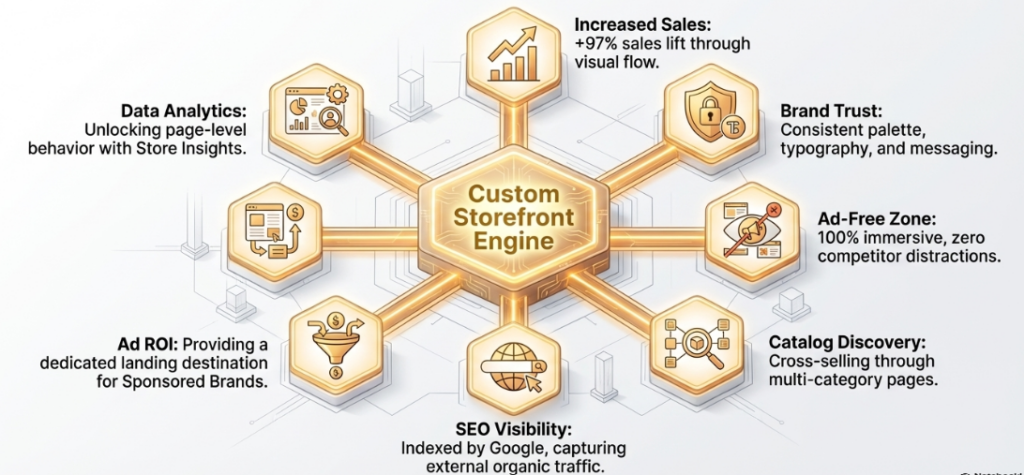
Now that you know what an Amazon storefront is, let’s look at the benefits of a custom Amazon storefront design:
1. Increased Sales and Conversion Rates
A well-designed Amazon storefront keeps shoppers engaged longer, and the more time shoppers spend on your store directly translates to more purchases. Multi-page stores with three or more pages see an 83% increase in shopper dwell time and a 32% increase in attributed sales per visitor (SellerSprite).
When your store has logical navigation, strong visuals, and a clear shopping journey, shoppers don’t bounce. They browse, and browsers convert.
2. Enhanced Brand Trust and Recognition
Brand recognition isn’t built on a single product page. It’s built through consistent visuals, a clear voice, and a brand experience that shoppers remember. A custom Amazon storefront design gives you the space to deliver all three.
When everything, like your imagery, color palette, typography, and messaging, feels intentional and consistent, shoppers trust you faster. And trust is what separates a one-time buyer from a repeat customer, while also helping you increase brand awareness with every new shopper who discovers your store.
3. Ad-Free, Immersive Experience
Every other page on Amazon is filled with ads, including your own product detail pages. Your storefront is the one exception.
When a shopper enters your brand store, they’re in your world. No competitor ads. No recommended alternatives. Just a personalized shopping experience built around your products. That’s a significant conversion advantage that most sellers simply leave on the table.
4. Better Product Discovery and Catalog Showcasing
If you sell across multiple categories, a single product listing can’t carry your full story. A custom Amazon store lets you build additional category pages, organize products by use case or audience. And this makes it easy for shoppers to find exactly what they need.
This kind of intentional structure means potential customers don’t just buy one product; they discover your range. That naturally increases average order value and opens the door to cross-selling.
5. Improved Search Visibility (SEO)
Your Amazon storefront isn’t just visible inside Amazon. It’s indexed by Google, too. A well-structured store with clear page titles, organized categories, and engaging content can surface in external product search results. And it is bringing in organic traffic from shoppers who never started their journey on Amazon.
Your brand presence extends beyond the Amazon platform when your store is built correctly.
6. Improved ROI on Amazon Ads
When you run Sponsored Brand campaigns, you choose where to send that traffic. Most sellers send it to a single product listing. The smarter move is sending it to a purpose-built storefront page.
Brands that drive traffic to their storefront via brand ads see 55% more page views per visit compared to sending shoppers to individual listings (SellerSprite). Your ad spend works harder when it has a proper destination.
7. Data-Driven Optimization Opportunities
Your Amazon brand store gives you access to Store Insights. It is a built-in analytics dashboard that shows traffic sources, page views, sales attribution, and visitor behavior at the page level. It is a built-in analytics dashboard that shows you traffic sources, page views, sales attribution, and visitor behavior at the page level.
You can see exactly which pages perform, where shoppers drop off, and which product launches or seasonal updates moved the needle.
Pro Tip: Most sellers don’t realize that your Amazon Brand Store has its own analytics dashboard, and it tells you exactly which pages shoppers visit, how long they stay, and where they drop off. If you’re not checking this data regularly, you’re essentially running your store blind. Pair this with a strong Amazon SEO strategy to drive sales to the pages that are already converting well.
What does a High-Converting Amazon Store Design Look Like?
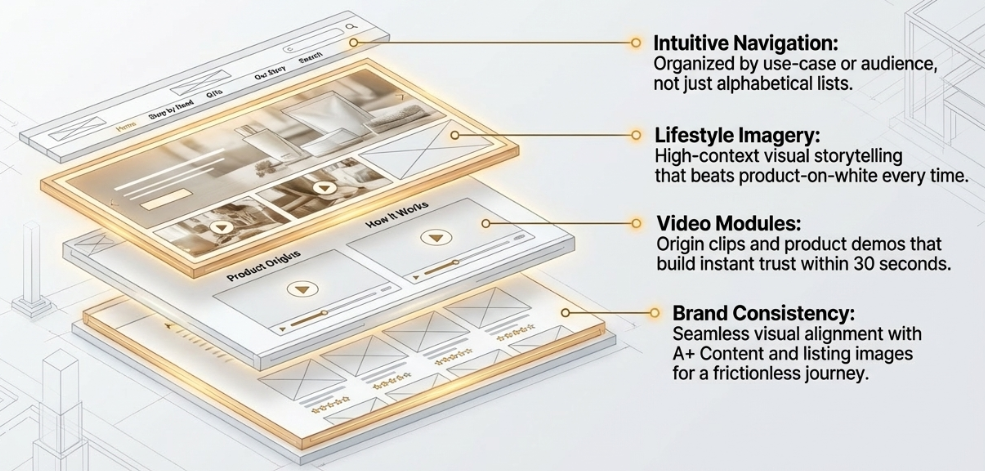
A good Amazon storefront design isn’t just about looking nice. Every design decision either helps a shopper move forward or gives them a reason to leave.
There’s a reason the best Amazon store designs feel effortless to shop.
As Donald A. Norman, author of The Design of Everyday Things, puts it:
“Good design is actually a lot harder to notice than poor design, in part because good designs fit our needs so well that the design is invisible.”
That’s exactly what a high-converting Amazon storefront should feel like. Shoppers shouldn’t notice the navigation; they should just find what they need. They shouldn’t think about the layout; they should simply move toward a purchase.
Navigation: It is the first thing to get right. Your store should be organized by product type, use case, or audience segment, not just thrown together alphabetically. Shoppers shouldn’t have to work to find what they want.
Lifestyle Imagery: It beats product-on-white every time. Context sells. A shopper can imagine owning your product when they see it being used in a real setting. That emotional connection is what static listing images can’t create.
Video: It is one of the most underused tools inside Amazon brand stores. A short brand origin clip, a product demo, or a how-to video does more to build trust in 30 seconds than three paragraphs of bullet points ever could.
Consistent Brand Identity: Across every module, colors, fonts, and tone are what make a store feel premium. When the design is inconsistent, it creates friction. Shoppers sense it even if they can’t name it.
Your storefront should visually align with your Amazon A+ Content and product listing images. When all three match, shoppers experience a seamless shopping experience from ad to storefront to product page.
Mobile: It is non-negotiable. Over 60% of Amazon traffic comes from mobile devices (IFGlobal). If your store isn’t checked and optimized for mobile before publishing, you’re designing for the minority and ignoring the majority.
Stores that are updated regularly for seasons, new product launches, and campaigns consistently outperform stores that were built once and abandoned.
Best Examples of Custom Amazon Storefront Designs
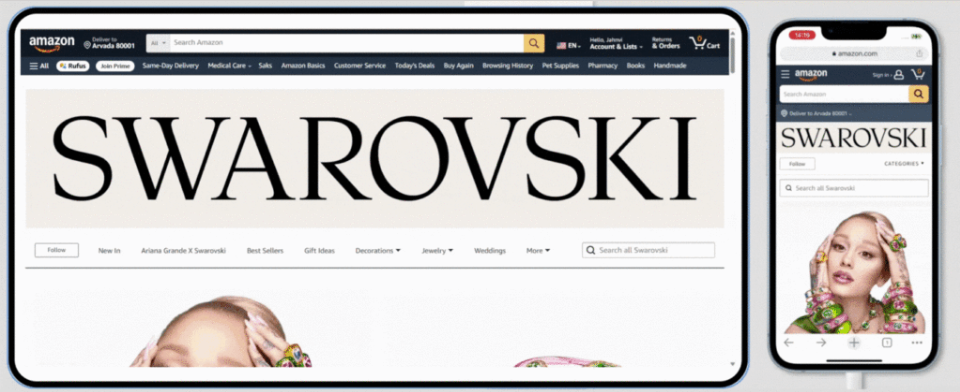
Swarovski keeps its Amazon brand store clean, elegant, and premium from the first scroll. Collections are easy to browse, photography does the talking, and the whole experience matches what shoppers expect from a luxury jewelry brand. See how Swarovski built its Amazon presence.
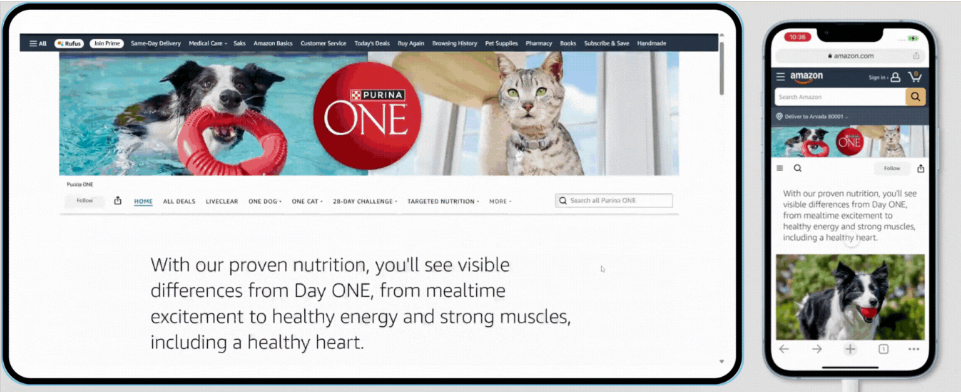
Purina ONE organizes its brand store around real pet needs, by pet type, health goal, and product format. Pet parents find all the information they need without digging, which builds the confidence that turns first-time buyers into repeat customers. Read the full Purina ONE storefront breakdown.
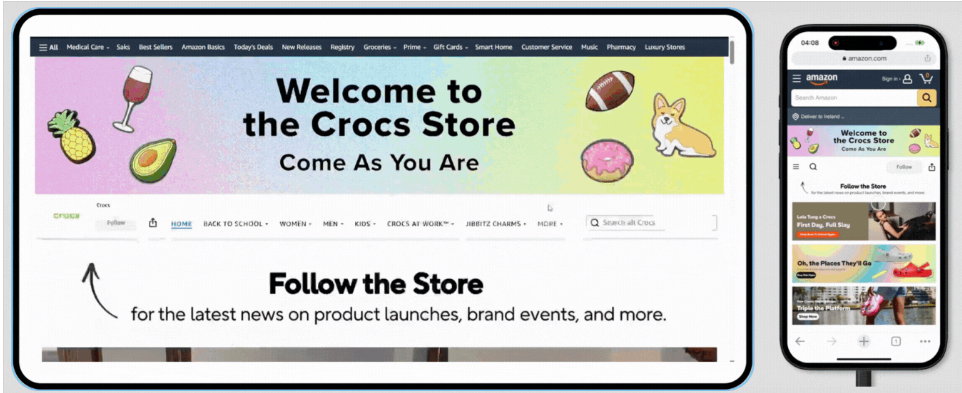
Crocs shows that in a crowded category like clothing and shoes, a well-structured Amazon storefront design still wins. Their store is clearly branded, easy to navigate, and built for a broad audience without feeling generic.
What all three have in common: they treat the Amazon storefront as a brand destination, not a product dump. That’s the mindset shift that separates brands that grow from brands that stagnate.
It’s the same mindset Aureate Labs brings to every storefront project: design that works for your brand, not just design that looks good.
Common Mistakes Brands make with their Amazon Storefront
Even good products can get buried under poor storefront decisions. Here are the ones that show up most often:
- Setting it up once and walking away: A storefront is not a one-time task. Amazon rewards stores that are actively updated with better performance metrics.
- Using listing images instead of lifestyle visuals: Your listing images are built for conversion on a product page. Your storefront needs campaign-quality imagery that tells a broader story.
- Ignoring mobile rendering: A store that looks great on desktop can look broken on mobile. Always preview on mobile before publishing any update.
- Building only one page: A single-page storefront gives shoppers nowhere to go after the home page, and a weak home page kills the first impression before it even starts. Multi-page stores create depth, exploration, and higher dwell time.
- Not linking the Brand Story module back to the storefront: The brand story section on your product detail pages is a direct pathway into your storefront; most sellers set it up and never connect it properly.
- Skipping analytics: Amazon now offers section-level performance data inside Store Insights. If you’re not using it, you’re optimizing blind.
A weak storefront is just one of the common Amazon seller mistakes that quietly drain sales. If you want to audit your full account health, this is worth a read.
When should you invest in a Custom Amazon Storefront Design?
The right time to invest is before the problem becomes obvious, not after you’ve already burned ad budget on a store that doesn’t convert.
That said, here are the clearest signals that it’s time:
Your PPC Has No Proper Destination: Sending paid traffic to a bare product listing is like running a TV ad that leads to a busy signal. Amazon storefront is where that traffic should land, not a generic product page with competitor ads on it.
Your Catalog Has Outgrown Its Structure: Once you cross 10+ SKUs, shoppers need clear navigation to find what they want. Without it, they bounce even if exactly what they’re looking for is right there.
You’re Chasing Repeat Purchases, Not One-Off Sales: Retention is where Amazon’s business profitability really lives. A well-designed Amazon store builds the kind of brand equity that helps you build loyalty and keep customers coming back without paying to re-acquire them every time.
You’re in a Category Where Looks Decide the Sale: Fashion, beauty, home goods, fitness, supplements. In these categories, shoppers pick the brand that looks more credible, even when the products are nearly identical.
A well-designed Amazon storefront is not just a visual upgrade; it’s part of a broader Amazon account management strategy that covers everything from listing health to brand content to ad performance.
Final Thoughts
We started with a simple question: why are your sales stuck when your product is solid? And the answer, more often than not, is that the brand experience breaks down before the shopper ever reaches your product page.
Your Amazon storefront is the one place on the entire platform that belongs entirely to you. No competitor ads. No algorithm decides what to show next. Just your brand, your products, and your story.
A custom Amazon storefront design is not decoration. It’s conversion infrastructure. It shapes how shoppers perceive your brand, how long they stay, how much they buy, and whether they come back.
Amazon’s own quality scoring now ties design quality directly to store performance. Aureate Labs specializes in Amazon storefront design and full-account growth, helping brand-registered sellers turn their Amazon presence into a real revenue channel.
If you’re ready to stop sending shoppers to a store that doesn’t do your brand justice, get in touch with us today and see exactly what a purpose-built, conversion-focused storefront looks like for a brand like yours.
FAQs
Are Amazon storefronts worth it?
Yes, especially if you’re enrolled in Brand Registry and running any form of paid advertising. A well-built Amazon brand store gives your ad traffic a proper landing destination, keeps competitors off your pages, and builds the kind of brand recognition that drives repeat purchases. Amazon’s data shows high-quality stores generate up to 97% more sales than low-quality ones.
How many followers do you need to create an Amazon storefront?
For brand-registered sellers (which is the standard Amazon business storefront), there is no follower requirement. The influencer storefront, a separate program, does require an active social following, but that’s a different product altogether.
Can I make my own Amazon storefront?
Yes. Any seller enrolled in Amazon Brand Registry can build a storefront using Amazon’s Store Builder tool, which uses drag-and-drop templates. The question isn’t whether you can build it yourself; it’s whether a template store will perform the way a custom-designed one does.
Can a business have an Amazon storefront?
Absolutely. Any brand enrolled in Brand Registry, whether you’re a small private label seller or a large consumer goods company, can create an Amazon storefront. It’s designed for businesses, not individuals.
How much does it cost to set up an Amazon storefront?
Amazon doesn’t charge to create or host a storefront. The cost depends on whether you build it yourself using free templates or work with an Amazon storefront design services agency. Professional design varies depending on the scope, number of pages, and level of custom creative work involved.






Post a Comment
Got a question? Have a feedback? Please feel free to leave your ideas, opinions, and questions in the comments section of our post! ❤️