

8 Best Link Building Services for B2B Software Brands in AI Search (2027)

Choosing the right link building service can help B2B software brands strengthen their SEO strategy and build visibility across search platforms. In this guide, I’ll compare eight providers, including their pricing, placement models, and approaches to AI search as part of a broader AI SEO strategy.
The providers below were reviewed using their own pricing and service pages, rather than third-party directories or roundups.
Let’s dive right in.
Key takeaways
- Branded mentions across third-party sites correlate far more strongly with AI Overview visibility than backlink counts do
- Listicles take roughly 41% of citations on commercial queries, and third-party lists beat self-published ones by a wide margin
- Published per placement pricing runs from roughly $80 to $550, while managed retainers run from about $2,500 to $15,000 a month
- Provider pricing and service details were reviewed using each company’s own website.
First, here’s what AI visibility actually asks for
Ask ChatGPT, Perplexity, or Gemini to name the best tool in your category.
You get a short list of names.
Your product is either on that list, or it’s invisible.
For a lot of B2B buyers, that short list is now the top of the funnel, which is why AI visibility belongs inside a full-funnel marketing strategy, not off to one side.
And here’s the uncomfortable part:
The deciding factor is rarely how many links you bought last quarter.
Ahrefs analyzed 75,000 brands and found that branded web mentions correlated most strongly with visibility in Google’s AI Overviews among the signals examined, at 0.664. Branded anchor text followed at 0.527, while total backlink counts correlated at 0.218. These figures describe statistical relationships, not proof that increasing a particular signal will cause a brand to appear more often in AI answers.
Raw backlink counts?
0.218.
The lowest correlation among these three signals.
That doesn’t make authority metrics useless. Domain Authority, Page Authority, and Domain Rating can help with initial screening, but they don’t guarantee that a brand will appear in an AI-generated answer.
But the correlation isn’t even the interesting part. Look at the spread.
Brands in the top quartile for web mentions averaged 169 AI Overview mentions. The quartile right below them averaged 14.
That’s roughly 10 times as many AI Overview mentions, one quartile apart.
(A further 26% of the brands analysed had no AI Overview mentions at all. So those correlations came from the remaining 74%.)
Here’s how this research applies to link building.
Wix Studio’s AI Search Lab analyzed 75,000 AI answers and over 1 million citations across ChatGPT, Google AI Mode, and Perplexity. Listicles accounted for 21.9% of all citations and about 40% of citations for commercial queries.
In its professional services analysis, 80.9% of listicle citations came from third-party lists, compared with 19.1% from self-promotional lists. While these findings highlight the potential value of independent comparison pages, results may vary by industry.
Note: Ahrefs is careful to say correlation is not causation, and that caveat holds for all of this. Treat these numbers as direction, not proof.
The findings suggest that evaluating link building services solely by Domain Rating can overlook other useful signals, including brand mentions and publisher relevance. When assessing a provider, consider the quality of its proposed placements and whether they reach an audience relevant to your business. Neither a high Domain Rating nor a third-party mention guarantees visibility in AI-generated answers.
How I picked these eight link building services
Every provider here sells link building or brand placements as a core service. Not as a bolt-on to a wider retainer.
I reviewed each company’s pricing and service pages to compare pricing, publisher standards, and delivery models.
Then I looked at four things: whether they actually work with B2B software and SaaS accounts, whether they publish enough detail to compare properly, whether their placements land on pages with real organic traffic, and whether they offer any explicit AI search or citation coverage.
Anyone relying on private blog networks or bulk directory submissions got cut.
Which link building services are best for AI visibility?
These eight providers offer different approaches to link building, from individual placements on selected publishers to managed campaigns and content-led outreach. You can compare their best use cases, models, and starting prices below.
Pricing and deliverables may vary, so confirm current rates and publisher requirements directly with each provider before finalizing a service.
| Service | Best for | Model | Starting price |
| Respona | Guaranteed placements in citable formats | Pay per placement | Starting from $100 per placement |
| Siege Media | Enterprise content and GEO programs | Retainer | Custom |
| uSERP | B2B SaaS buying high-authority links | Retainer | $5,500 per month |
| Editorial Link | Approving every publisher yourself | Pay per link | $375 per link |
| Stellar SEO | Regulated and competitive industries | Monthly packages | $2,500 per month |
| BlueTree Digital | Tech publication placements | Monthly packages | $3,500 per month |
| Authority Builders | Seeing metrics and price before ordering | Marketplace | Per placement |
| FATJOE | Agencies reselling at volume | Per link and packages | $81 per niche edit |
1. Respona
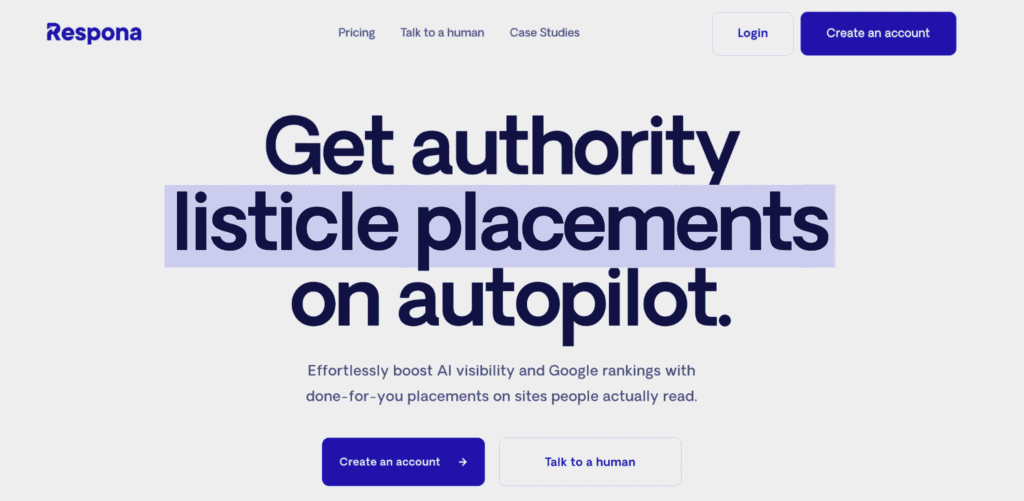
- Best for: guaranteed placements in the formats AI answers quote
- Model: pay per placement
- Pricing: $100 to $500 per placement by publisher tier
Respona sells you the finished placement instead.
Tiers run from $100 on DR 20+ sites up to $500 on DR 60+ sites, with volume discounts starting from $1,500 a month.
But the pricing isn’t what makes this interesting for AI visibility.
It’s the format control.
You can request listicles, comparison guides, and product reviews. Which means the exact formats AI answers quote most often become something you ORDER, not something you hope for.
Standard turnaround is 28 days. Express delivery of 14 days costs extra. And every placement ordered is guaranteed to go live within the agreed timeframe.
Does any of this actually work?
Respona’s published OpusClip case study describes a campaign involving 105 links and listicle placements, with an average Domain Rating of 50. The case study reports an increase in core-topic visibility. These results are specific to that campaign and should not be treated as a guarantee of similar outcomes for other brands.
2. Siege Media
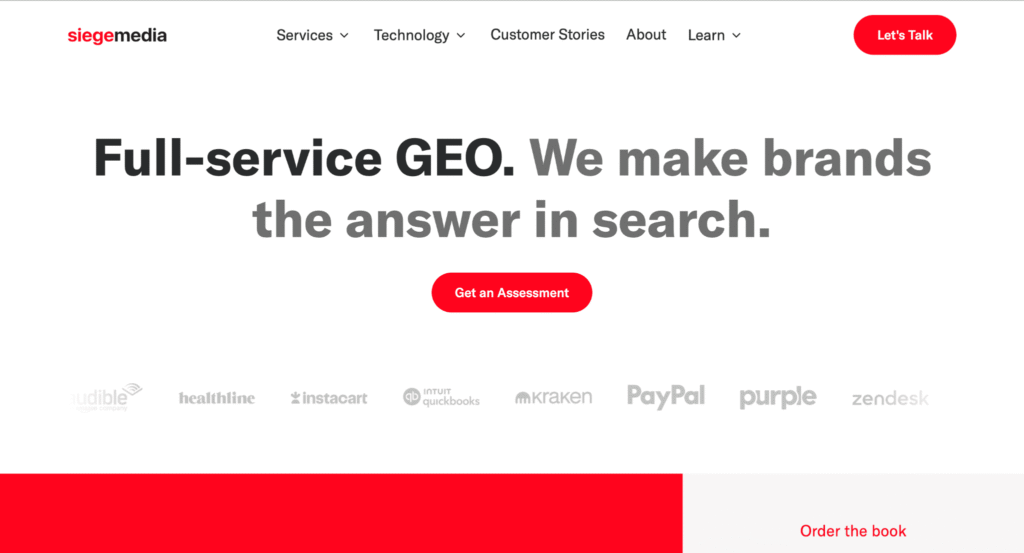
- Best for: enterprise content and GEO programs
- Model: retainer
- Pricing: custom
Siege Media pairs in-house content production with outreach, and now runs a dedicated generative engine optimization service alongside its link work. Offices in Austin, New York City, Chicago, and San Francisco.
Their campaigns lean on original data studies and research reports that publishers cite on their own merit.
This content-led approach can be a good fit for companies with the budget and resources to invest in original research.
Just know what you’re signing up for: this is a strategic engagement, not a shopping cart.
3. uSERP
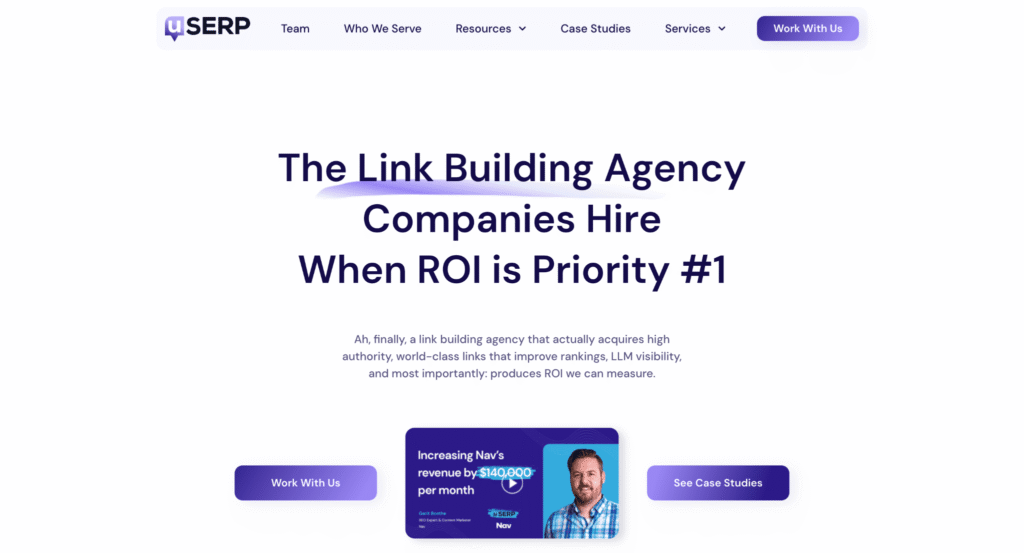
- Best for: B2B SaaS teams buying high-authority placements
- Model: retainer
- Pricing: $5,500 to $15,000 per month
The Denver agency publishes its plans.
Launch at $5,500 a month covers five DR 60+ links and ten DR 20 to 59 links. Accelerate at $10,000 and Dominate at $15,000 scale the volume from there.
uSERP also offers a managed SEO and AI search program and lists AI/LLM citation counts among the metrics it tracks.
If AI visibility is one of your campaign goals, ask which platforms an agency monitors, how often it reports results, and whether it distinguishes brand mentions from linked citations.
4. Editorial Link
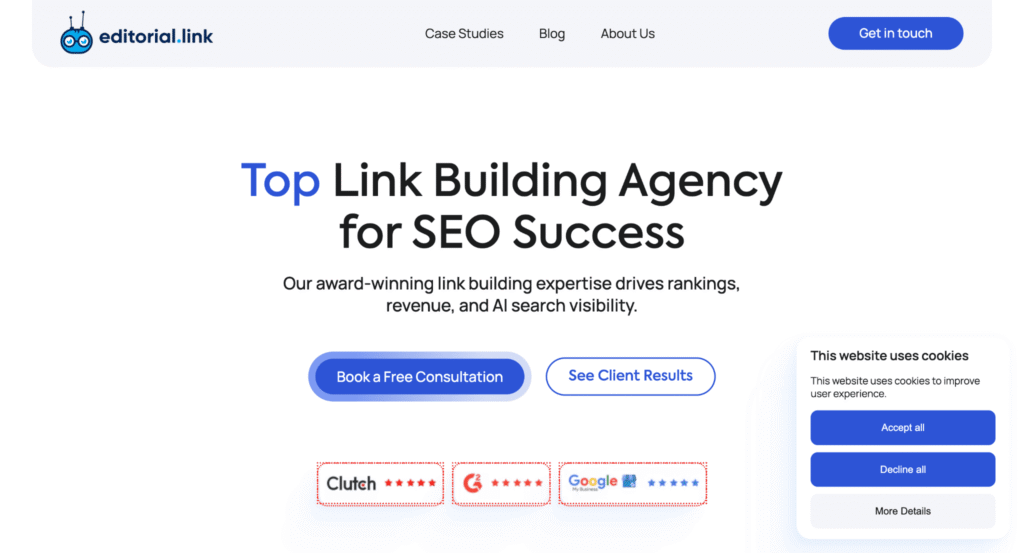
- Best for: buyers who want to approve every publisher
- Model: pay per link
- Pricing: $300 to $550 per link
One backlink costs $375. Five cost $1,750. Twenty cost $6,000, which works out to $300 each.
Premium placements on top-tier sites start at $550. The standard packages list an average Domain Rating range of 50–90, along with a minimum traffic threshold of 5,000.
Here’s the part I like:
Editorial Link offers publisher pre-approval, allowing buyers to review prospective placements before committing to them. This can be useful for teams that want greater control over publisher selection.
So if you’ve ever been handed a link report full of sites you’d never have approved, this model solves that specific problem.
It also sells listicle placements and brand mentions as distinct services aimed at AI search.
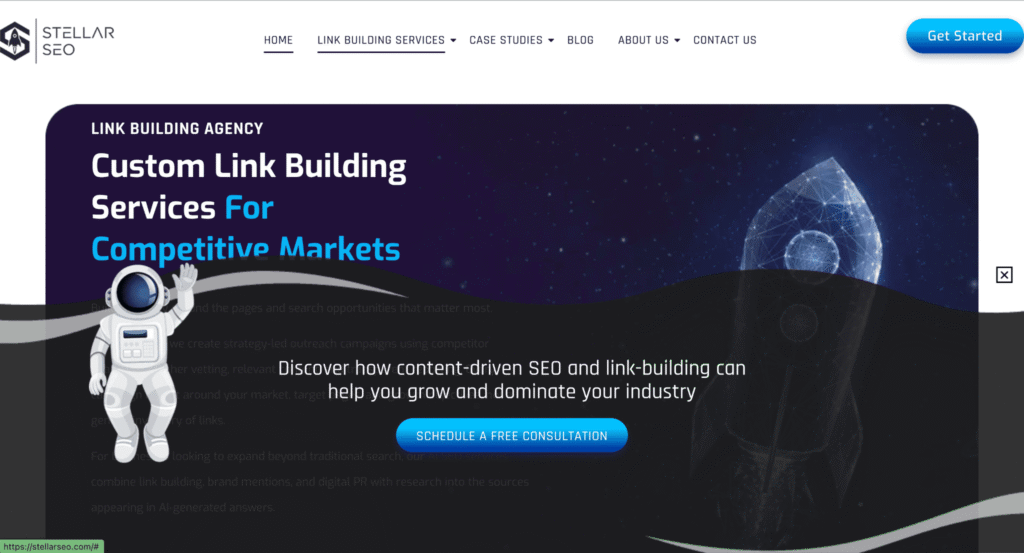
5. Stellar SEO
- Best for: regulated and highly competitive industries
- Model: monthly packages or custom
- Pricing: $2,500 or $5,000 per month
Foundation Builder is $2,500 a month for eight links, six at DR 30+ and two at DR 40+. Growth Accelerator is $5,000 for sixteen.
Every candidate site clears a 27-point quality check and must show at least 1,000 monthly organic visits in Ahrefs.
The traffic threshold is a useful screening measure, but it does not guarantee that a site’s audience is relevant to your buyers. Review the proposed page, its topic, and its organic search visibility before approving a placement.
Trading since 2012 and ranked on the Inc. 5000, the agency builds around an entity-driven framework designed to get a brand classified correctly by Google and AI systems alike.
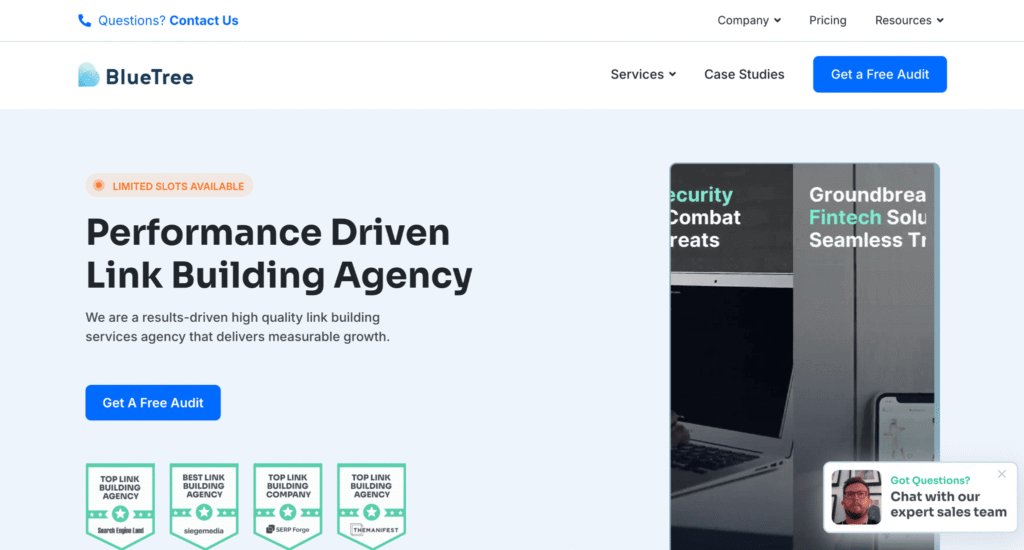
6. BlueTree Digital
- Best for: B2B and SaaS placements on tech publications
- Model: monthly packages
- Pricing: $3,500–$7,500 per month
BlueTree Digital offers three monthly plans: Starter at $3,500 for six editorial links per month, Pro at $5,000 for 10 links, and Enterprise at $7,500 for 15 or more links. Annual billing offers a 10% discount, bringing the monthly rates to $3,150, $4,500, and $6,750, respectively.
The company reports 7,541 links built over seven years, with teams in Miami Beach, Dubai, and Manila.
Note: BlueTree now operates on bluetree digital, not the bluetree ai domain still listed in older roundups.
7. Authority Builders
- Best for: teams that want to see the metrics and the price before ordering
- Model: marketplace with a managed option
- Pricing: per placement, varies by site
You browse vetted inventory, see the metrics and the cost, then order. The process is designed for self-service ordering.
Site URLs are masked for new accounts and shared with verified clients on request. Authority Builders states that sites applying to join its inventory must have at least 1,000 monthly organic visitors according to Ahrefs. Review the available site metrics and placement details before ordering.
There are no retainers or minimums on the marketplace side. A managed service exists if you’d rather hand selection over entirely.
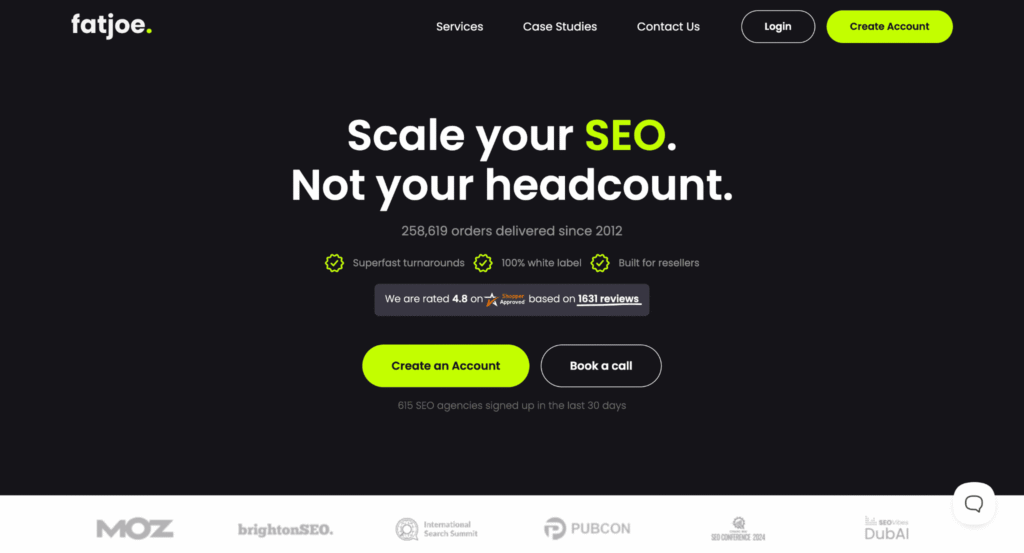
8. FATJOE
- Best for: agencies reselling links at volume
- Model: per link and packages
- Pricing: niche edits from $81
The UK provider sells blogger outreach and niche edits by DR tier through a self-serve dashboard. They’ve run on that model since 2012 with more than 5,000 agency accounts.
Links carry a lifetime guarantee.
The catch?
You choose a DR tier, not a specific publication.
The entry-level price reflects a tier-based service rather than selection of a specific publisher. Review the available placement details before ordering.
5 things to avoid when you’re buying links for AI visibility
Not all backlinks offer the same value, and some link-building tactics can put your SEO performance at risk. Before choosing a provider, look beyond link volume and domain metrics to assess publisher quality, relevance, and compliance with search engine policies.
1. Private blog networks: Links from networks built primarily to manipulate search rankings can create SEO risk and may lack meaningful editorial value. Evaluate a publisher’s ownership, content quality, audience, and linking patterns rather than relying on link metrics alone.
2. DR with no traffic behind it: A DR 70 domain with 200 monthly visitors is a metric, not an audience. Domain authority metrics are a useful diagnostic, but they’re a starting point, not the answer. Ask for organic traffic on the specific page. Not the domain.
3. Relying only on self-published rankings: Remember that 80.9% number? Your own “why we’re best” page is on the wrong side of it.
4. Link counts without publisher standards: If a vendor quotes volume but won’t state a traffic floor, a DR band, or a replacement policy, that number means nothing.
5. Paid links that violate search engine policies: Buying or selling links intended to manipulate search rankings can violate Google’s spam policies. For paid placements, ask how the publisher qualifies links and whether it uses rel=”sponsored” or rel=”nofollow” where appropriate. A high Domain Rating or a replacement guarantee does not make a placement compliant with Google’s policies.
How to evaluate a link building service
Start with where the placement lands. Not what it costs.
A high-DR link isn’t automatically the better choice. A relevant placement on a page that attracts your target audience may be more useful than a link on a higher-DR site with little topical relevance. Evaluate the publisher, the specific page, and its audience rather than relying on Domain Rating alone.
Then ask three questions before you sign anything.
- First, can you approve domains before publication?
- Second, can you request the content format?
- Finally, will the provider name your brand in the body copy, or only in the anchor?
A branded anchor and an unlinked brand mention are different signals. Ahrefs found that branded web mentions correlated more strongly with AI Overview visibility than total backlink counts did. However, the study does not establish that a particular anchor text or placement will cause an AI system to mention your brand.
Many of the same principles apply to vetting an SEO agency, particularly around transparent reporting and realistic timelines.
Pro tip: Review contract length, cancellation terms, and replacement policies before signing. If you’re still testing which publishers work best for your category, prioritize transparent terms and flexible commitments over link volume alone. When planning your overall search budget, review the factors that influence eCommerce SEO costs to understand how SEO investments can add up.
Bottom line
The eight providers serve different needs. Pay-per-placement services give buyers more control over individual publishers and content formats. Retainer agencies offer ongoing strategy and campaign management, while content-led agencies focus on earning coverage through research and useful resources.
Before choosing a provider, compare the proposed publishers, audience relevance, placement format, reporting process, and paid-link policies. If AI visibility is a goal, track brand mentions and AI citations alongside conventional SEO metrics rather than treating backlink volume as the only measure of success.
No link building service can guarantee inclusion in AI-generated answers. Choose the provider whose approach, pricing, and reporting fit your business goals and budget.
Frequently asked questions
1. What is the best link building service for AI visibility?
It depends on control versus scale. Pay-per-placement providers suit teams that want to specify format, anchor, and domain themselves. Retainer agencies suit teams that want strategy handled for them.
2. How much do link building services cost in 2027?
Published rates run from about $80 to $550 per placement depending on domain rating, and from $2,500 to $15,000 a month for managed retainers. Actual costs depend on the provider, campaign scope, and placement requirements.
3. Do backlinks still matter for AI Overviews and ChatGPT?
Yes. Backlinks remain relevant to SEO, but their relationship with AI visibility is more complex than backlink volume alone. In a study of 75,000 brands, Ahrefs found that branded web mentions correlated more strongly with Google AI Overview visibility than total backlink counts did. The study shows an association, not proof that increasing mentions or backlinks will cause a brand to appear in AI answers.
4. What kind of page gets cited most by AI search?
Wix Studio’s AI Search Lab found that listicles accounted for 21.9% of citations overall and about 40% for commercial queries. Among the 1,000 most-cited URLs in professional services, third-party listicles made up 80.9% of listicle citations. These findings suggest listicles can improve AI visibility, though results vary by industry and query.
Resources:
1. An Analysis of AI Overview Brand Visibility Factors (75K Brands Studied)






Post a Comment
Got a question? Have a feedback? Please feel free to leave your ideas, opinions, and questions in the comments section of our post! ❤️