

SEO vs. Google Ads: The 2026 D2C Ecommerce Guide
For a D2C brand on Shopify or Magento, choosing SEO vs Google Ads isn’t really about picking a winner. It’s a capital allocation decision. You’re deciding whether to buy immediate demand, build durable demand capture, or do both in a way that makes each channel cheaper and smarter over time.
Leadership teams face this question at predictable moments. A new product line is launching, CPCs are getting harder to defend (Google Ads CPC rose across 87% of industries in 2025). AI Overviews are reshaping search behavior, and organic search results no longer guarantee clicks the way they used to.
The better move is to use Google Ads as a live demand intelligence system and SEO as the asset that compounds from that intelligence. When you do that well, paid campaigns stop being just a media cost. They become research and validation.
Your SEO stops being slow, broad guesswork. It becomes targeted demand capture tied to actual buyer behavior.
Key Takeaway (TL;DR)
- Neither SEO nor Google Ads wins outright. The smarter question is which job each channel needs to do, given your current growth stage, cash flow, and competitive landscape.
- Google Ads gives you immediate traffic, conversion data, and search term intelligence. SEO builds durable demand capture that compounds over time without paying per click.
- The highest-leverage move is feeding paid search data directly into your SEO roadmap. If “wide toe box white sneakers” converts in ads, your SEO team should already be building around it.
- AI Overviews now appear in roughly 25 to 48% of Google searches, compressing clicks on informational content. This makes high-intent commercial pages more valuable for both channels.
- Budget split should follow growth stage: new stores lead with Ads; scaling brands shift investment toward SEO as a margin play; market leaders use both for defense, expansion, and efficiency.
Where Should D2C Brands Invest First
A founder reviews the monthly dashboard. Revenue is up, but so is acquisition cost. Google Ads still converts, but every scaling decision feels expensive. SEO is on the roadmap, yet it keeps getting pushed behind inventory planning, creative production, and retention work.
That’s the D2C dilemma. The question is not whether one channel is good and the other is bad. It’s whether you need speed, resilience, or both.
On Shopify, this often shows up after a strong launch phase. Paid campaigns carried the first wave of customer acquisition, but now branded search is doing too much of the work, and non-brand search is expensive.
On Magento or Adobe Commerce, the pattern often appears after a migration or site rebuild. The site is stronger technically, but leadership wants to know whether to double down on paid traffic or turn the rebuilt store into an organic growth asset.
A lot of teams frame this as a binary budget fight. That’s the wrong frame. You’re really choosing your growth model. Do you want traffic you rent, traffic you build, or a system where one channel funds and informs the other?
A serious eCommerce plan usually needs all three motions at different times. Paid search for launches, promos, and high-intent terms. Search engine optimization for category, product, and educational queries. And feedback loops where search query and conversion data shape what you optimize next.
If your brand hasn’t aligned those motions, your search strategy is fragmented. A stronger eCommerce growth strategy starts by treating search as one commercial system, not two teams competing for budget.
Renting vs. Owning Your Traffic: The Fundamental Models
Google Ads is rented attention. SEO is owned visibility. That’s the cleanest way to think about it.
What You’re Buying with Google Ads
With Google Ads, you pay for placement and speed. You can launch campaigns quickly, control keyword targeting, direct website traffic to specific landing pages, and tie spend to revenue with far more precision than most channels.
That makes paid search useful when you need answers fast. New product. Seasonal push. Clearance event. Market test. Google Ads can start generating traffic and leads within hours of launching a campaign, providing immediate visibility and results. You spend on the traffic that comes in. You pause, spend, that traffic stops.
Google Ads operates on a simple principle: you bid on particular keywords, your paid advertisements appear when those terms are searched, and you pay each time someone clicks. Working with an experienced Google Ads agency ensures your bids, match types, and campaign structure are set up to capture the right demand from day one.
For D2C brands, that tradeoff is often worth it. You don’t wait for rankings. You buy the signal now.
What You’re Building with SEO
SEO works differently. You invest in site structure, category architecture, technical performance, internal linking, content depth, and page optimization. Rankings take time, and there’s less direct control over exactly when Google’s algorithm rewards the work.
But once strong web pages rank, they can keep acquiring demand without requiring a click fee every time someone visits. That free traffic compounds over time in a way paid clicks never can.
Think of a well-built collection page on Shopify or a high-intent category page on Magento. If that page earns trust, performs well on mobile, and satisfies search intent, it becomes more than a page. It becomes an acquisition asset that improves your business’s online presence without continuous ad spend.
SEO can also signal built-in trust to users, indicating that Google considers the site authoritative and relevant.
Why Leadership Teams Misjudge this Choice
Teams often compare SEO and Google Ads using the wrong lens.
They compare paid search this month versus SEO this month. Visible ad spend versus blended internal and agency investment. Immediate attributed revenue versus work in progress.
The right comparison is different. Temporary demand capture versus durable demand capture. Cost to maintain visibility versus cost to build future visibility. Channel output versus channel asset creation.
That’s why the smartest brands rarely ask, “Which one should we do?” They ask, “Which job does each channel need to do right now?”
Head-to-Head Comparison for eCommerce Brands
Your Shopify team is pushing for faster revenue. Your SEO lead wants budget for technical fixes, category page expansion, and content production. Both are asking for growth dollars from the same P&L.
The wrong move is treating this like a simple channel vote. For eCommerce brands, the real question is which channel creates cash flow now and which channel lowers acquisition cost six months from now.
| Decision factor | SEO | Google Ads |
|---|---|---|
| Speed to results | Slower build, stronger over time | Immediate visibility and testing |
| Cost model | Upfront initial investment in technical work, content, and optimization | Continuous ad spend is required for every traffic surge |
| Long-term ROI | Stronger compounding economics | Effective for short-term demand capture |
| Targeting control | Driven by search intent and relevance | Tight control over keyword and audience targeting |
| Scalability | Scales through authority and page coverage | Scales until CPC and efficiency limits kick in |
| Measurement | Harder to attribute cleanly across long journeys | Easier to measure directly inside the ad platform |
| Volatility | Exposed to algorithm changes and SERP shifts | Exposed to auction pressure and rising click costs |
| Best use case | Long-term growth and lower long-run CAC | Launches, promotions, and fast learning |
Ads Win on Speed, SEO Wins on Learning
Google Ads gives you traffic and feedback immediately. That matters when you are launching a product, entering a new category, or trying to protect a revenue target this quarter. Running Google Ads even for a short window gives you first-party data that would take months to gather organically.
SEO runs on a longer payback cycle. Ahrefs notes that SEO typically takes months, not weeks, to show material results, with timelines varying by competition, domain authority, and the amount of technical optimization completed.
In practical terms, SEO typically takes three to six months to show significant results. Google Ads can generate traffic and leads almost immediately after launching a campaign.
Leadership should plan for that reality instead of forcing SEO results into paid media reporting windows.
The mistake is stopping at speed. Google Ads campaigns also produce search terms, copy, landing pages, and conversion data that should shape SEO priorities. If a Magento store sees strong conversions on “waterproof diaper bag backpack” but weak performance on broader bag terms, that signal should drive SEO page titles, collection page copy, filters, and internal linking.
Paid search can tell your SEO team where buyer intent is strongest before organic rankings catch up.
SEO Wins on ROI, Ads Win on Cash Flow
Long-term economics generally favor SEO because strong category and product-adjacent pages can keep producing visits after the build cost is absorbed. PPC ads keep charging rent on every click.
Google Ads can generate immediate traffic and leads, but it requires continuous spending to maintain visibility. SEO can deliver lasting traffic without ongoing costs once established.
That distinction matters during platform migrations and growth planning. If you are deciding whether to fund a store rebuild, template overhaul, or content expansion, think of SEO as a long-term investment rather than campaign spend. It’s closer to acquisition infrastructure.
Search ads still earn their place. They let you buy demand during promos, new product launches, and seasonal peaks when waiting for organic gains would cost revenue.
AI Overviews are Widening the Intent Gap
SEO is strongest when your site deserves to rank higher for category, comparison, and educational queries over time. Google Ads is strongest when you need exact control over which queries, offers, and landing pages get traffic now.
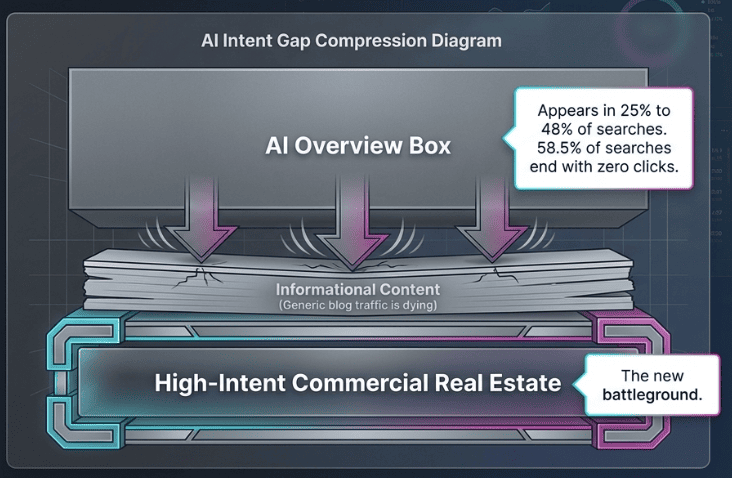
That difference has gotten sharper as Google expanded AI Overviews. As of early 2026, AI Overviews appear in roughly 25–48% of Google searches, depending on the query type and industry (AlmCorp). Informational searches are increasingly answered directly on the results page.
Our guide on eCommerce AI SEO covers exactly how to position your store for visibility inside AI-generated results.
For many D2C brands, that reduces the value of generic blog traffic and raises the value of ranking for commercial intent pages that still drive clicks, such as category terms, comparison queries, and branded product investigations. It also raises the value of paid advertising on high-intent queries where you cannot afford to lose visibility to SERP features.
For a beauty brand, the split is practical. SEO covers collection pages, ingredient hubs, comparison content, FAQ markup, and branded education. Google Ads covers top-SKU campaigns, brand defense, promotional terms, and proven non-brand commercial queries.
Ads Give Control, SEO Gives Durability
Google Ads work best when you need to steer campaigns day to day. You can change bids, creative, budgets, audiences, and landing pages this afternoon. SEO requires engineering time, merchandising input, content production, and patience.
But SEO creates more staying power if the work is done properly. A well-structured Shopify catalog with indexable collections, clean faceting rules, strong internal links, and pages built around proven demand can keep producing revenue even when paid budgets tighten. Ads stop the moment finance cuts spending.
That is why channel decisions should be tied to business conditions, not channel ideology. Brands under launch pressure should fund Ads first. Brands with repeatable demand, weak non-brand visibility, and rising paid CAC should build long-term SEO strategies aggressively.
Don’t let Attribution Bias Your Budget
Paid ads usually look better in-platform because the path is shorter and easier to measure. SEO often assists research, brand recall, and return visits that convert later through branded search, email, or direct traffic.
That reporting gap causes bad decisions. Teams overinvest in what is easiest to track and underinvest in what improves margin over time.
As Rand Fishkin, CEO of SparkToro, put it in his 2026 search behavior research: “Focus on the channels and search engines your specific audience and customers are already engaging with, rather than jumping on general trends.’ For most D2C brands, that means Google search is still where your buyers are, and using both paid and organic together is how you capture them most efficiently.“
A better operating model is to use Google Ads as a research engine for SEO. Mine search term reports for converting modifiers. Test promotional language in ad copy before rolling it into title tags and meta descriptions. Use landing page conversion rates to decide which categories deserve SEO efforts.
This is the highest-value connection between the channels, especially as AI Overviews compress organic opportunity at the informational layer.
Which Channel Fits Which Stage of the Funnel
Potential customers don’t move through search with one intent. They research, compare, leave, come back, and then buy when timing, offer, and trust line up. That’s why channel mapping matters more than channel loyalty.
1. Top of Funnel Needs Visibility, Not Just Clicks
Organic traffic still dominates in total click volume, but the landscape is shifting. As of 2024, approximately 58.5% of US Google searches ended without a click to any external website, a trend that has continued accelerating into 2026 (Sparktoro). For many informational queries, users get their answers directly on the results page.
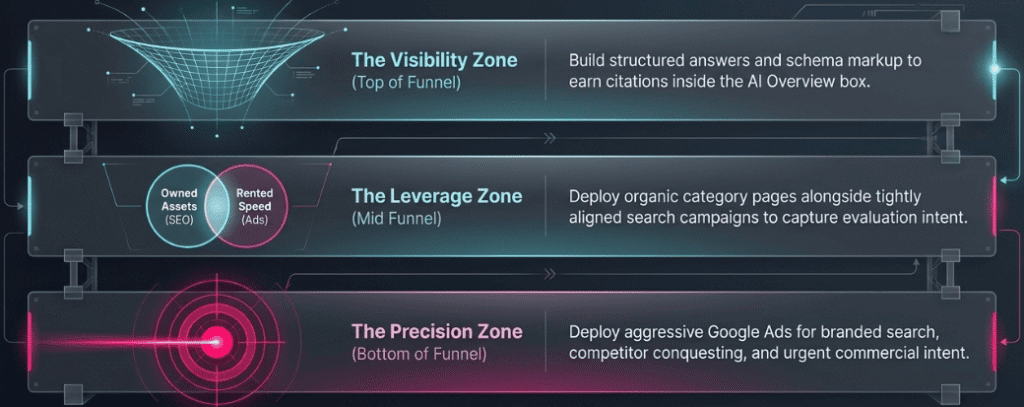
For D2C brands, that changes the top-of-funnel SEO strategy. Informational content still matters for authority and brand building, but it needs to earn real estate on the search engine results page through strong titles, structured answers, schema markup, and useful page formatting that positions you for AI Overview citations.
For example, a footwear brand can use SEO content for queries like how to clean suede sneakers, best walking shoes for travel, and why white sneakers turn yellow.
2. Mid Funnel is Where Overlap Creates Leverage
Here, SEO and Google Ads should both be active.
A shopper searching “best white leather sneakers” or “vegan tote bag comparison” isn’t fully sold. They’re evaluating. Relevant search results matter here. Organic category pages, comparison content, and well-built collection pages work at this stage. So do tightly aligned search campaigns sending traffic to matching landing pages.
A structured eCommerce sales funnel helps teams assign the right search asset to the right intent instead of dumping every query into the same campaign bucket.
3. Bottom of Funnel Belongs to Paid Precision
When the query is transactional, Google Ads usually deserves the budget first. Branded search, product-specific search, competitor conquesting, and shopping-led intent all sit here.
Use pay per click campaigns when the customer is close to purchase, and you need fast capture of urgent demand for proven SKUs, promotional control over sale messaging, limited-time offers, and SERP defense to protect branded demand from competitor bids.
SEO still plays a role at the bottom of the funnel through product and category pages. But if a term already signals commercial intent and your margin model supports paid acquisition, don’t wait for rankings.
Mapping SEO and Google Ads to funnel stages only works if you’ve clearly defined what each stage looks like for your specific store.

Pro Tip: If you haven’t done that yet, our guide on full-funnel marketing strategy for eCommerce walks you through how to assign the right channels, content, and KPIs to each stage.
Can SEO and Google Ads Work Better Together
Your Shopify team launches search campaigns for a new product line on Monday. By Friday, you already know which modifiers drive revenue, which landing page angles raise conversion rate, and which search terms waste spend. If that insight stays trapped inside Google Ads, your SEO program stays slow for no good reason.
The highest-performing D2C teams use Google Ads as a testing system for SEO, then use SEO improvements to make paid traffic more efficient. That two-way loop matters more in 2026 because AI Overviews are stripping clicks from broad, informational queries. Organic visibility alone no longer guarantees traffic.
Revenue teams need paid and organic search to operate from the same query, page, and margin data. This is what a comprehensive marketing strategy looks like in practice.
Google Ads Should Set SEO Priorities Faster
SEO roadmaps built only from keyword research and competitor exports are often too generic for eCommerce. Paid search gives you first-party evidence from your own store. You see which queries convert, which ad messages improve click-through rate, and which product themes fail even with a budget behind them.
Search engine algorithms reward pages that genuinely satisfy intent. When you know from paid data which terms your buyers actually use, you stop guessing and start building pages that both convert and rank.
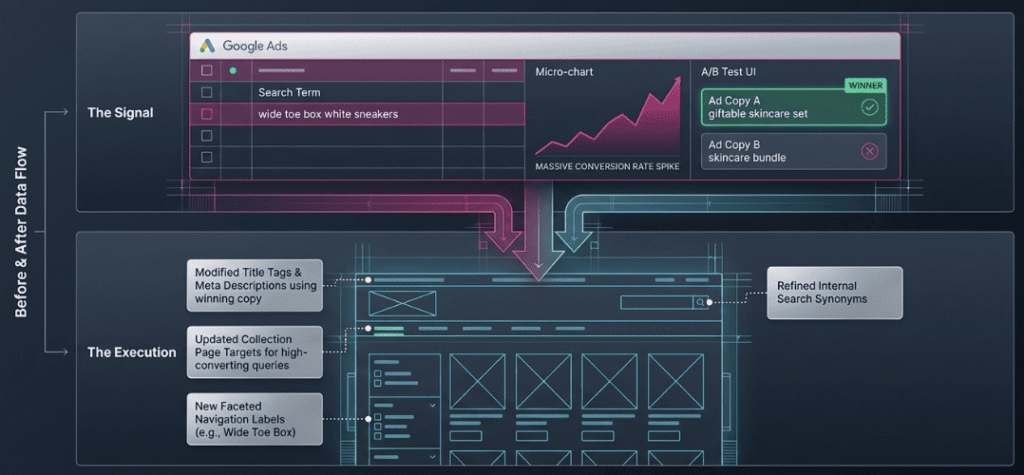
If your search campaigns show that “wide toe box white sneakers” converts better than broader category language, your SEO team should update collection page targets, on-page copy, product filters, internal search synonyms, and FAQ content around that demand pattern.
If “giftable skincare set” beats “skincare bundle” in ad copy tests, that insight should shape title tags, collection headers, and merchandising language across the site.
For Shopify brands, this usually means testing benefits, bundles, and product angles in ad copy before rolling the winning language into collection templates and product page modules. For Magento brands, especially after a Hyva or headless rebuild, it should influence category structure, faceted navigation labels, landing page taxonomy, and CMS content production.
One rule is simple: SEO should not guess what paid search has already validated.
Strong SEO Pages Improve Paid Economics
The feedback loop runs both ways. Better organic pages often become better paid landing pages because they match intent more closely, explain the product clearly, and create less friction between click and purchase.
On-page optimization directly improves your Google Ads Quality Score, which lowers your cost per click. This isn’t just theory. A user on Reddit shared how scaling an eCommerce brand from $200 to $1,200 per day in profitable spend came down to seven actions, one of which was implementing SEO to lower CPCs and cost per purchase, a real-world example of both channels reinforcing each other.
If your paid team sends traffic to thin campaign pages while your SEO team builds stronger commercial pages elsewhere, you are splitting data, splitting authority, and making both channels less efficient.
A better model is shared page ownership. One commercial page should be built to rank, convert, and support Quality Score unless there is a clear testing reason to isolate a campaign page.
AI Overviews Raise the Value of Coordination
Google’s expanded AI Overviews change the old SEO versus Ads debate. AI Overviews answer more upper-funnel questions directly in the SERP, which means many brands will see less traffic from educational content even when they remain visible.
For eCommerce leadership teams, the implication is straightforward. Use SEO to build long-term credibility and coverage around high-intent commercial topics. Use Google Ads to capture demand where AI layers compress or intercept clicks.
Then feed the paid search terms, ad copy winners, and audience signals back into SEO so your organic program generates traffic from terms with proven buying intent instead of vanity traffic.
Google Ads speeds up SEO decisions. SEO lowers paid friction and strengthens conversion paths. Brands that run both from one search strategy will adapt faster than brands that are still managing them as separate channels.
How Should You Split Your Search Budget
Your budget split should match your growth stage and cash-flow reality.
A Shopify brand doing $0 to $100K a month should not fund search the same way as a Magento store already doing seven figures with rising paid CAC. The underlying question is simpler. Where does the next dollar produce revenue now, and where does it reduce acquisition cost six months from now?
At Aureate Labs, we work with D2C brands on Shopify and Magento through exactly this decision, and the answer almost always comes down to growth stage and margin tolerance.
1. New Store Launch
For a new store, put Google Ads in front.
You need transaction data, search term reports, pricing feedback, and landing-page proof fast. SEO should start at the same time, but the first wave is infrastructure. Fix indexation, build collection-page architecture, clean up internal linking, write useful product and category copy, and make sure search engines can crawl and understand the catalog.
Commit most of the search budget to Google Ads for immediate results. Fund SEO foundations from day one. Use paid search queries and conversion data to decide which categories deserve a full SEO buildout.
AI Overviews make that sequencing more important for eCommerce brands. Informational clicks are getting squeezed on many searches, so leadership teams need clearer separation between content that builds authority and pages that capture immediate sales.
2. Scaling Brand
Once a D2C brand has product-market fit, SEO stops being a future project and becomes a margin project.
At this stage, the job is not to cut paid search. The job is to stop using paid search as your only source of demand discovery. Keep spending on terms that convert, then use keyword difficulty data to prioritize which organic opportunities are worth pursuing.
Build stronger category pages, expand subcategory coverage, tighten product-page relevance, and publish content that supports commercial searches instead of chasing broad traffic.
The Ads-to-SEO feedback loop pays off. Paid campaigns tell you which queries bring revenue, which messages lift CTR, and which landing pages convert by device, geography, and product line. Your SEO team should use that data to shorten the guesswork phase and focus on pages that can carry revenue.
3. Market Leader
A market leader should budget for defense, expansion, and efficiency.
Use SEO to hold and widen your footprint across core categories, brand-adjacent searches, and repeat-purchase journeys. Use Google AdWords for brand defense, product launches, high-margin pushes, and competitor terms where speed matters.
Brands that target specific demographics with paid campaigns while holding strong organic search rankings in their core category get the most efficient blended CAC. If your brand already has authority, the biggest mistake is overspending on paid clicks you could have earned organically.
Timeline Discipline Matters
Set expectations by quarter, not by hope.
In the first 30 days, Google Ads generates sales data, search term data, and landing-page feedback. From months 2 to 4, SEO fixes technical blockers, strengthens category and product templates, and publishes or improves commercial pages.
Constant optimization of both channels during this phase is what separates brands that compound efficiently from those that plateau. From months 4 to 9, higher rankings start appearing on proven terms, which lets the brand rely less on paid clicks for every sale.
Paid and organic should not run as separate reporting lines with separate keyword logic. They should operate as one revenue system, especially now that AI Overviews compress more upper-funnel traffic and increase the value of owning high-intent searches.
Conclusion
The SEO vs. Google Ads debate tends to produce the wrong answer because it starts with the wrong question. As we said at the top, this is a capital allocation decision, not a channel loyalty contest.
Google Ads buys you signal and speed. SEO builds the infrastructure that makes every future dollar cheaper. When you run them as one search system rather than two competing line items, paid campaigns stop being a pure media cost and start informing where organic investment will actually pay off.
In 2026, with AI Overviews compressing informational traffic and CPCs rising across most industries, coordination matters more than ever. Brands still treating these as separate budgets are leaving margin on the table.
If you want to see how this plays out in practice for a D2C brand at your growth stage, get a free search audit from Aureate Labs and walk away with a prioritized action plan.
The brands that figure out how to make paid search and SEO talk to each other will spend less to acquire the same customer six months from now. The ones that don’t will keep renting traffic at rising prices.
FAQs
Is Google Ads better than SEO?
Neither is categorically better. Google Ads wins on speed, control, and short-term demand capture. SEO wins on long-run ROI and margin. The right answer depends on whether you need revenue now or a lower acquisition cost later.
Is SEO dead or evolving in 2026?
Evolving, not dead. AI Overviews are reducing clicks on broad informational content, but high-intent commercial pages, category terms, and comparison queries still drive meaningful organic traffic. The shift rewards brands that build pages around actual buyer intent rather than generic keyword volume.
Is SEO more effective than Google Ads?
Over a long enough time horizon and with the right execution, SEO typically produces stronger economics because traffic accrues without paying per click. But “more effective” is context-dependent. A brand launching a new product today cannot wait six months for organic rankings.
What is the new SEO strategy in 2026?
The biggest shift is treating paid search data as the primary input for SEO prioritization rather than relying solely on keyword research tools. Beyond that, the focus has moved toward commercial intent pages, schema markup for AI Overview citations, technical performance, and tighter alignment between what converts in ads and what you build organically.
Resources:






Post a Comment
Got a question? Have a feedback? Please feel free to leave your ideas, opinions, and questions in the comments section of our post! ❤️