

Google Ads Agency vs In-House Team: 2026 Guide
When Google Ads starts driving serious revenue, the way you manage it stops being a tactical question and becomes a structural one.
Most eCommerce brands hit this decision while already under pressure. Spend is up, but efficiency feels murky. Reporting is shallow. Testing is slow. No one’s fully confident that the budget is going to the best opportunities.
What makes this harder is that Google Ads itself has changed. With Performance Max, AI Max for Search, and Smart Bidding now central to how campaigns run, the platform rewards teams that can combine specialist judgment with fast execution, not just someone who knows how to push buttons.
If you’re already running campaigns and suspect budget is leaking, see the most common eCommerce PPC mistakes that quietly drain ad spend before reading further.
This guide walks through the real trade-offs between running a Google Ads agency vs in-house team, working with an agency, what each model costs, and how to decide which fits where your business is right now.
Key Takeaways (TL;DR)
- Agencies win on speed and cost efficiency at lower-to-mid spend levels. In-house wins when you need daily cross-functional coordination and can staff a real team.
- A mid-level in-house PPC hire costs $8,000 to $12,000+ per month fully loaded. A mid-market agency runs $2,000 to $5,000 per month.
- Performance Max and AI Max for Search require pattern recognition that agencies running many accounts develop faster than most internal teams.
- The hybrid model is underrated: an internal lead paired with an external agency gives you business context plus specialist execution.
- There is no permanently correct answer. Revisit this decision as your spend, complexity, and team maturity evolve.
The Core Trade-Off: Control vs Specialization
The simplest way to frame this decision is control versus specialization.
What Control Actually Means
In-house management means your team is immersed in the business all day. They know which SKU margins changed this morning. They can align campaign priorities with sales forecasts, promotions, inventory, and leadership decisions without waiting for a weekly call.
That embedded context matters most when your business is operationally complex, and campaign decisions constantly touch other functions. When you manage your own account, you don’t have to translate business context across an external relationship; it’s already in the room.
Internal teams can provide deep brand intimacy, leading to more authentic brand messaging and a better understanding of unique value propositions.
What Specialization Actually Buys You
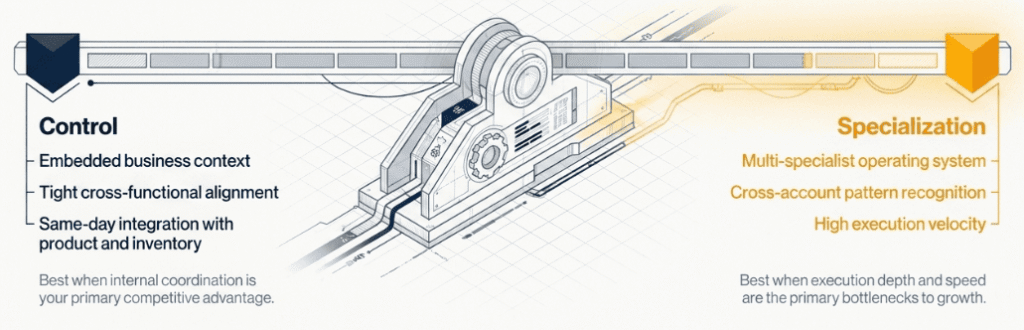
Agency expertise isn’t just extra hands. You’re buying a multi-specialist operating system. Paid search strategy, feed management, audience structure, bid optimization, experimentation, and performance diagnosis are distributed across people who work in those disciplines every day, across multiple clients.
That matters because the platform has gotten complex. Managing Performance Max, layering RLSA audiences, maintaining Shopping feed quality, and running structured tests simultaneously is a lot to ask of one or two internal people. Agencies that work across multiple clients develop cross-account insights that a single in-house operator simply can’t accumulate at the same pace.
Practical rule: If your growth bottleneck is execution quality, specialized expertise usually creates more value than additional control.
The Hidden Strategic Question
Most leaders say they want control. What many actually need is decision confidence.
Direct control helps when your team already knows what to do. Specialization helps when the challenge is figuring out what to do next, faster than your competitors.
Choose control when internal coordination is your main source of competitive advantage. Choose specialization when execution depth and speed are what’s holding growth back.
A True Cost Comparison of Key Decision Factors
Choosing between an agency and an in-house team isn’t just a budget decision; it’s an operational one. Here’s how the two models actually compare across cost, performance, speed, and team structure.
1. Cost and ROI
The most common mistake in this analysis is comparing an agency fee to salary alone. That ignores benefits, tools, training, recruiting costs, management time, and the revenue impact of slower optimization. Running a proper true cost comparison means accounting for all of it.
Here’s what the numbers actually look like in 2026:
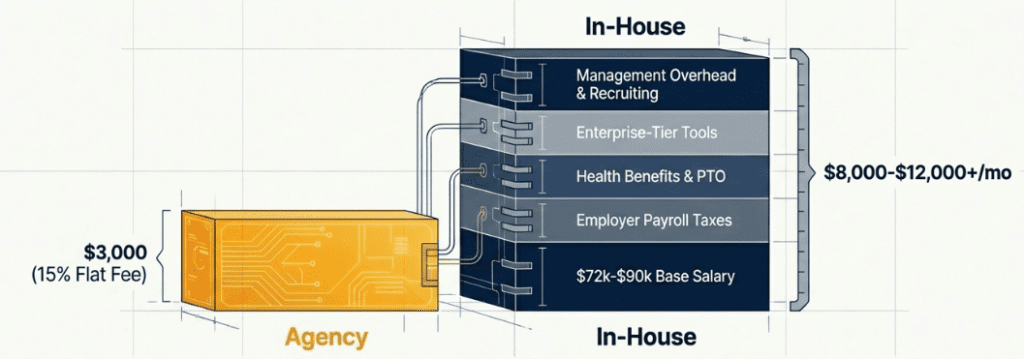
A mid-market Google Ads agency typically charges between $2,000 and $5,000 per month on a flat retainer, or 15% to 20% of monthly ad spend on a percentage model. For a business spending $20,000 per month on ads, a 15% fee comes to $3,000 in management costs.
A mid-level PPC manager in the US earns roughly $72,000 to $90,000 per year in base salary. Once you add employer payroll taxes, benefits, advanced tools, and the management overhead required to support them, the fully-loaded monthly cost sits between $8,000 and $12,000 or more, depending on location and experience.
The math tends to favor agencies at lower and mid-range spend levels. But cheap execution is not efficient execution. A lower-cost structure only helps if it protects margin. Weak account management, poor budget allocation, and stalled testing can produce worse contribution profit even when the line-item cost looks lower.
2. Performance and Expertise
Performance differences between agency and in-house usually come down to specialization density. One capable in-house marketer may handle the basics well. Agency teams spread responsibility across operators, analysts, and strategists who review many accounts and spot failure patterns earlier.
That matters because small execution gains compound. Better keyword research, tighter Shopping feed hygiene, cleaner audience segmentation around the right target audience, and disciplined testing of ad groups can improve ROAS without increasing budget.
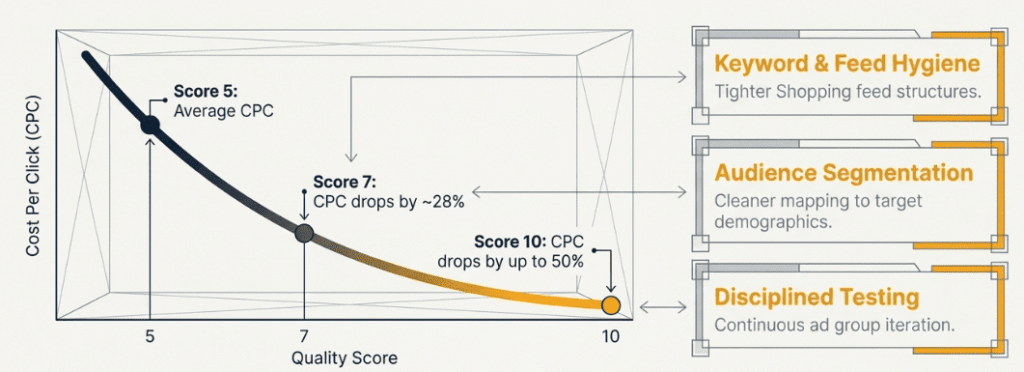
Quality Score is a useful example. Improving from a score of 5 (the average) to a 7 reduces cost per click by roughly 28% on average. Getting to a 10 can cut CPC by up to 50% compared to baseline. With smart bidding increasingly managing bids automatically, Quality Score improvements now also flow through to better ad rank and higher click volume. The principle of improving relevance still reduces wasted spend; it just shows up differently in practice.
It’s also worth noting that poor performance is often a systems problem, not just a bidding problem. Tracking gaps, weak landing pages, and poor offer-message alignment frequently depress results more than bid strategy does.
If your conversion rate is underperforming relative to your traffic, check eCommerce conversion rate benchmarks by industry to understand where you actually stand.
3. Speed and Scalability
Growth velocity changes the economics of this decision significantly.
If your business needs to launch advertising campaigns quickly, test new offers, support seasonal demand, or expand into new product lines, agency capacity usually creates less drag. Hiring internally takes time. Ramp time takes longer. During that window, you’re still spending, and competitors are still iterating.
Agencies can scale campaigns by reallocating resources and adding specialists as priorities shift, without adding headcount complexity on your side.
The rise of Performance Max and AI-driven campaign types requires active oversight, structured data inputs, audience signals, creative testing, and ongoing budget decisions. Agencies managing these across many accounts build pattern recognition that a lean internal team typically can’t match early on.
In-house teams scale well once the company has built the right structure around them. Until then, growth tends to outpace internal capacity.
4. Team and Tooling
Single-person in-house setups carry a specific risk: one person becomes the bottleneck for strategy, execution, reporting, and troubleshooting simultaneously. As the account grows, that problem gets worse, not better.
Agencies spread that risk across multiple specialists and typically bring established workflows and enterprise-tier tools from day one. Internal teams gain the advantage when the business can support real role depth, clear process ownership, and tight cross-functional coordination.
Until that structure exists, agencies usually provide better coverage per dollar and less exposure to turnover or skill gaps.
| Pillar | Agency Advantage | In-House Advantage |
| Cost structure | Lower fixed overhead at early/mid stages | Better economics once spent, and team utilization is consistently high |
| Performance | Broader specialist coverage; cross-account pattern recognition | Stronger brand context and tighter business alignment |
| Speed | Faster launch capacity; easier scale during demand spikes | Faster internal decisions once the full team is in place |
| Tooling and coverage | Full ownership of systems, processes, and institutional knowledge | Better economics once spent, and team utilization are consistently high |
When to Build an In-House Google Ads Team
Building in-house makes the most sense when scale and complexity rise together. High spend alone isn’t the trigger. The stronger signal is repeated demand for tight coordination across pricing, promotions, inventory, finance, analytics, and creative, and a marketing team with the capacity to own it properly.
Signs Your Business is Ready for Internal Ownership
An in-house marketing function for Google Ads usually makes sense when several of these are true at the same time:
- Media spend is large enough to keep multiple specialists productive: The business can support role depth across campaign strategy, execution, analysis, and creative testing, not just one person doing everything.
- Growth depends on cross-functional speed: Managing campaigns in-house means campaign decisions can get direct, same-day input from product, merchandising, or finance. When delays from an external agency are creating measurable waste, that’s a signal.
- The Google Ads account is structurally demanding: Multiple markets, product lines, margin tiers, or complex promotional calendars require constant internal alignment that an external agency can’t efficiently manage.
- Google Ads is becoming company knowledge, not just channel execution: Bid logic, testing history, search advertising data, and audience learnings need to stay inside the business long-term.
- Leadership can actually manage the team: Someone internally can hire well, set clear standards, and review campaign performance, not just receive reports.
Why In-house Gets Stronger as the Business Matures
The strongest case for internal ownership appears when Google Ads stops being a standalone acquisition channel and starts functioning as part of the operating model. Product availability changes conversion rates. Pricing strategy changes acceptable CAC. Landing page priorities affect traffic quality more than bid adjustments do.
For a deeper look at how conversion bottlenecks compound, eCommerce growth strategy guide covers how paid media, CRO, and retention connect as the business scales.
In-house teams handle this better because they sit closer to the people who control those inputs. They also build institutional memory around seasonality, offer fatigue, product-level demand shifts, and historical test results. That improves prioritization over time. That kind of accumulated context is hard for an external agency to replicate.
What Must Be True Before You Hire In-house?
Building in-house only works when the business is prepared to fund a real function, not a single overwhelmed hire.
That means salary, benefits, management overhead, tooling, and coverage during turnover or leave. Deciding to hire in-house is a commitment to the full structure, not just the headcount. One junior PPC hire may keep campaigns running, but that’s different from building a reliable growth system.
Without enough role depth, one person carries strategy, execution, analysis, experimentation, and stakeholder communication at once. Performance usually plateaus because the structure is too thin, not because the person is weak.
When to Hire a Google Ads Agency
An agency wins when growth demands outpace internal capacity. That applies to early-stage brands, but it also applies to established businesses launching new categories, entering new markets, or trying to fix a plateau without slowing operations down.
The Best-fit Situations for Agency Support
- You need execution speed now: Agencies can onboard faster and absorb workload immediately without the recruiting and ramp time of a new hire.
- Your spend doesn’t yet justify a full internal build: For most e-commerce businesses operating below $150,000 to $200,000 in monthly ad spend, the fully-loaded cost of a properly staffed in-house team is hard to justify against a well-run agency engagement.
- You need cross-functional marketing depth: Effective PPC management in 2026 depends on SEO, CRO, analytics, feed management, and creative testing working together. One internal hire rarely covers all of that at a high level.
- You’re in a testing phase: Agencies bring new ideas and innovative strategies faster when you need to learn quickly before locking in a permanent operating structure.
- You have limited internal resources: If your current team is already stretched across multiple digital marketing efforts, adding full Google Ads management in-house often means something else breaks.
Why Agencies Help During High-velocity Growth
Growth creates volatility. Campaign priorities shift. New products launch. Offers change. Performance swings across markets, devices, and audience segments. Businesses in that phase need a team that can respond without adding payroll complexity every time priorities change.
A Google Partner agency brings verified platform expertise, access to beta features, and dedicated Google account support that most in-house teams don’t get. This matters more now that Performance Max and AI Max for Search require active oversight, not set-and-forget management.
In 2026, Performance Max is expected to be the default for most campaigns, with agencies handling complex, AI-driven feeds better due to more data signals.
Good agencies also bring competitive analysis and competitive intelligence built from running ppc campaigns across many industries and spend levels. That kind of perspective is hard to build internally without years of cross-account experience.
The best agency relationships don’t remove accountability. They sharpen it because performance is reviewed from the outside and tied directly to business objectives.
What to Watch Out For
One real risk with agencies is the too many clients problem. Some agencies grow their client base faster than their team. When a single account manager is juggling 20+ accounts, your Google Ads account stops getting the attention it needs. Ask directly how many accounts each manager handles and how decisions get escalated.
At Aureate Labs, each account has a dedicated team with clearly defined ownership, not a shared queue.
The Hybrid Model: A Powerful Alternative
The best answer often isn’t purely agency or purely in-house. A hybrid model lets you keep internal strategic ownership without giving up specialist execution. For many eCommerce brands, this is the most practical structure.
Model 1: Internal Strategy, External Execution
An in-house lead owns goals, brand alignment, budget priorities, and cross-functional communication. The external agency handles Google Ads management, campaign execution, ad creation, testing, optimization, and reporting. This works well when leadership wants strategic control but isn’t ready to hire a full bench of paid media specialists.
The internal lead must be substantive, not symbolic. If nobody inside the company can challenge assumptions or connect campaign decisions to business priorities, this model weakens fast.
Model 2: Core In-house Coverage, Agency Specialists
Some brands already have a capable internal team managing core advertising efforts. Their problem is edge-case complexity. In that situation, keep core ownership inside the business and bring in agency management for specific needs: market expansion, account restructuring, Shopping feed diagnostics, or high-stakes promotional periods.
This also works well for brands running both Google Ads and Microsoft Ads. Managing two platforms with full depth is a lot for a small internal team, bringing in agency support for the secondary platform is often the right call.
Model 3: Agency-led Capability Transfer
A company hires an agency with the explicit expectation that internal capability will grow during the engagement. The agency runs the entire account, documents process, builds reporting discipline, and helps train an internal hire who eventually takes over more responsibility.
This is the most underrated version of the hybrid model. It’s also the model Aureate Labs uses most often with eCommerce brands that are building toward internal ownership over time.
How to Make Hybrid Work
Hybrid models fail when roles are unclear. Keep responsibilities explicit:
- Internal team owns: business goals, margin context, approval logic, product priorities, and landing page alignment.
- Agency owns: platform execution, testing cadence, diagnostics, optimization routines, and specialist recommendations, including negative keywords management and ad groups structure.
- Shared responsibility: reporting, budget decisions, forecasting assumptions, and post-mortem analysis.
Your Decision Framework
A useful decision framework starts with business reality, not preference.
Four Questions that Clarify the Right Model
- Is Google Ads spend high enough to justify multiple dedicated hires?
If yes, in-house becomes more viable. If not, an agency or a hybrid usually makes more sense. - Does your business require daily coordination with internal teams for ppc strategy to work? If decisions constantly depend on engineering, merchandising, or sales context, in-house gains real value.
- Is speed-to-market more important right now than building internal ownership?
If yes, agency support usually wins. - Do you need specialist depth across more than one growth lever?
If your digital marketing needs span paid search, SEO, CRO, and analytics together, hybrid or agency models reduce strain and execution risk.
Transition Checklist for Hiring an Agency
- Keep account ownership inside your business: Platform access, conversion tracking, audience lists, and conversion history for your Google Ads account should stay with you, not the agency. This is non-negotiable.
- Test strategic thinking, not just certifications: Ask how they approach keyword research, diagnose wasted spend, prioritize experiments, and handle margin-sensitive decisions.
- Set operating rhythm upfront: Review cadences, escalation paths, decision rights, and success metrics before advertising campaigns expand.
- Fix attribution before scaling: If attribution and event tracking are weak, fix that early. Better marketing analytics for ROI improvement often matters as much as campaign changes.
Transition Checklist for Building In-house
- Hire for business judgment first: Your first paid media hire should understand trade-offs across the whole business, not just the platform interface.
- Define adjacent support before you hire: Decide who owns landing pages, feed quality, ad creation, and analytics reporting.
- Build reporting standards early: Document testing routines and budget governance before scale adds noise.
- Create redundancy: Critical knowledge about managing campaigns shouldn’t live with a single person.
Conclusion
When Google Ads was a smaller part of your business, the management question was simple. Now that it touches inventory planning, cash flow, and growth targets, the answer has to match the complexity.
The Google Ads agency vs in-house team decision isn’t about preference. It’s about what your business actually needs right now: speed and specialist depth, or tighter internal control and cross-functional ownership. Most brands benefit from an agency early, a hybrid structure mid-growth, and a properly staffed in-house team once the operational complexity justifies it.
What you can’t afford is to leave the decision on autopilot. The wrong structure compounds quietly through slow testing, shallow reporting, and budget waste that looks small week to week but adds up fast.
If you’re ready to stop guessing and build a paid media setup that’s right for your stage, see how Aureate Labs has helped eCommerce brands like yours scale Google Ads profitably. Contact us today!
The question isn’t just agency or in-house. It’s whether your current setup is actually built to grow.
FAQs
What is the 3-3-3 rule in marketing?
The 3-3-3 rule is a messaging framework suggesting you have roughly 3 seconds to grab attention, 3 lines to communicate your core value, and 3 seconds for the reader to decide whether to keep engaging. In the context of Google Ads, it’s a useful reminder that ad copy needs to lead with the most relevant message immediately, before the reader scrolls past.
Is $20 a day good for Google Ads?
It depends heavily on your industry and goals. At $20 per day ($600 per month), you can test basic search campaigns and gather early data. Still, in most competitive eCommerce categories, the budget will limit your reach and slow down optimization. For meaningful performance data and reliable results, most businesses need at least $1,000 to $2,500 per month to work with.
What are three drawbacks of in-house marketing?
First, a single in-house hire often stretches across strategy, execution, and reporting simultaneously, limiting depth in any one area. Second, in-house teams build expertise slowly because they only see one account. Third, the true, fully-loaded cost is almost always higher than it looks on paper once you factor in benefits, tools, and turnover coverage.






Post a Comment
Got a question? Have a feedback? Please feel free to leave your ideas, opinions, and questions in the comments section of our post! ❤️