

Google Ads Quality Score: D2C Success Playbook

Rising CPCs are easy to blame on competition or seasonality. But in a large number of D2C eCommerce accounts, the quieter problem is relevance. Recent coverage shows that moving from an average Quality Score to a top score can cut CPC by roughly 25% to 50%, depending on the account and keyword mix (Ryze).
Google sees a weak connection between the search term, the Ad, and the landing page, and then charges you more to keep showing up. That gap is exactly what Quality Score measures.
For D2C brands working with a Google Ads agency on Shopify or Magento, Quality Score sits right at the intersection of paid acquisition and on-site conversion. Weak product page speed, messy keyword grouping, vague ad copy, and poor message match all show up here long before your finance team calls out rising CAC.
This playbook breaks down how Google Ads Quality Score works, what actually moves it, and the exact sequence to improve it across your highest-revenue search terms.
Key Takeaways (TL;DR)
- Google Ads Quality Score is a diagnostic tool (1–10), not a bidding lever, but it directly controls what you pay per click and where your ads appear.
- Three components drive the score: expected CTR, ad relevance, and landing page experience. Each one sits with a different team inside your org.
- A weak score on your highest-spend keywords is often a storefront problem, not just a media problem. Slow PDPs, poor message match, and bloated Shopify or Magento themes all show up here.
- You do not need a 10/10 across the board. Focus on pulling 1–4 scoring keywords up. That is where the real efficiency gains are.
- The fastest path to improvement: tighten ad groups, rewrite copy around search intent, match each cluster to the right landing page, and fix mobile UX on the templates carrying the most paid traffic.
What Is Google Ads Quality Score?
Google assigns Quality Score at the keyword level on a scale of 1 to 10. It is a diagnostic rating built from three components, each rated as above average, average, or below average. The score does not directly enter the auction, but it shapes your Ad Rank, which determines where your ad appears and what you pay per click.
For D2C teams, the important thing to understand is that each component sits with a different owner inside your organization. If paid media, merchandising, CRO, and dev work in silos, Quality Score almost always stalls at average.
Three Components of Google Ads Quality Score
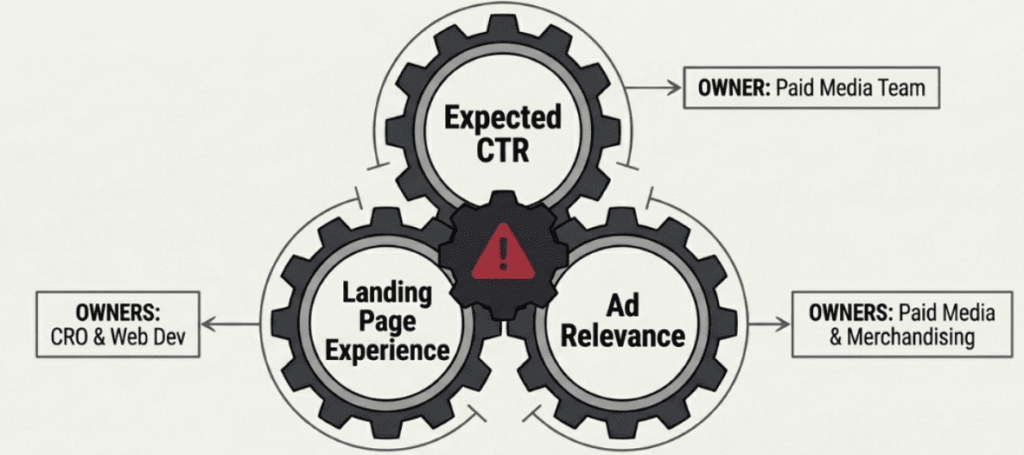
1. Expected Click-Through Rate:
Expected CTR is Google’s estimate of how likely a searcher is to click your ad for a given keyword, before ad position fully distorts the result. It reflects whether your ad copy matches the buying intent behind the search.
A D2C brand selling apparel or supplements hurts expected CTR by writing broad ads for tightly defined searches. “Shop premium activewear” is weak if the query is “high-waisted black flare leggings.” The closer the ad mirrors the intent, the better Google expects the click.
2. Ad Relevance:
Ad relevance measures how closely your keyword and ad copy align with what the shopper searched for. To keep ads relevant and make sure your ads align with search intent, this needs to be an account design decision as much as a copywriting one.
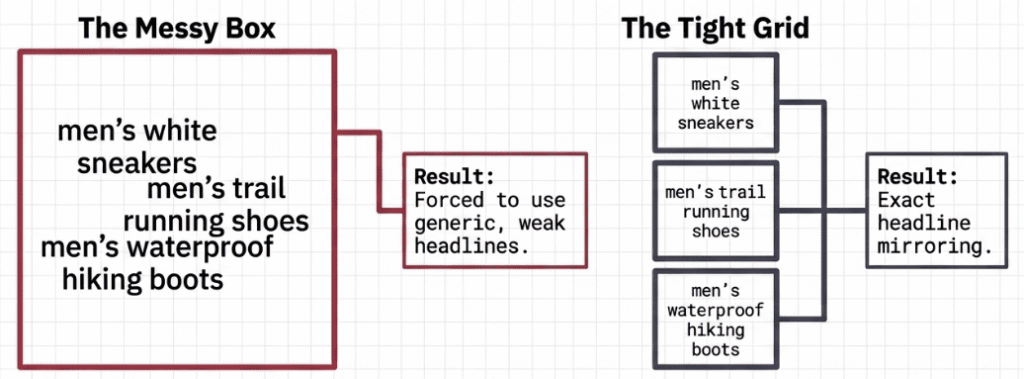
A generic ad group that mixes “men’s white sneakers,” “men’s trail running shoes,” and “men’s waterproof hiking boots” forces generic headlines. Google reads that as a loose match.
For eCommerce brands with large catalogs, product feed quality affects this more than most teams expect. Vague product titles and inconsistent category labels make it harder to segment search themes cleanly.
3. Landing Page Experience:
This is where media efficiency connects directly to CRO and platform performance. Google evaluates whether the page is relevant, useful, and easy to use after the click.
A poor landing page experience for D2C often looks like this: the ad promotes a specific SKU, but the click lands on a broad collection page. The PDP is slow on mobile because of the Shopify app bloat. A Magento build forces extra variant selection before the shopper can confirm color or size. The headline does not reflect the product that the Ad promised.
Before running a Quality Score audit, check your mobile page speed first. A slow PDP will drag down landing page experience scores across every keyword pointing to that page. Fixing one page can lift Quality Score on dozens of terms at once.

Pro Tip: Not sure where your store stands? Our eCommerce A/B testing guide covers how to test page changes systematically before rolling them out across your templates.
Why Quality Score Directly Affects Your Growth Economics
Marketing directors do not need another diagnostic number unless it changes business outcomes. Quality Score does.
In Google’s auction, Ad Rank is tied to both your bid and your Quality Score. A stronger score acts like a discount on visibility. A weak score behaves like a surcharge. Two brands can compete in the same auction, and the one Google sees as more relevant often wins better ad placements at a lower effective cost.
What the Quality Score Stats Show
Google still defines Quality Score as a keyword-level metric based on expected CTR, ad relevance, and landing page experience. Keywords with Quality Scores of 9–10 had a 27% CTR, compared with 2% for keywords scoring 1–2, showing how stronger relevance can translate into better engagement (GrowByData).
Recent 2026 benchmark reporting also suggests that high-Quality-Score accounts can pay materially less per click, though the exact reduction depends on the account and auction.
The table below shows the trade-off:
| Quality Score | Ad Rank (at $2 max bid) | Bid Pressure | Efficiency |
| 10 | 20 | Low | Strong discount potential |
| 7 | 14 | Moderate | Competitive without heavy bidding |
| 5 | 10 | Baseline | Neutral |
| 4 | 8 | Elevated | Premium pressure starting |
| 2 | 4 | High | Must overbid to maintain position |
This table does not predict your exact CPC. It shows the dynamic. If your score is low, the bid becomes your crutch. If your score is high, relevance does more of the work.
The Downstream Business Impact
Low Quality Score affects more than media efficiency. For D2C brands, it sits upstream of multiple business outcomes at once:
- Lower costs: It means you can buy the same traffic more efficiently.
- Higher Ad Rank: It means a higher quality score unlocks better ad placements and stronger impression share without needing a bigger bid.
- Tighter message match: Better alignment between Ad and page means the traffic arriving is easier to convert.
- Lower acquisition friction: It gives you more margin to test feeds, promotions, and landing page variants at scale.
A low score does not always mean “pause the keyword.” It usually means “stop paying for traffic that arrives at a poor user experience.”
Quality Score Myths D2C Teams Should Stop Believing
Getting your overall quality score to a healthy level requires clearing out some bad assumptions first. Here are the ten most common ones.
Myth 1: Quality Score Is a Key Performance Indicator
- The Reality: Quality Score is a diagnostic tool, not a key performance indicator. It measures how well your keywords, ads, and landing page work together. It does not measure profitability.
- D2C Action: Focus on ROAS, CPA, and conversion rate as your actual KPIs. A keyword with a 6/10 score that drives high-profit conversions is more valuable than a 10/10 keyword that generates zero sales. Use Quality Score to find friction, not to judge campaign health on its own.
For more on the broader patterns that inflate acquisition costs, see our breakdown of common eCommerce PPC mistakes.
Myth 2: You Must Achieve a 10/10 Score for All Keywords
- The Reality: Raising a keyword from an 8 to a 10 often yields diminishing returns compared to fixing a keyword sitting at 3/10. A score of 7 to 10 is generally efficient. The real gains come from pulling poor performers up, not chasing perfection on already-healthy terms.
- D2C Action: Use the 1 to 10 scale to identify actively harmful keywords in the 1 to 4 range. Prioritize those first. Do not let the pursuit of 10/10 distract from more impactful account work.
Myth 3: The 1–10 Score Directly Affects Real-Time Bids
- The Reality: Google has stated that the visible 1 to 10 score is not used in real-time auction calculations. The auction uses the underlying data, expected CTR, ad relevance, and landing page experience, to determine Ad Rank. The number you see is a summary for your reference, not a live input.
- D2C Action: Do not react to daily score fluctuations. Focus on the component ratings (Above average / Below average) to understand where you are actually falling short, and work on those.
Myth 4: Pausing Low-Score Keywords Is the Best Strategy
- The Reality: Pausing a keyword erases its historical data. If you reactivate it later, it essentially starts from scratch, which can hurt your account’s ability to build relevance signals over time. A low-scoring keyword may also still serve a role in brand visibility or top-of-funnel discovery.
- D2C Action: Instead of pausing, diagnose and repair. Check whether the ad copy is relevant to the search term. Check whether the landing page delivers on the ad’s promise. Fix the inputs before you remove the keyword.
Myth 5: Landing Page Experience Is Only About Page Speed
- The Reality: Speed matters, but relevance matters just as much. A fast-loading page that does not deliver on the ad’s promise will still receive a low landing page experience rating. Google is evaluating whether the page answers what the searcher came for, not just how quickly it loads.
- D2C Action: Ensure your landing page directly reflects the keyword intent, features the product mentioned in the ad, and provides a clear path to purchase on mobile. Speed and message match need to work together.
Myth 6: You Need Single Keyword Ad Groups (SKAGs) to Get High Scores
- The Reality: Tight thematic grouping is important, but modern Google Ads with Smart Bidding often performs better with broader thematic groups that allow for more data collection. Over-segmentation can prevent Smart Bidding from learning effectively and fragment the conversion data each group needs to optimize.
- D2C Action: Create tightly themed ad groups around product categories or intent clusters (for example, “moisturizer,” not “skincare”), but do not feel forced to create a separate ad group for every single keyword. Let the theme drive the structure, not the desire for a perfect score.
Myth 7: Quality Score Does Not Apply to PMax or Broad Match
- The Reality: Performance Max campaigns do not show a numeric Quality Score, but Google still evaluates the quality of your assets and landing pages. Low-quality assets lead to lower reach and higher effective costs, regardless of campaign type. The same logic applies.
- D2C Action: For automated campaigns, treat Ad Strength and asset variety as your quality signals. Focus on giving the system strong headlines, descriptions, images, and landing pages. The AI uses these inputs the same way Quality Score uses keyword-level signals in Search.
Myth 8: Niche D2C Brands Are Stuck With Low Scores
- The Reality: Low-volume keywords lack historical data, which can drag on expected CTR and relevance signals. But that is a harder starting point, not a permanent ceiling.
- D2C Action: Use Performance Max campaigns with custom audience segments to bootstrap historical data for low-volume terms. Running the same keywords across both PMax and Search helps build relevance signals faster. PMax does not replace the search structure, but it helps bridge the data gap.
Myth 9: Quality Score Only Concerns the Paid Media Team
- The Reality: Every function that touches the product experience shapes at least one Quality Score component. Merchandisers determine feed title quality. CRO teams decide whether a PDP clearly presents the offer. Developers determine whether the page loads quickly on mobile.
- D2C Action: If your Shopify theme bloats collection pages or your Magento store renders slowly before a product image appears, the paid team absorbs that cost in Quality Score and CPC. Search performance often improves after a site cleanup, even when bids barely change. Treat Quality Score as a cross-functional metric.
Myth 10: Acceptable ROAS Means Quality Score Can Be Ignored
- The Reality: A campaign can hit the target while carrying avoidable inefficiency. This is common in branded search, high-AOV categories, or periods when demand is strong enough to mask account waste.
- D2C Action: If Quality Score is weak across a theme, it signals that scaling will get expensive sooner than it should. Unchecked inefficiency quietly drains your ad budget before it shows up in ROAS. Audit relevance before you add ad spend.
How to Diagnose Quality Score in Your Google Ads Campaigns
The right way to read Quality Score is not “this keyword is a 6, so it is bad.” The useful question is: which component is weak, and what specific action addresses that weakness?
How to Find Quality Score in Your Account
In Google Ads, go to your keyword reporting view and add these columns:
1. Sign in to your Google Ads account.
2. Select Campaigns or Search Keywords from the left-hand menu.
3. Click the Columns icon (Modify columns) in the top right.
4. Expand the Quality Score section.
5. Check the boxes for:
- Quality Score (your current quality score for each keyword)
- Expected CTR (component rating)
- Ad Relevance (component rating)
- Landing Page Experience (component rating)
To access your scores quickly, use the Quality Score column in the keyword view, it is the fastest way to spot which terms need attention. The component ratings matter more than the headline number because they tell you where the friction is.
Reviewing a specific keyword’s quality score alongside its component breakdown gives you a much clearer picture than the number alone.
Reading What You See
Use the component ratings as a decision tree:
When Expected CTR is Below Average
Start with the ad copy. Ask whether the ad matches the user’s search query closely enough to earn the click:
- Does the ad mention the exact product type, category, or use case?
- Is the offer obvious? (price, shipping, promotion, product benefit)
- Would a first-time shopper understand why your result is worth the click?
- Are there mismatches between the target keyword and the headline?
Generic copy is the usual culprit. “Shop premium skincare online” will not compete as well as ad copy written specifically for a search theme.
When Ad Relevance is Below Average
This is almost always a structure problem. Check whether the ad group holds too many keyword themes. If one ad group mixes branded, category, and problem-aware searches, your ads cannot stay tightly matched. Split themes until the copy can mirror intent cleanly.
When Landing Page Experience is Below Average
Open the page on mobile and act like a first-time shopper. Check for:
- Load speed issues: slow render, heavy imagery, unstable layout
- Message mismatch: the ad promised a product or discount that is not obvious on arrival
- Friction in the buying path: hidden add-to-cart, awkward variant selection, cluttered above-the-fold design
- Trust signals are buried too far down the page
Do not diagnose landing page experience from a desktop preview. Paid traffic exposes mobile friction first. If you are on Shopify and load speed is a recurring issue, our guide to Shopify speed optimization covers the most common causes and how to fix them.
A Practical Review of Cadence
- Pull Quality Score component columns weekly for your top commercial search themes.
- Flag “Below average” components by ad group or category.
- Assign each issue to the right owner: paid media handles ad and keyword structure, CRO handles page clarity, and dev handles speed.
- Compare with performance movement. If CPC pressure and weak component ratings rise together, the diagnosis is usually reliable.
A user on Reddit noted that after splitting landing pages by intent, scores didn’t move for two weeks, a reminder that Quality Score updates lag behind changes, so give fixes time before concluding.
How Do D2C Brands Actually Improve Quality Score?
Stop chasing a 10/10 across every keyword. That is not how this works. To increase quality score where it actually matters, focus on your highest-revenue search themes, that is, where the gains land: lower click costs, cleaner traffic, and more effective ad campaigns that convert when shoppers arrive.
Here is how to get there.
Why Are People Not Clicking Your Ads?
If the expected CTR is weak, the ad is probably not matching the user’s search intent. That is the whole problem. When you write ad copy, your goal is to make someone feel like they found exactly what they searched for. High-quality ads do not just describe the product; they reflect the user’s search and make the click feel obvious.
Strong D2C ad copy does four things:
- Mirrors the search closely: name the product type, attribute, use case, or problem being solved.
- Makes the click feel worth it: lead with something the shopper cares about: price, shipping speed, a bundle deal, ad extensions like promotions or ratings, or a clear product benefit.
- Filters the wrong people out: if the product is premium, custom, or subscription-only, say so. Bad clicks waste budget.
- Points to the right page: specific product intent goes to a PDP. Broader comparison intent goes to a collection page.
Take a D2C supplement brand as an example. “Collagen peptides,” “marine collagen,” and “unflavored collagen powder” are all in the same category, but they need compelling ad copy tailored to each and different landing pages to match. Send all three to a generic RSA and one broad collection page, and CTR drops, conversion softens, and CPCs climb.
Is Your Account Structure Working Against You?
Low ad relevance is rarely a writing problem. It is a structural problem. To optimize ad relevance, you need to stop letting ad groups carry more ground than they can cover. When an ad group tries to serve too many different searches at once, your ads will never reflect what the user’s search query actually was. The fix is to create ads that are built around tight, specific themes using your most relevant keywords.
What works:
- Tight thematic ad groups where every keyword shares one intent and one message
- Headlines that reflect how shoppers search, not how you label products internally
- Product-specific searches are getting product-specific ads, not homepage copy
- Solid negative keywords that keep category, brand, and product-level traffic from bleeding into each other
What hurts:
- One ad group holding multiple unrelated product families
- The same RSA copy is running across large sections of the account
- Keywords with different intent all pointing to the same landing page
- Broad match without enough negative keyword control to keep things clean
Feed discipline matters here, too. If your Shopify product titles are vague or your Magento taxonomy is inconsistent, that messiness carries into your ads and landing pages. More relevant ads become harder to build when the underlying catalog is noisy.
What Happens After the Click?
This is where a lot of D2C accounts quietly bleed money. The ad is fine. The keyword is relevant. The bid strategy is reasonable. But the shopper lands on a slow PDP, waits for review widgets and app carousels to load, fumbles with a variant selector, and leaves.
For Shopify brands, this usually comes from heavy themes, too many apps, and oversized media. For Magento brands, front-end weight and theme architecture are often the culprits. A Hyvä-based front end can help by cutting the overhead that paid traffic feels most.
It is one of the reasons Aureate Labs recommends Hyvä to Magento brands where paid traffic is a meaningful acquisition channel. Fixing front-end weight directly boosts quality score because landing page experience is one of the three components Google is evaluating.
Audit your PDPs and collection pages like paid landing pages, not browse pages. Check for:
- Message match: within two seconds, the product or offer from the ad should be obvious.
- Mobile usability: price, hero image, variant options, and add-to-cart all visible without scrolling or friction.
- Trust signals: shipping, returns, delivery timing, and reviews should be easy to find, not buried.
- Clean buying flow: no confusing variant logic, broken CTAs, or intrusive popups before the shopper decides.
- Speed: core content loads fast, especially on mobile connections.
If the ad says “20% off protein bundles,” the page needs to confirm that immediately. If the search is “black linen duvet cover queen,” do not make the shopper dig through a general bedding collection to find it.
Is Your Landing Page Built for Paid Traffic or Just for Browsers?
A page can convert fine for returning visitors and still underperform for paid search. Paid clicks arrive cold. The shopper formed a specific expectation from the query and the ad, and if the page does not meet that expectation in the first few seconds, both Quality Score and conversion rate suffer. As the page experience improves, the quality score increases, and your overall ad performance strengthens along with it.
CRO changes that help paid landing pages:
- Move the product promise above the fold
- Cut visual clutter from the collection and PDP templates
- Write headlines and subheadings around search intent, not brand voice
- Make pricing and promotions easy to confirm without scrolling
- Fix mobile CTA placement and variant selection
- Get trust signals higher on the page
Collection pages need extra scrutiny here. They work well for people browsing, but often fail as paid landing pages because they do not tell the shopper which product fits their search. A “running shoes” collection page likely needs better filtering and clearer copy to convert someone who searched “women’s stability running shoes.”
Is Your Feed Telling the Same Story as Your Ads?
Quality Score is a Search metric, but your product feed is part of the same system. A clean, well-structured feed supports better ad performance across Shopping, Search, and Performance Max alike.
The feed controls how products are named, categorized, and described across Google. If that language does not match your search structure and landing pages, relevance weakens across the board. If it is clean and consistent, the whole account gets easier to manage.
Feed improvements that directly support Quality Score:
- Product titles with clear, specific attributes: color, size, material, gender
- Consistent field use across the catalog
- Accurate product types and category mapping
- Feed promotions that match what the landing page actually says
- Up-to-date pricing and availability
At scale, this matters even more. A brand with thousands of SKUs cannot rely on ad copy alone to hold relevance. The catalog, site taxonomy, and campaign structure all need to say the same thing.
Conclusion
We started with a simple premise: rising CPCs are not always a competition problem. More often, they are a relevance problem. And Google Ads Quality Score is where that relevance gap shows up first.
Getting this right requires more than tweaking bids. It means aligning what your shopper searches for, what your ad says, and what they find when they land on your page. For D2C brands on Shopify or Magento, that alignment runs through paid media, CRO, dev, and merchandising at the same time.
The brands that treat quality score as a cross-functional signal rather than a paid media metric are the ones that scale search profitably without chasing CPCs up a cliff.
At Aureate Labs, we work with D2C brands across Shopify, Magento, and Hyvä to close exactly this gap. From storefront speed and PDP clarity to Google Ads structure and feed hygiene. If your paid search spend is climbing and the returns are not keeping up, that is a pattern worth auditing before adding more budget.
See how we have helped D2C brands reduce CAC and improve paid search efficiency. Get in touch with the Aureate Labs team.
Is your Quality Score working for you, or are you silently paying a relevance tax on every click?
FAQs
What is a good Quality Score in Google Ads?
A score of 7 to 10 is generally considered good and efficient. Scores below 5 indicate a meaningful disconnect between your keyword, ad copy, or landing page. Prioritize fixing scores in the 1–4 range before chasing a perfect 10.
Does Google Ads still have Quality Scores?
Yes. As of 2026, Google still assigns Quality Score at the keyword level in Search campaigns on a 1–10 scale. The visible score is a diagnostic summary; the underlying components (expected CTR, ad relevance, landing page experience) are what Google actually uses in the auction.
Where is the Quality Score on Google Ads?
Go to your keyword view, click the Columns icon (Modify columns), expand the Quality Score section, and add Quality Score, Expected CTR, Ad Relevance, and Landing Page Experience. The columns will then appear in your keyword report.
How do I check my Google Ads Quality Score?
You can use the native Google Ads interface by adding the Quality Score column as described above. For a bulk view across large accounts, a Google Ads Quality Score checker tool or a Google Ads script can pull scores into a spreadsheet for easier analysis.
What does the Quality Score in Google Ads measure?
It measures how well your keyword, ad copy, and landing page work together to serve a relevant experience for a given search. It is built from three components: expected CTR, ad relevance, and landing page experience. It reflects Google’s assessment of your relevance, not your profitability.
What happens if your Google Ads Quality Score is low?
A low score increases the bid required to win a given ad position, raises your effective CPC, and limits your impression share on competitive terms. It does not automatically pause your ads, but it makes growth more expensive. The fix is to diagnose which component is below average and address the underlying account, copy, or landing page issue.
Resources: What is Google Quality Score and What is its Impact on Ads?






Post a Comment
Got a question? Have a feedback? Please feel free to leave your ideas, opinions, and questions in the comments section of our post! ❤️